Spanish Cooperation Agency responds to humanitarian emergency caused by Typhoon Yolanda in Philippines
News - 2013.11.11





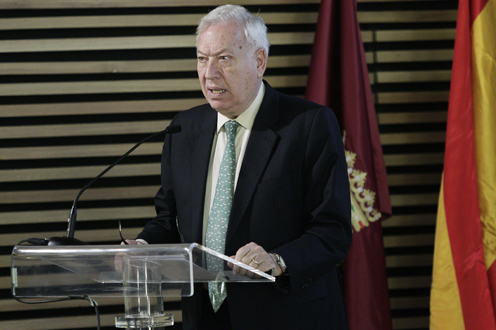
The Minister for Foreign Affairs and Cooperation, José Manuel García-Margallo, announced the dispatch of this humanitarian aid during the event held to commemorate the 25th anniversary of the Spanish Agency for International Development Cooperation (Spanish acronym: AECID). This operation is being undertaken by the AECID itself in conjunction with the Spanish Red Cross and the NGO Action Against Hunger.
The first plane - chartered by the AECID - will carry a total of 15 tonnes of material from the AECID, Action Against Hunger and the Spanish Red Cross, including equipment for the treatment and distribution of drinking water and shelter (tents, waterproof covers, mosquito nets) to help 2,500 people. This first plane is expected to leave from Torrejón de Ardoz Air Base on Monday night. The second plane - chartered by the Spanish Red Cross and financed by the AECID - will carry 40 tonnes of material financed by the AECID, including five sterilisation units capable of providing drinking water to 70,000 people a day.
The AECID will also make a contribution of 200,000 euros in response to the emergency: 150,000 euros will be channelled through the Disaster Relief Emergency Fund (DREF) of the International Federation of Red Cross and Red Crescent Societies for water and sanitation, shelter, food safety and health. The remaining 50,000 euros are destined to provide aid through the Technical Office of the Spanish Cooperation Agency and the Spanish Embassy in the Philippines. A team of four experts will also be dispatched to support the identification of needs in the region, together with equipment for the United Nations Disaster Assessment and Coordination team.
In addition, it is feasible that emergency agreements between the AECID and Spanish humanitarian organisations (Spanish Red Cross, Action Against Hunger and Save the Children Spain) will be activated once the needs on the ground have been identified and assessed, to which the team of experts from the Spanish Cooperation Agency sent to the region will contribute in coordination with UN agencies, such as OCHA, UNICEF and the World Food Programme.
The Republic of the Philippines is the only country considered as a Partner Country (i.e. of highest priority) in the Asia-Pacific region by the current Master Plan of the Spanish Cooperation Agency. Spain is the only Member State of the European Union with a permanent humanitarian aid team in the Philippines and has donated more humanitarian aid since 2007 than any other EU partner (26 million euros), which enabled the Spanish Cooperation Agency to be the first to issue an alert to other donors and partners on this occasion.
Through its cooperation programmes on the ground, the Spanish Cooperation Agency has currently been working on strengthening local capacity to tackle natural disasters in close coordination with the Philippine authorities. In recent years, AECID has been independently carrying out a programme to strengthen disaster response capabilities in the province of Albay by adapting schools into shelters, strengthening the provincial office of the Governor to coordinate these events and building the recently-opened Josefina Durán Hospital. Of the 700,000 people evacuated during the hours before the typhoon struck, 400,000 were from the province of Albay.
In turn, the Reina Sofía Foundation is collaborating with Laboratorios Normon and the AECID to send medicines (antibiotics, pain killers and local anaesthetics) to the victims of the typhoon, at a cost of some 300,000 euros.