The Malaspina 2010 expedition sets sail around the world to research the impact of global change and ocean biodiversity
News - 2010.12.15





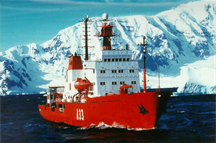
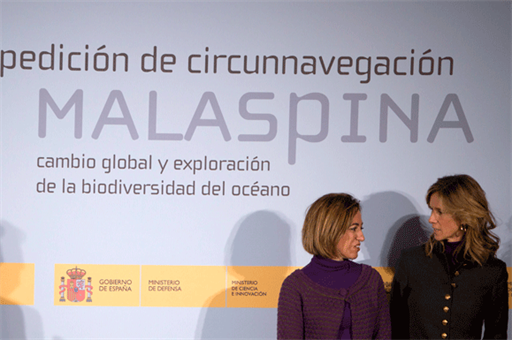
Carme Chacón and Cristina Garmendia visited the facilities on board the Hespérides alongside the Chairman of the National Scientific Research Council (CSIC), Rafael Rodrigo, and the Chief of the Navy Staff, Admiral General Manuel Rebollo, as well as other dignitaries who attended a presentation on the Malaspina 2010 expedition from the project coordinator and CSIC researcher, Carlos Duarte, and the ship's captain, Frigate Captain Juan Antonio Aguilar.
Afterwards, the Minister for Defence, Carme Chacón, highlighted the importance of collaboration between scientists and the military to research the ocean and foster scientific knowledge in Spain. "Over the course of seven months, the more than 50 scientists and 55 sailors that make up the crew on board the Hespérides are going to take part in the largest scientific expedition in the history of Spain", she said.
Furthermore, Carme Chacón highlighted that this expedition has been equipped with the most advanced technical resources, including devices expressly designed for this occasion, and added that the results from the mission will be fundamental "not only because of the data to be obtained directly but because of the scope of the progress that will be made over the course of the next two years".
New reality for Spanish science
 EFE
EFEFor her part, the Minister for Science and Innovation, Cristina Garmendia, praised the mere existence of a project such as the Malaspina Expedition, "it speaks of a new reality for Spanish science and the situation of our scientists".
According to Cristina Garmendia, "Malaspina 2010 is a great symbol of what our country is and represents in terms of science: science that is living through its best moments in history". Moreover, the Minister for Science and Innovation stressed the need to overcome the pessimistic and unfair view of the state of research in Spain. "We need to provide the evidence that will banish certain ghosts from the past that have not done us justice". She concluded by saying "we will continue to compete for the loyalty of international talent, we will awaken greater interest among our own young people and we will consolidate our position among the global scientific powerhouses that has taken us so much time and effort to achieve".
Multidisciplinary study
 EFE
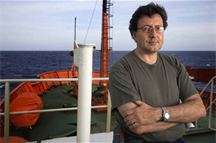
EFEThe purpose of the Malaspina 2010 expedition, run by the National Scientific Research Council (CSIC), is to undertake a multidisciplinary study to assess the impact of global change and ocean biodiversity. In total, tests will be performed at 350 different locations on the oceans and 70,000 air, water and plankton samples will be collected from the surface down to a depth of 5,000 metres.
The expedition, a project forming part of the Consolider-Ingenio 2010 programme funded by the Ministry of Science and Innovation, consists of 27 research groups from the CSIC, the Spanish Oceanographic Institute (IEO), 16 Spanish universities, one museum, a public research foundation and the Spanish Navy. Funding for the project, in which the CSIC, the Spanish Navy and the BBVA Foundation, as well as Spanish universities and autonomous regions, are involved, amounts to approximately 6 million euros.
Hespérides
 EFE
EFEIn total, more than 250 researchers from 19 Spanish institutions will be taking part in the project; a number that rises to 400 when including students and researchers from the 16 foreign institutions associated with the project, which include NASA and the European Space Agency.
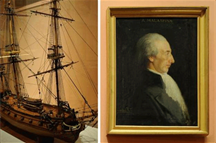
The expedition has been named after the Italian mariner Alejandro Malaspina (Mulazzo, 1754 - Pontremoli, 1810), a frigate captain in the Spanish Royal Armada. 2010 commemorates the 200th anniversary of his death. In July 1789, Alejandro Malaspina led the first Spanish expedition to circumnavigate the globe on board the corvettes Descubierta and Atrevida, which left Cadiz to return five years later.
The journey and the day-to-day life of the project can be followed via the website at www.expedicionmalaspina.es.
EFE