Council of Ministers
The Government of Spain steps up coordination of measures to restore normality in Ceuta
Council of Ministers - 2026.8.25
Moncloa Palace, Madrid
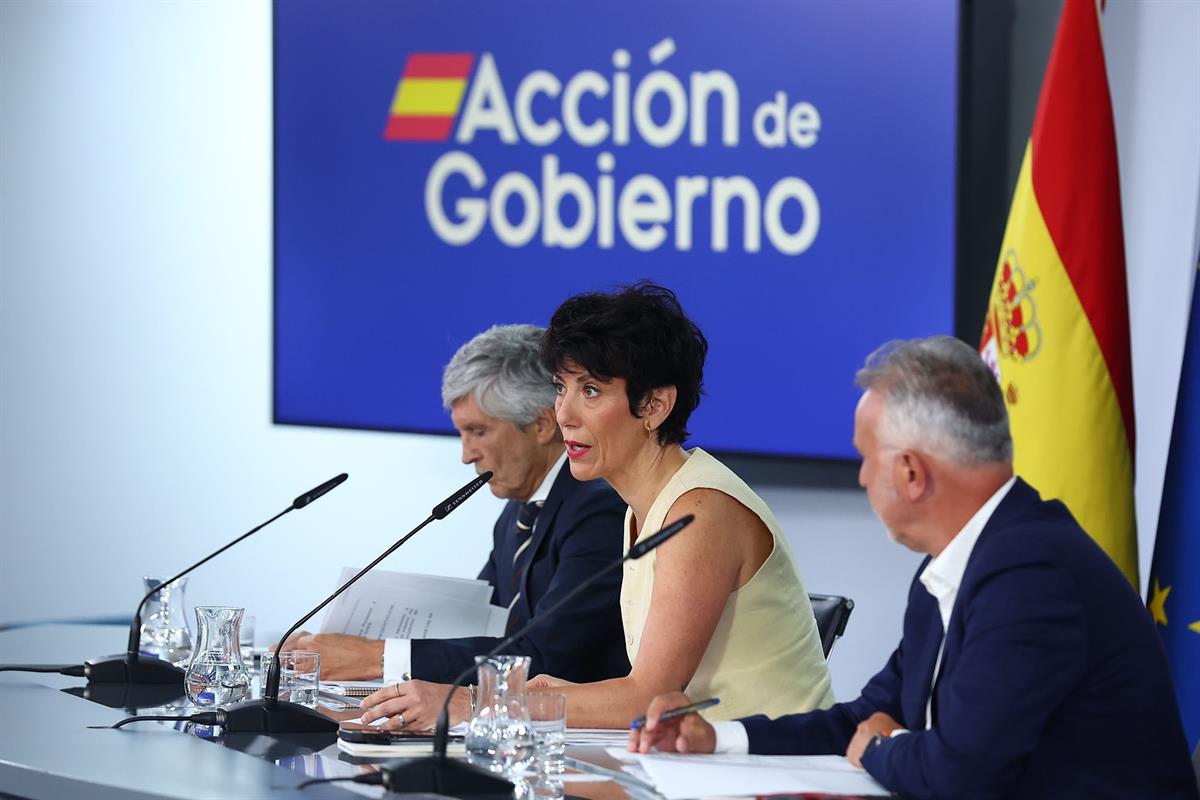 Ministers Fernando Grande-Marlaska, Elma Saiz and Ángel Víctor Torres, at the press conference after the Council of Ministers (Pool Moncloa/ Fernando Calvo)






The Council of Ministers has declared a situation of national security concern in Ceuta in light of the migration crisis in the autonomous city. "The Government of Spain has been, is, and will continue to be there for as long as it takes, with whatever resources are needed", said Elma Saiz, Minister for Inclusion, Social Security and Migration and Government Spokesperson.
The situation in Ceuta is "extraordinary" and the government's response is proving to be so as well, according to the spokesperson. Saiz pointed out that the Government's response has been carried out in different phases, ranging from security and institutional cooperation to humanitarian aid, and that "this new phase requires even greater coordination between all the authorities and administrations involved".
Following the extraordinary meeting of the National Security Council held this morning, the Government has approved the statement regarding Ceuta and has established an operational authority, known as the "single command", to coordinate the response. Responsibility lies with the Minister for Territorial Policy and Democratic Memory, Ángel Víctor Torres, who will be assisted in this task by a specialist committee comprising representatives of the autonomous city, through its president, Juan Jesús Vivas, the Government Delegation in Ceuta, the National Intelligence Centre, all the ministries involved and the Department of National Security. "It is a measure that enables the State and all public authorities to work in a coordinated and effective manner", said Saiz.
Legal repatriation, humanitarian response and economic recovery in Ceuta
 The Minister Minister for Territorial Policy and Democratic Memory, Ángel Víctor Torres, during his speech at the press conference after the Council of Ministers | Pool Moncloa/ Fernando Calvo
For his part, the Minister for Territorial Policy and Democratic Memory emphasised that the Government took immediate action following the arrival of more than 70,000 people in Ceuta on 30 and 31 July. In the initial phase, more than 90% of them were successfully returned to Morocco, and since then "the Government of Spain has maintained a permanent and constant presence in the city of Ceuta", stated Ángel Víctor Torres.
"The Government", he added, "has been preparing the second phase, which is now beginning with the declaration of a situation of national security interest and the establishment of the collegiate body headed by the Minister for Territorial Policy". Torres explained that the objectives of this second phase are the return and repatriation of "as many people as possible, both adults and children", whilst always respecting the legal framework and the best interests of the child, which requires a series of conditions to be met for their repatriation, whilst at the same time working on "the humanitarian and reception response that must be provided to those seeking asylum or to unaccompanied minors".
Another cornerstone of the Executive's work is the economic and social recovery of Ceuta, the minister emphasised, noting that the First Vice-president of the Government, Carlos Cuerpo, is in Ceuta to meet with social and economic stakeholders, having discussed yesterday with the president of the autonomous city the expansion of Ceuta's Comprehensive Socio-Economic Development Plan. Torres himself will travel to Ceuta today, where he will have a series of engagements over the next few days; the minister has also requested to appear before the Joint Committee on National Security of the Lower House of Parliament next Thursday.
Provision of premises, funding and additional staff
Ángel Víctor Torres explained that an initial report from the various ministries had been presented to the Council of Ministers, setting out the measures that had been adopted and those proposed to restore normality in Ceuta. Among these, he mentioned the provision of accommodation for migrants; the approval of a budget of 25 million euros for the care of unaccompanied minors; the holding of sectoral conferences; the healthcare and vaccination response; the reinforcement of staff in the Ministries of Home Affairs, Justice, Defence, Foreign Affairs and Territorial Policy; and the activation of a contingency plan to protect women from sexual violence. The minister also announced that a special meeting will be held tomorrow to prepare for the start of the school year in Ceuta.
 The Minister Minister for Territorial Policy and Democratic Memory, Ángel Víctor Torres, at the press conference after the Council of Ministers | Pool Moncloa/ Fernando Calvo
The minister recalled that in the summer of 2020, at the height of the COVID-19 pandemic, there were at one point nearly 3,000 migrants at the Arguineguín quay in Gran Canaria; although there were no permanent facilities in place to accommodate them and spaces had to be set up by various authorities, normality was restored by November of that same year. Torres emphasised the Government of Spain's loyalty to Ceuta and its people: "I understand your situation because I, too, come from a place where we are used to experiencing peaks in the number of immigrants arriving." The Minister for Territorial Policy also emphasised the defence of human rights and condemned "any form of xenophobia".
Strengthening immigration and asylum laws
The Council of Ministers discussed the drafting of an asylum bill and the reform of the Act on the Rights and Freedoms of Foreign Nationals in Spain and their Social Integration. The aim of both initiatives is to bring the Spanish legal framework into line with the European Pact on Migration and Asylum, which was adopted by the European Parliament and the Council of the EU in 2024.
The Minister for Home Affairs, Fernando Grande-Marlaska, pointed out that the migration and asylum situations in the Member States differ, and therefore transposing EU regulations into Spanish legislation requires legislative amendments.
In this regard, two draft bills have been drawn up which take a rights-based approach, respecting the human rights of migrants, whilst at the same time ensuring the necessary management of the borders to guarantee the country's security. This same approach, the minister emphasised, "led us to reject the regulation on return to third countries".
Both documents will be forwarded to the relevant ministries, institutions and bodies so that they may submit their comments. The minister is confident that, as soon as possible, the Council of Ministers will approve these regulations as draft bills and refer them to Parliament for parliamentary consideration and final approval.
Preliminary draft asylum bill
 The Minister for Home Affairs, Fernando Grande-Marlaska, at the press conference after the Council of Ministers | Pool Moncloa/ Fernando Calvo
Fernando Grande-Marlaska argued that drafting a brand-new asylum law will enable the comprehensive incorporation of all the provisions of European regulations relating to applicants for and beneficiaries of international protection. Furthermore, it will provide greater clarity and legal certainty in an area that has hitherto been scattered across various European Union regulations.
"Our aim is simply to have a more flexible, effective, well-organised and rights-based protection system, one that responds better to the new reality of migration without in any way reducing the safeguards for applicants and beneficiaries. To this end, particular attention is being paid to vulnerable people, minors and, of course, the preservation of family unity", he emphasised.
Among the most significant aspects of the forthcoming law, the minister highlighted that it updates and clarifies the definitions of international protection, refugee status and subsidiary protection. Furthermore, it explicitly incorporates issues that were already relevant in practice, such as persecution on the grounds of gender, gender identity or gender expression, and disability, thereby improving the way in which specific situations of vulnerability are addressed.
With regard to the processing of applications for international protection, the legislation distinguishes between the standard examination procedure and an accelerated examination procedure, which must be concluded within three months.
Furthermore, it establishes a new border procedure that is mandatory in certain circumstances, with a maximum timeframe of twelve weeks for a decision to be reached, during which time the applicant for international protection must remain at the disposal of the Spanish authorities. This measure is a precautionary step, as the minister explained, which is applied before they are formally authorised to enter the country and facilitates their return should their application for protection be refused.
Preliminary draft of the Organic Law on Immigration
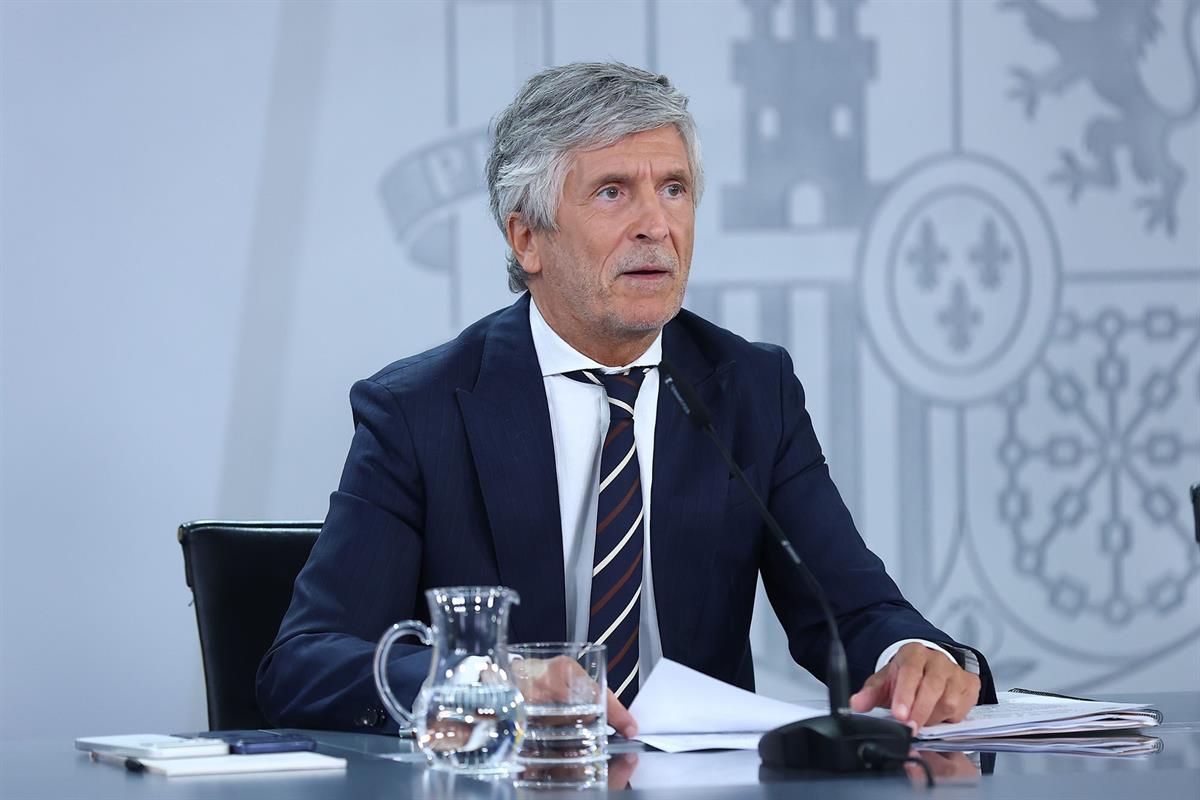 The Minister for Home Affairs, Fernando Grande-Marlaska, speaks at the press conference after the Council of Ministers | Pool Moncloa/ Fernando Calvo
The Minister for Home Affairs explained that the Organic Law on the rights and freedoms of foreign nationals in Spain and their social integration is being partially amended in those areas affecting fundamental rights, in order to comply with the European Pact on Migration and Asylum.
The reform introduces the concept of 'triage', which is the process of gathering information on foreign nationals who cross the European Union's external borders without having undergone border checks. To begin with, this screening process includes a medical examination, a vulnerability assessment, identification, the collection of biometric data, a security check and referral to the appropriate procedure in each case.
Fernando Grande-Marlaska pointed out that, although European regulations allow the triage procedure to last up to seven days, in Spain it will remain at 72 hours, extendable only by a court decision. The aim is to keep the time a foreign national spends on police premises to the absolute minimum.
With regard to the border return procedure, the reform being promoted by the Government incorporates the provisions of the European Pact on Migration and Asylum, which prevent the entry into national territory of those who arrive irregularly and are not entitled to international protection. The return must be completed within a maximum of twelve weeks.
Applicants for international protection whose applications are rejected will receive a notice, along with a refusal of entry and an order to leave the country.
State register of interest groups
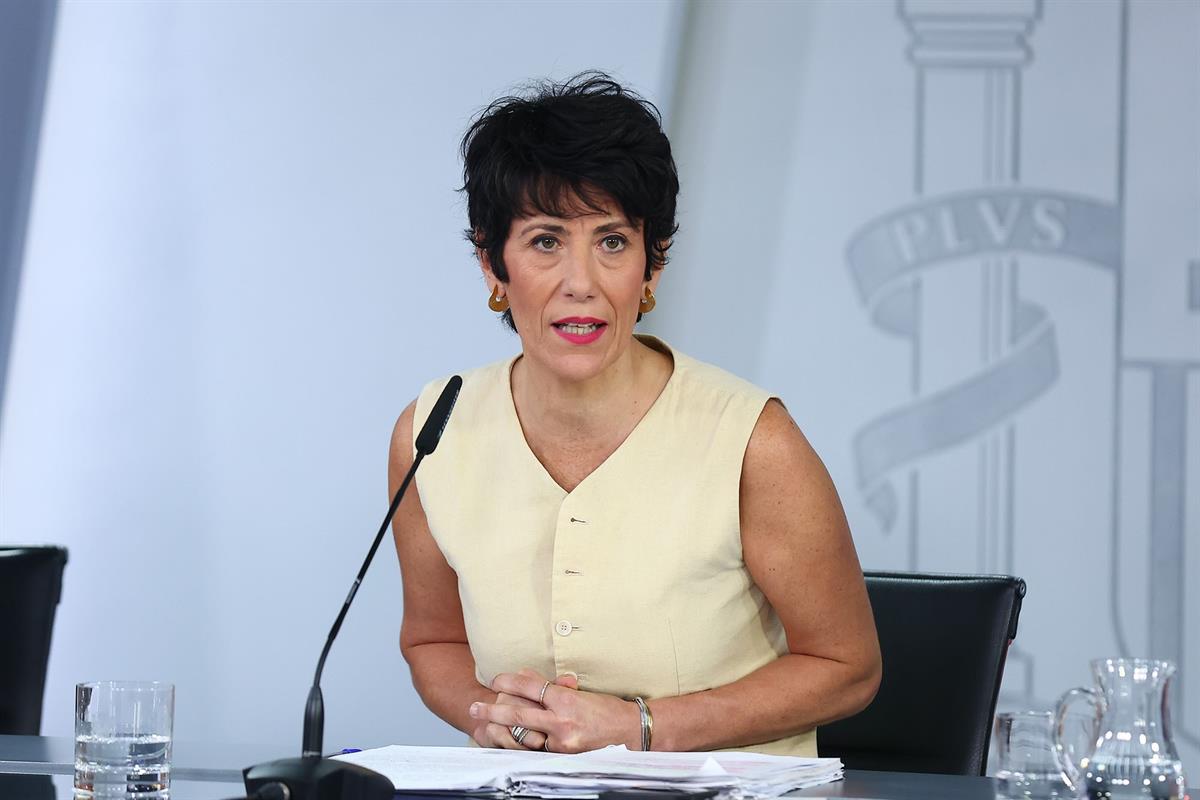 The Minister for Inclusion, Social Security and Migration and Government Spokesperson, Elma Saiz, during her speech at the press conference after the Council of Ministers | Pool Moncloa/ Fernando Calvo
The Council of Ministers also approved the Royal Decree-law on Transparency and Integrity in the Activities of Interest Groups.
The Government Spokesperson stated that the purpose of this regulation is to govern, within the General State Administration and its institutional public sector, the relationship between interest groups and public officials who may be subject to influence. The regulation sets out who is considered to be an interest group, what constitutes lobbying, and who is eligible to receive it.
Elma Saiz added that this register is compulsory and will be managed and supervised by the Council for Transparency and Good Governance.
Non official translation