Council of Ministers
The Government of Spain will mobilise more than €8 billion up to 2030 to transform high scientific capabilities into technological leadership
Council of Ministers - 2026.5.19
Moncloa Palace, Madrid
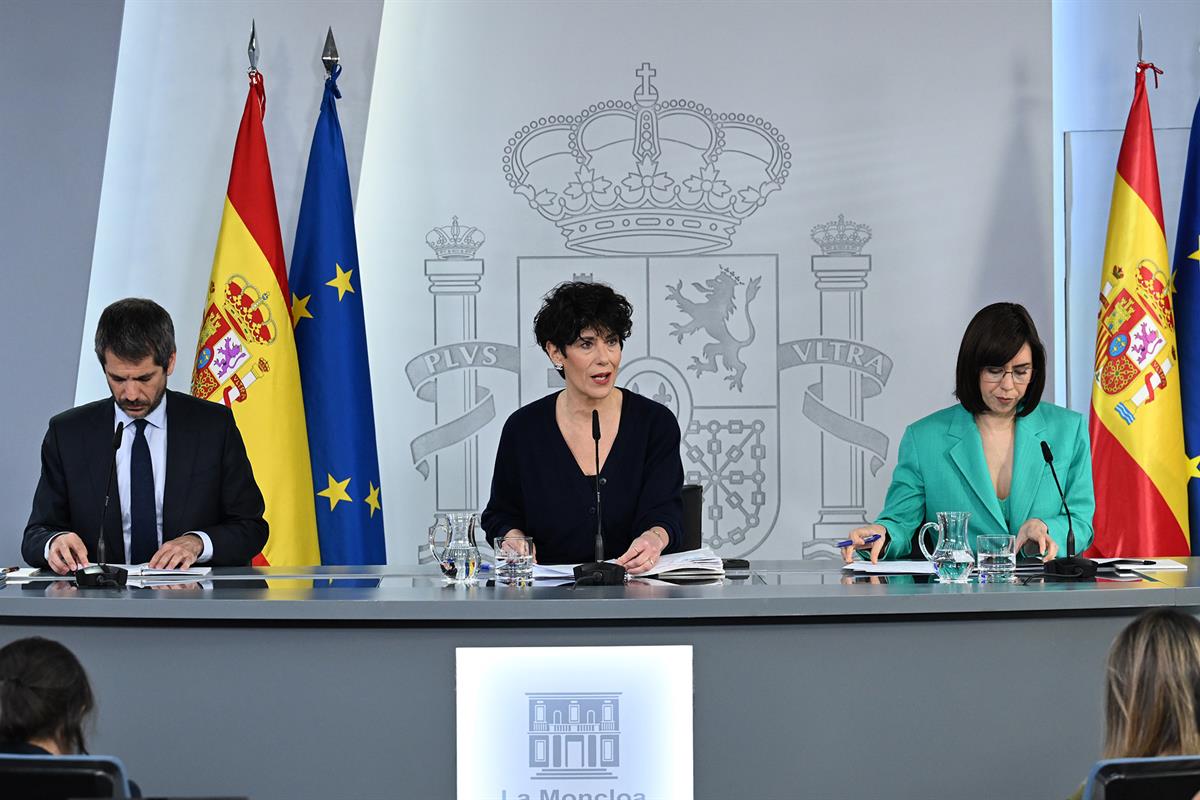 The Minister for Culture, Ernest Urtasun, the Minister for Inclusion, Social Security and Migration and Government Spokesperson, Elma Saiz, and the Minister for Science, Innovation and Universities, at the press conference after the Council of Ministers (Pool Moncloa / Borja Puig de la Bellacasa)





The Council of Ministers has approved the Deep Tech Spain Strategy, which will mobilise more than 8 billion euros until 2030 to transform Spain's high scientific capabilities into technological leadership.
The Minister for Science, Innovation and Universities, Diana Morant, explained that Deep Tech technologies are science fiction until they are developed and become science and reality: "These are aspirations for scientific and technological developments that can have a major impact on society and therefore need extraordinary support because they need more time to mature and more investment.
Morant pointed out that these technologies are not only electronic devices, but all technological and innovative solutions that come from scientific development, such as, for example, CAR-T therapies, biotechnology, clean energy, artificial intelligence, digital, quantum, space and propulsion technologies.
During her speech at the press conference following the Cabinet meeting, Diana Morant assured that Spain has the capacity to accompany these scientific aspirations as an entrepreneurial State, as it has done in recent legislatures, and to lead the development of these technologies, as it is doing with clean energies.
Pillars of the Deep Tech Strategy
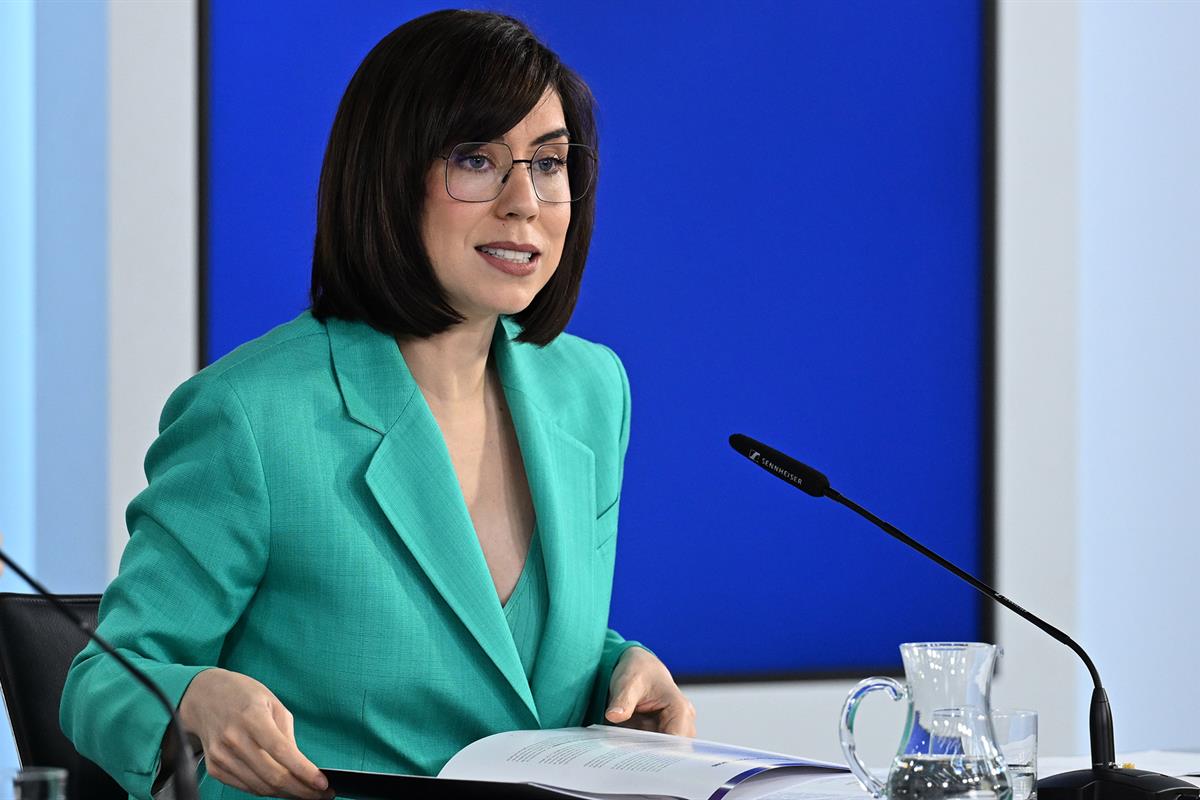 The Minister for Science, Innovation and Universities, Diana Morant, speaks at the press conference held after the Council of Ministers | Pool Moncloa / Borja Puig de la Bellacasa
The minister explained that the strategy is structured around three pillars. The first aims to strengthen scientific and technological capacities, promoting multimillion-dollar infrastructures in Spain. In this regard, she cited as examples the IFMIFF-DONES accelerator in Granada, which is studying materials for a fusion reactor; the Iberian Centre for Energy Storage Research in Cáceres; Spain Neurotech in Madrid; and the Hadron Therapy Accelerator in Valencia.
The second focus, which will receive 80% of the strategy's budget, is on supporting innovative companies that want to enter into the development of deep technologies together with research centres. Diana Morant pointed out that there are already around 1,000 deep technology start-ups in Spain that have emerged from the public science system, mostly from public universities, and are receiving support from the government to develop their technologies. This pillar will also promote advanced public-private partnership models to stimulate demand for innovation.
The third pillar of the strategy involves building a dynamic and coordinated Deep Tech ecosystem. To achieve this, regulations will be adapted to technological development in order to provide flexibility and ensure that science progresses at a competitive pace compared to other countries.
Strengthening the competitiveness of the economy
Diana Morant reiterated that the strategy approved today confirms that the Government will continue to support science and innovation to transform the labour market and the economy of our country. In this context, she noted that one in five new jobs in Spain has been created in sectors related to science and innovation. "This commitment is creating jobs, jobs with better wages, with higher added value. This commitment makes our country more productive and more competitive", she stressed.
The minister went on to say that Spain is already leading the way in many deep technologies and will remain so because the Government will continue to support both the scientific and productive sectors.
Renewal of the programme facilitating cinema attendance for senior citizens
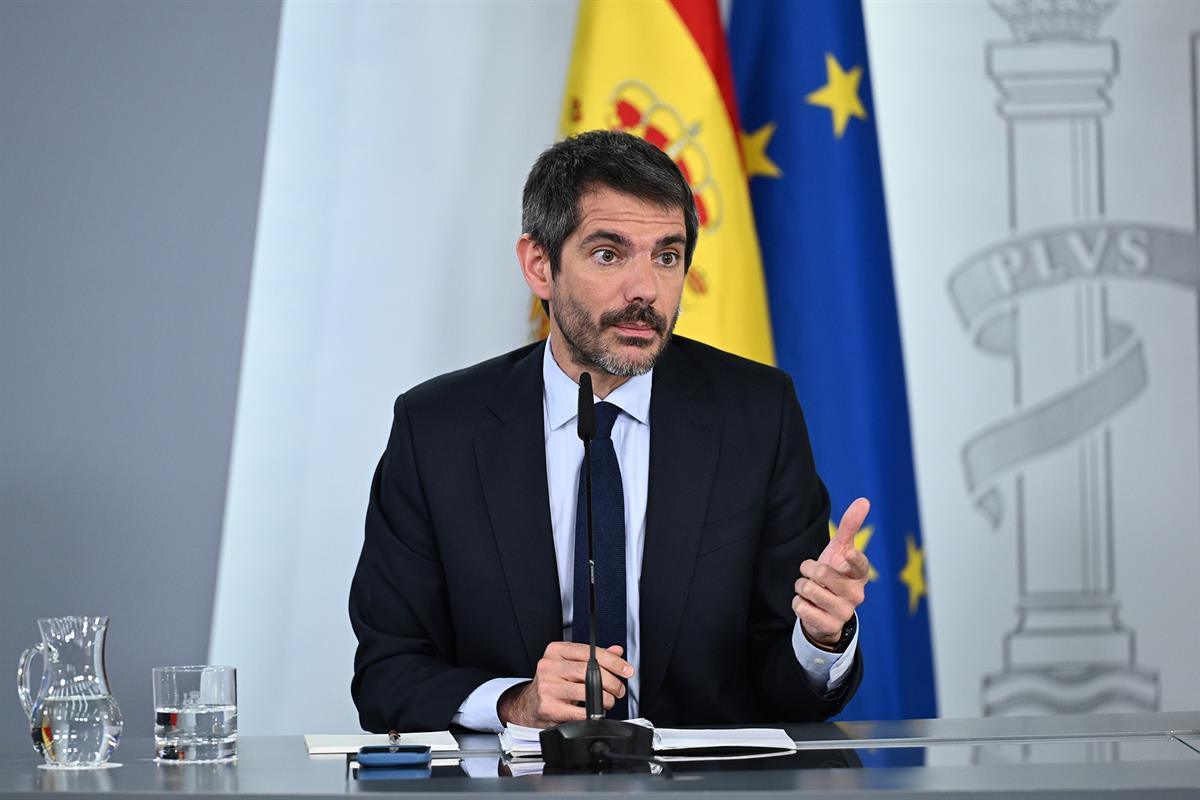 The Minister for Culture, Ernest Urtasun, speaks at the press conference after the Council of Ministers | Pool Moncloa / Borja Puig de la Bellacasa
The Council of Ministers has renewed two initiatives to promote cultural rights: the Senior Cinema programme and the Youth Culture Voucher. The Minister for Culture, Ernest Urtasun, stressed that the government interprets these rights not only as the possibility of accessing culture, but also as full participation in the cultural life of the country and as the right to cultural creation.
With regard to the Senior Cinema programme, the government has approved its continuation for the period 2026-2027 with a budget of 11.5 million euros. This initiative finances cinema attendance for people aged 65 and over so that they can go to the cinema on Tuesdays for 2 euros.
The Minister for Culture explained that this initiative has four objectives: to contribute to keeping cinemas open, "a first-rate cultural ecosystem"; to facilitate access to culture; to promote active ageing and combat loneliness among the elderly and, lastly, to support Spanish cinema, since the majority of viewers choose national films.
Urtasun underlined the evolution of the number of participants in this initiative: while the first edition attracted 900,000 people, the second reached 1.6 million, and the current edition has already reached 1.5 million viewers in its first 28 weeks. In fact, Senior Cinema accounted for a third of the total box office in Spain last year.
The minister added that his department is also "investing in the audiences of the future" through the Cine Escuela programme, which aims to bring young students to cinemas as a training activity in audiovisual culture. He also mentioned other measures in support of cinema, such as the recovery of aid for screenplays, efforts to internationalise Spanish cinema, and actions to support producers, distributors and the industry in general.
"The policies that we are carrying out at the Ministry of Culture are supporting an extraordinary moment for Spanish cinema," said Urtasun, who recalled that for the first time three Spanish films are participating in the official section of the Cannes Film Festival. The minister also expressed his support for artists who suffer reprisals for their opinions, and in particular, "for denouncing the genocide in Palestine and supporting the Palestinian people". "The government rejects any measure of censorship or attack on our national artists for freely expressing their opinion," he said.
Youth Culture Voucher: expansion to new products and services
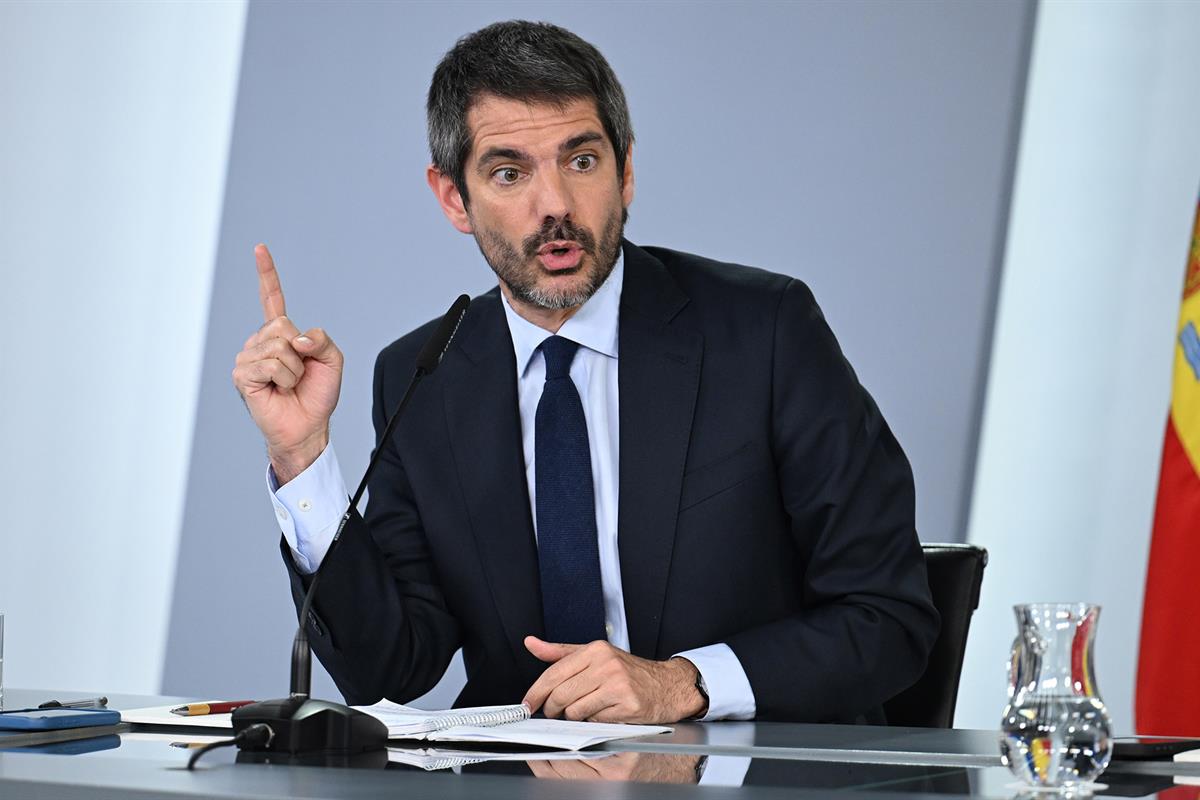 The Minister for Culture, Ernest Urtasun, at the press conference after the Council of Ministers | Pool Moncloa / Borja Puig de la Bellacasa
The Government has modified, through a royal decree, the regulations of the Youth Culture Voucher, the programme promoted by the Ministry of Culture that offers a 400 euro grant to people turning 18 to promote their access to culture.
Ernest Urtasun pointed out that more than 360,000 young people benefited from this resource in 2025, 8% more than the previous year and almost 70% of the measure's target audience. "It is a great success that shows that young people in our country enjoy culture and want to participate in cultural life", said the minister, who added that, contrary to the rumours spread by some campaigns on social networks, 99.7% of the cultural voucher is used correctly.
The new regulation includes two significant changes that seek to guarantee equality of opportunities and to extend the vision of culture not only as an element of consumption, but also as a right to creation.
Firstly, the Ministry is going to reach agreements with third sector entities so that all young people can access the voucher regardless of their origin, income or environment. The Ministry of Culture hopes to extend this programme to young people from disadvantaged backgrounds and increase its reach from the current 70% to 80-85%.
Secondly, the voucher can be used for the purchase of musical instruments, artistic material and face-to-face or online training in the cultural field. While a young person could previously use the voucher to attend a concert or buy a book, they can now use it to purchase a guitar or participate in a writing course or workshop, Urtasun explained. The goal, he remarked, is for young people "not to be mere spectators of culture, but to become active participants".
Barcelona Airport mural declared an Asset of Cultural Interest
The Council of Ministers has approved the declaration of the mural by Joan Miró and Josep Llorens Artigas at Josep Tarradellas Barcelona-El Prat Airport as an Asset of Cultural Interest. The Minister for Culture pointed out that, in this way, the protection of a symbol of Barcelona and Spain, one of the most important monumental works of Spanish art, is improved.
More than €2.57 billion for active employment policies
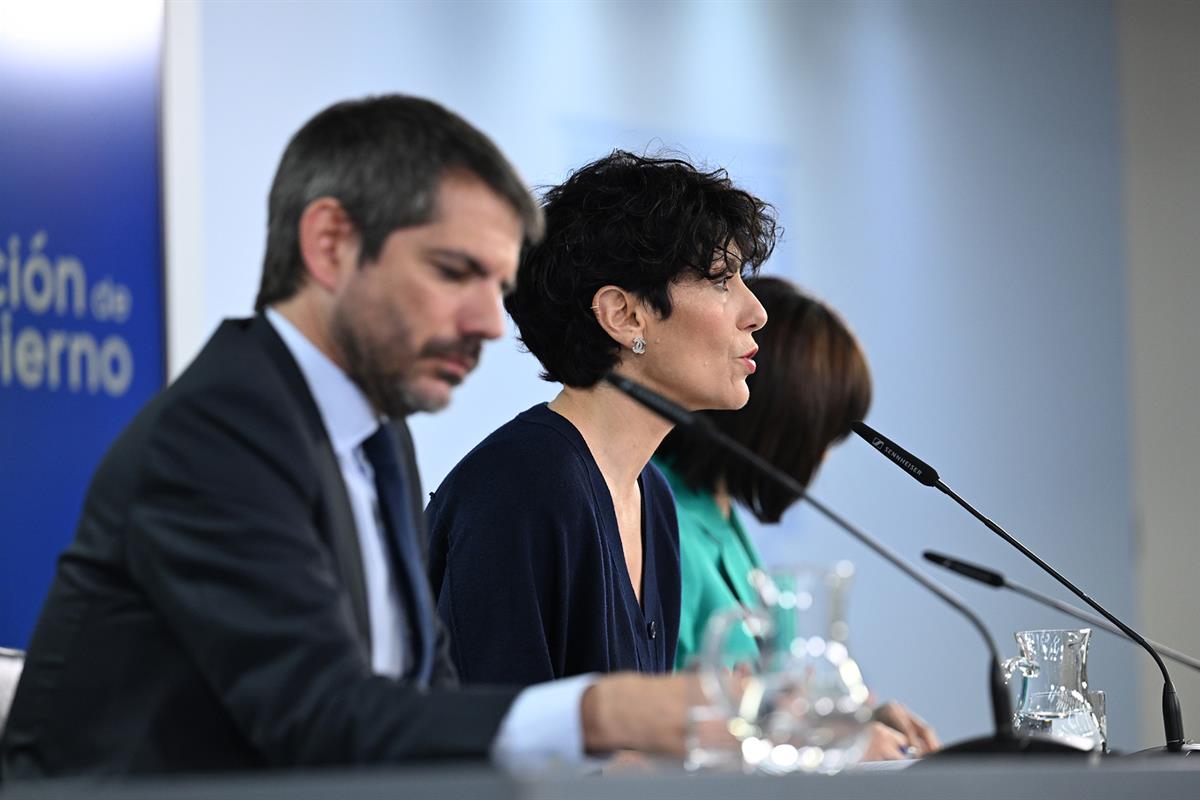 The Minister for Culture, Ernest Urtasun, the Minister for Inclusion, Social Security and Migration and Government Spokesperson, Elma Saiz, and the Minister for Science, Innovation and Universities, at the press conference after the Council of Ministers | Pool Moncloa / Borja Puig de la Bellacasa
The Minister for Inclusion, Social Security and Migration and Government Spokesperson, Elma Saiz, reported that the Council of Ministers has authorised the proposal for the territorial distribution of nearly €2.572 billion earmarked for active employment policies. As she explained, the objective of this measure is "to continue moving towards a more inclusive, more stable labour market with more opportunities throughout the country".
These funds will be drawn from the 2026 budget of the Public State Employment Service (SEPE) and will be submitted to the Sectoral Conference on Employment and Labour Affairs to determine the territorial distribution.
The spokesperson underlined the role of the autonomous communities in the development of these policies, as they are the administrations in charge of managing part of these resources within the framework of their competences. In this regard, she noted that the funds will allow for the promotion of training programmes, career guidance, and employability enhancement.
Saiz also highlighted that these actions will be aimed especially at groups with the greatest difficulties accessing the labour market, including those over 52 years of age and young people, with the aim of strengthening their opportunities for integration and stability in employment.
Spain Grows Fund
The Council of Ministers has approved the launch of the Spain Grows Fund, a new initiative endowed with €13.3 billion, including loans and transfers from the Recovery, Transformation and Resilience Plan to boost investment and strengthen economic growth.
As Elma Saiz explained, the aim of the programme is to mobilise, through the Official Credit Institute (ICO), up to €120 billion in public-private investment in sectors considered strategic for the country, including housing, innovation, the green transition, digitalisation and strengthening the industrial base.
Saiz pointed out that, through this fund, the ICO will be able to deploy different financial instruments, such as loans, guarantees or equity investments, in order to "support the growth of Spanish companies at all stages of their development".
The government spokesperson stressed that this is a "strategic" initiative to strengthen the productive fabric, boost business competitiveness and accelerate the country's economic transformation.
Current affairs: labour market and International Museum Day
The Minister for Culture, Ernest Urtasun, the Minister for Inclusion, Social Security and Migration and Government Spokesperson, Elma Saiz, and the Minister for Science, Innovation and Universities, at the press conference after the Council of Ministers | Pool Moncloa / Borja Puig de la Bellacasa
In her speech during the press conference, the Government spokesperson, Elma Saiz, referred to the Social Security affiliation data for the first half of May. Specifically, the number of employed individuals exceeded 22.3 million in the daily series, an increase of 545,560 compared to the same period last year.
"This is a great figure that proves the strength of our economy in a complex international context", said Saiz. The minister added that the evolution experienced in recent months corroborates "the profound change that our labour market has undergone since the implementation of the labour reform".
Finally, Elma Saiz recalled the events organised to celebrate International Museum Day, which is commemorated every 18 May, and Museum Night 2026, which takes place on 23 May.
The 16 state museums of the Ministry of Culture have joined the initiative with "very interesting" activities for all audiences. The minister particularly recommended the collective activity 'Vista y plano del mundo' which can be visited at the El Greco Museum in Toledo. "This exhibition highlights the diverse origins of who we are today and those who visit the museum," she noted.
Non official translation