Council of Ministers
The Government of Spain consolidates the priority of public management of the healthcare system
Council of Ministers - 2026.5.12
Moncloa Palace, Madrid
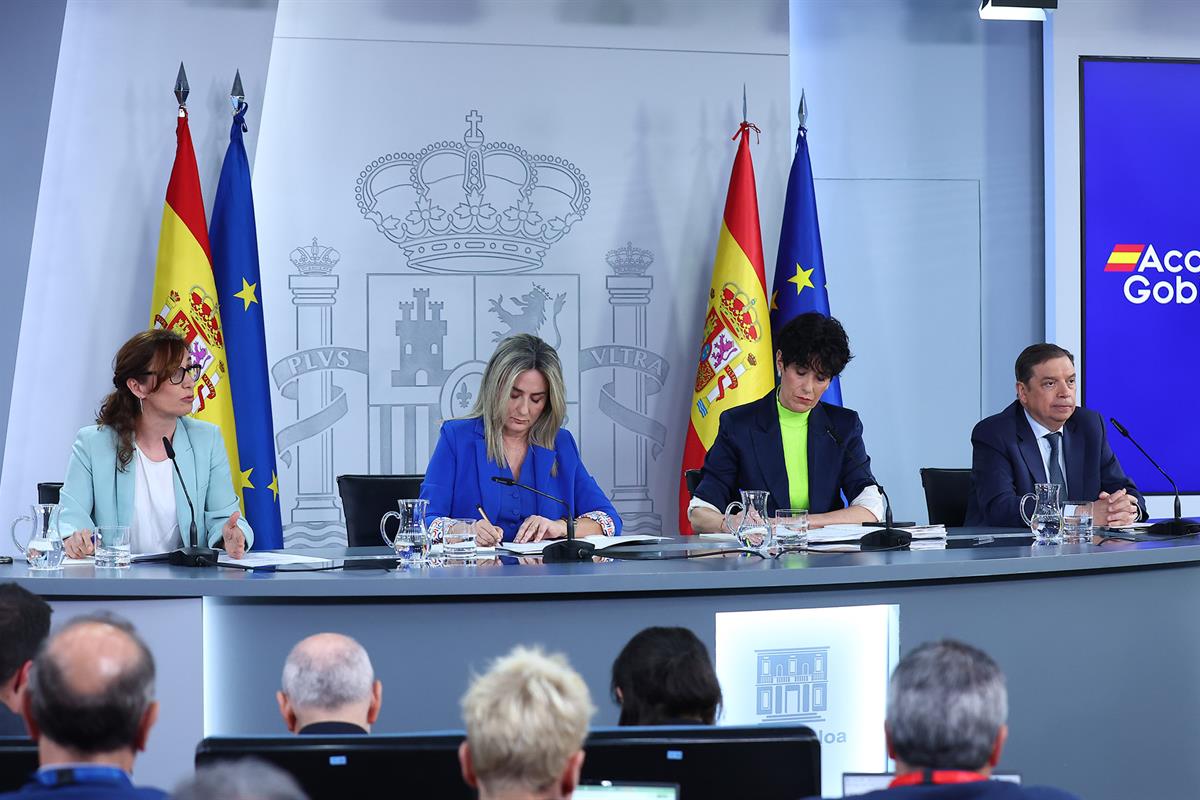 The Ministers for Health, Mónica García, for Education, Vocational Training and Sports, Milagros Tolón, for Inclusion, Social Security and Migration and Government Spokesperson, Elma Saiz, and for Agriculture, Fisheries and Food, Luis Planas (Pool Moncloa / Fernando Calvo)






The Council of Ministers has approved the referral to Parliament of the Bill on Public Management and Integrity of the National Health System (SNS). The regulation expressly repeals Law 15/1997, which allowed private sector involvement in the public health system on a widespread basis through various arrangements.
The Minister for Health, Mónica García, underlined that the future law points out "something as simple as the fact that the public health system must be managed from the public sector, with clear rules, transparency, democratic oversight and the general interest as the priority".
The regulation enshrines direct management as the fundamental pillar of the NHS. This means, according to the minister, that "health centres and services should preferably be managed by the competent health administrations, by public sector entities or by public consortiums".
Indirect management of health services becomes an exception. From now on, in order to resort to it, an administration must objectively justify that it does not have the capacity to provide the service directly, accredit that the chosen formula is sustainable and efficient, and guarantee the quality, continuity, accessibility and equity of healthcare. "No more turning public healthcare into a kind of franchise for vulture funds and large private groups. This model, which has allowed the parasitisation of public health for the business of a few, is over", stressed Mónica García.
The law introduces new guarantees of evaluation, transparency and accountability. Before resorting to an indirect management formula, collegiate bodies made up of experts, health professionals and patients' organisations will be set up, which will make a prior assessment and issue a report indicating whether the indirect management formula complies with the provisions of the law. The Interterritorial Council of the National Health System will agree on common guidelines so that these reports are drawn up with homogeneous criteria throughout the territory.
The minister also informed that the regulation strengthens economic control in concession contracts. "It will be obligatory to request a report from the National Evaluation Office or the equivalent regional body in order to verify the financial sustainability of this operation and to prevent unrealistic economic estimates from affecting the quality of care provided by our health system," he said.
Another key factor is the preference for the social sector, as García pointed out: "Priority will be given to not-for-profit entities within the framework allowed by procurement rules and European law".
Health management evaluation reports
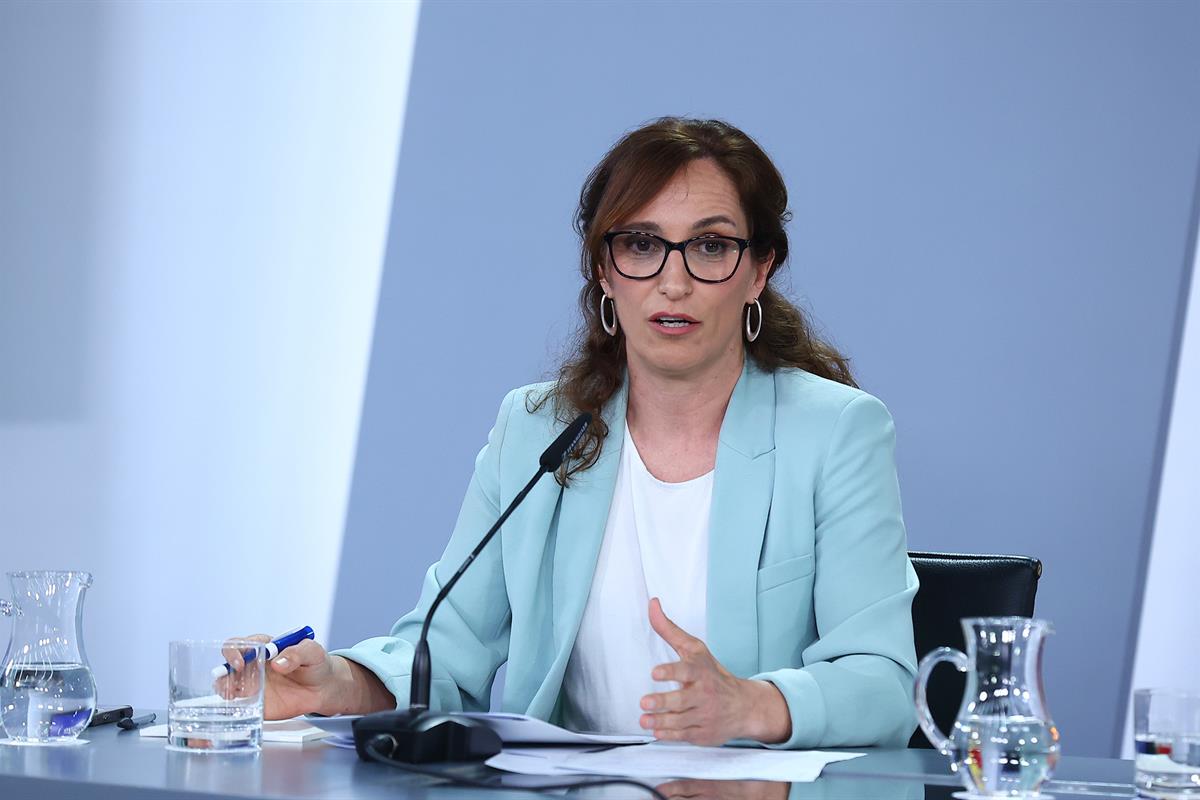 The Minister for Health, Mónica García, speaks at the press conference after the Council of Ministers | Pool Moncloa / Fernando Calvo
On the other hand, the Health Minister announced that administrations will have to publish annual health outcome indicators for all their NHS centres, irrespective of their management model. In addition, the Ministry of Health's High Inspectorate will provide technical advice to administrations wishing to recover services for direct public management.
The Ministry of Health will compile an evaluation report on the various management approaches implemented in Spain since 1997 to assess the impact that privatisation and outsourcing models have had on the quality of care.
Reform of the pharmaceutical co-payment system
The Government has modified the system of user contributions for outpatient pharmaceutical services with the aim of strengthening equity in citizens' access to medicines.
Mónica García stressed that the reform is based on the principle that "no one should be denied access to treatment for financial reasons". The minister argued that the reform corrects the inequalities detected in the current system, particularly among chronic patients or patients with prolonged treatment who have medium or low incomes.
The main novelty is that a more progressive co-payment system will be implemented without increasing the contribution made so far by the different groups. Thus, it moves from three to six income brackets, adjusting the co-payment percentages.
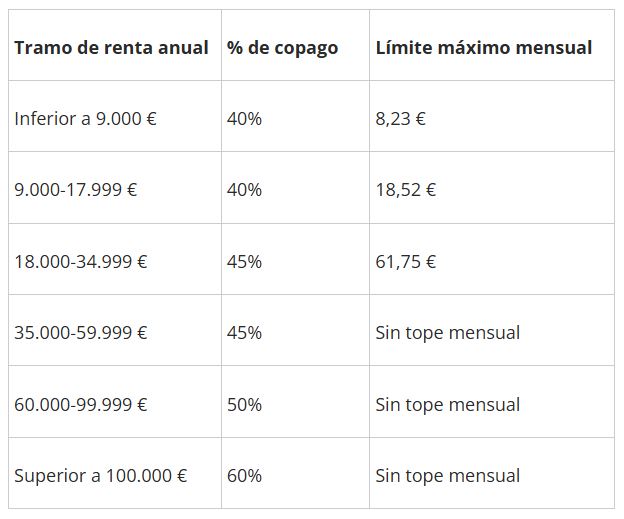
The reform also revises the contribution brackets and monthly limits for pensioners to improve protection for older people with lower revenues, and incorporates an intermediate bracket for those with incomes between €18,000 and €60,000.
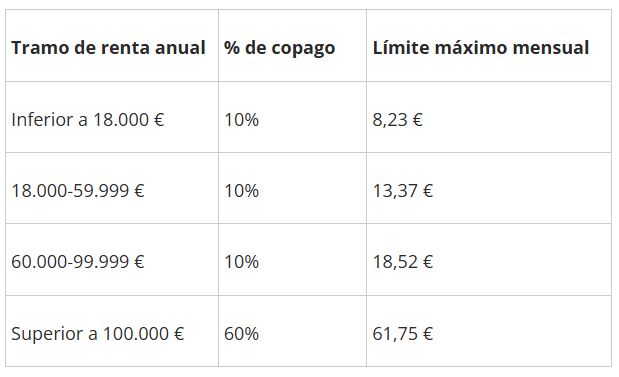
The reform proposed by the Government will not result an increase in what citizens currently pay for medicines, according to the minister, since the Spanish State will cover the cost. "We reduce what low and middle income earners must contribute. Broad exemptions remain in place for vulnerable groups, including people on Minimum Basic Income and non-contributory pensions, the unemployed without benefits, those with minimum incomes, disabled minors and people affected by accidents at work or occupational illnesses", she specified.
Strengthening Mental Health and Preventing Suicide 2026
The Executive has authorised the proposed distribution to the autonomous communities and the National Institute for Health Management (INGESA) of €39 million for actions under the Mental Health Action Plan, and €17.83 million to develop the Action Plan for Suicide Prevention.
The Minister for Health stated that the funds ensure the continuity of the policies introduced under the Mental Health Strategy 2022-2026 and maintain the same level of funding as the previous year.
Legal, moral and health commitment to those affected by hantavirus
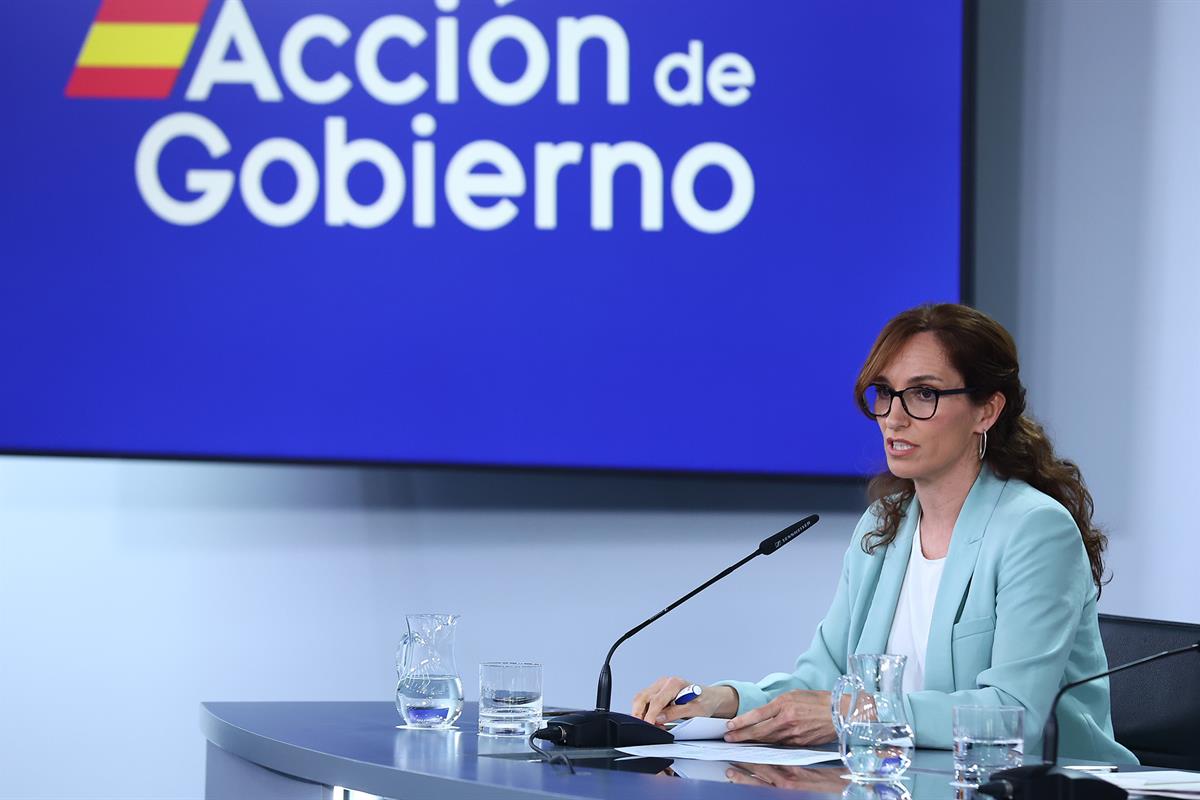 The Minister for Health, Mónica García, at the press conference after the Council of Ministers | Pool Moncloa / Fernando Calvo
The Minister for Health also presented to the Council of Ministers a report on the Andes hantavirus outbreak detected on the MV Hondius cruise ship, and the operation to disembark passengers in the Canary Islands and repatriate them.
During her speech at the press conference following the Cabinet meeting, Mónica García said that the Government considers "this operation to have been a success", as do various other governments, international health organisations and institutions, and the passengers themselves, who have expressed their appreciation.
"We had a legal commitment, a moral commitment and a health commitment, and we have delivered. We are not a government that looks the other way; we are a government that takes charge, both of the health of our compatriots and of global health", she remarked.
The minister added that Spain has projected an image of a serious, well-prepared and supportive country capable of providing an internationally coordinated response, acting swiftly and with scientific rigour. She also said that the operation will go down in history and will serve as a model and benchmark for future international health crises.
In the minister's view, Spain has responded as a nation: "It is not only a success for the Government of Spain, but also for the country we are, for a society that is supportive and empathetic, and that responds with unequivocal confidence in science, in public services and in its professionals".
In addition to expressing her gratitude to all the professionals who took part in the operation and to the people of the Canary Islands, Mónica García addressed the press: "Every journalist that has reported accurately has become an asset to public health". She also paid special tribute to the health professionals still on board the ship, the sea captain, and the director of Tenerife Sur airport.
Epidemiological information
The Health Minister reiterated that from the moment the outbreak of hantavirus on the ship MV Hondius became known, the Government has provided "entirely transparent information on the epidemiological situation of each and every one of the passengers, as attested by the four doctors who were on board the ship conducting epidemiological surveys".
Mónica García said that in the coming days more positive cases could be added to the current 10 because the virus has a long incubation period. The fact that all cases are being detected is, in the minister's opinion, further proof of the success of the epidemiological surveillance carried out by both international and Spanish health authorities.
Funds to improve employability and the quality of education
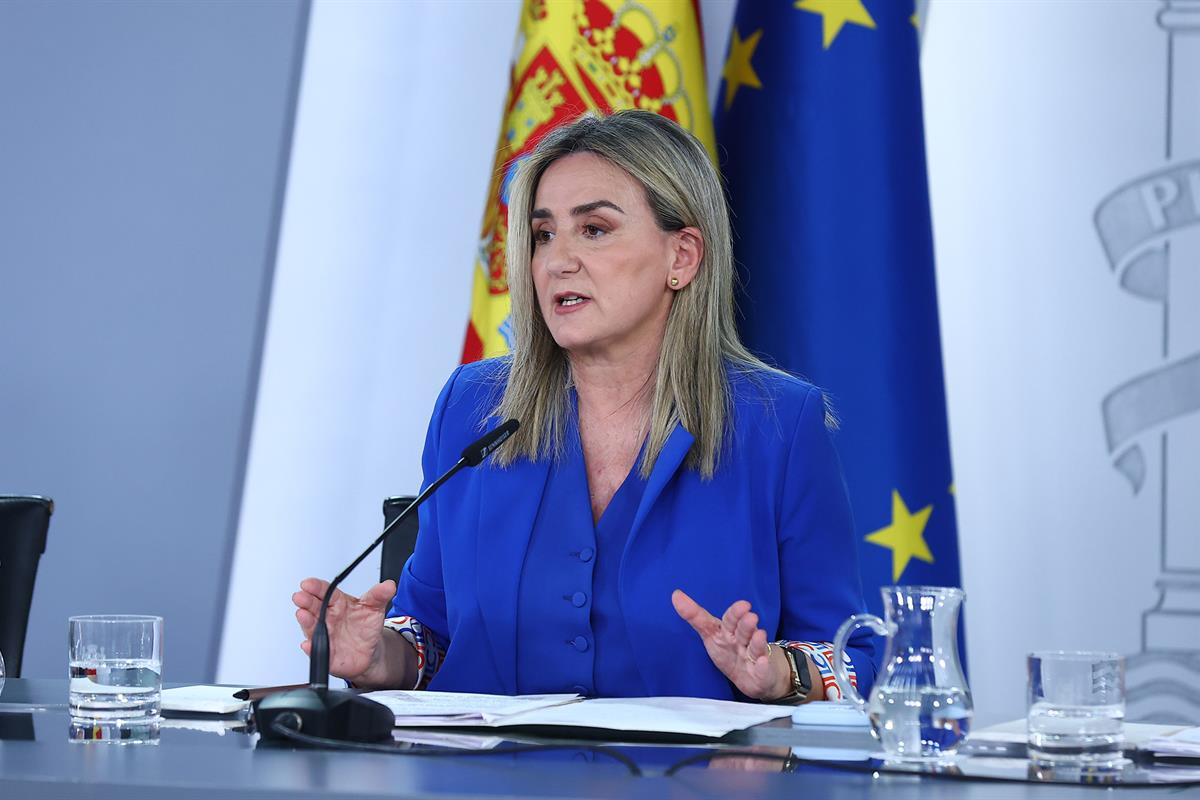 The Minister for Education, Vocational Training and Sports, Milagros Tolón, speaks at the press conference after the Council of Ministers | Pool Moncloa / Fernando Calvo
The Council of Ministers has approved the allocation of almost €1.18 billion to the autonomous communities for training and education. The amount breaks down to €867.3 million for vocational training for workers, and €311.4 million for educational programmes under the territorial cooperation scheme.
The Minister for Education, Vocational Training and Sport, Milagros Tolón, explained that the first tranche of funding allows both employed and unemployed people to access training within the vocational training system, thereby improving their skills and employability. "It is a flexible training programme leading to a qualification that improves both workers' prospects of finding quality employment opportunities and the competitiveness of companies," said the minister. Since 2021, the Government has transferred more than €4 billion to the autonomous communities to develop this programme.
Support for schools facing the greatest challenges and skills development
A total of €105.3 million, co-financed by the Ministry and the European Social Fund Plus, will be allocated to the Programme for Educational Guidance, Advancement and Enrichment (PROA+). The initiative aims to ensure that the schools facing the greatest challenges have the necessary resources for all pupils to achieve educational and school success. Aimed at students in pre-primary, primary and secondary education, the programme seeks to ensure the minimum conditions necessary for pupils' educational development, support students with learning difficulties, and improve the teaching of key skills.
A second programme is the Inclusive Education programme, also co-financed by the European Social Fund Plus. Endowed with €28.7 million, its aim is to promote the transformation of schools into fully inclusive environments. Milagros Tolón pointed out that this initiative strengthens human resources and professional development, and also has an impact on the elimination of physical, social, communicative, methodological and organisational barriers that make it difficult for all students to have equal access to the education system. "We want them to take part fully in school life and to develop their learning in a fully inclusive environment," she said.
The third programme aims to strengthen reading literacy, with a budget of €56.2 million. Covering pre-school, primary and secondary school, and intermediate vocational training, the objective is to offer more personalised attention to the students with the greatest difficulties, reduce the gender gap in reading, and train teachers in literacy methodologies.
Last, €120.6 million have been earmarked for the programme to strengthen skills in mathematics, in this case for primary and secondary schools, and higher education.
Taking all the territorial cooperation programmes together, the ministry has transferred more than €4.425 billion to the autonomous communities since 2018, as highlighted by Tolón, who added that the final territorial distribution will be agreed soon in the sectoral conferences.
Increased subsidies for agricultural insurance
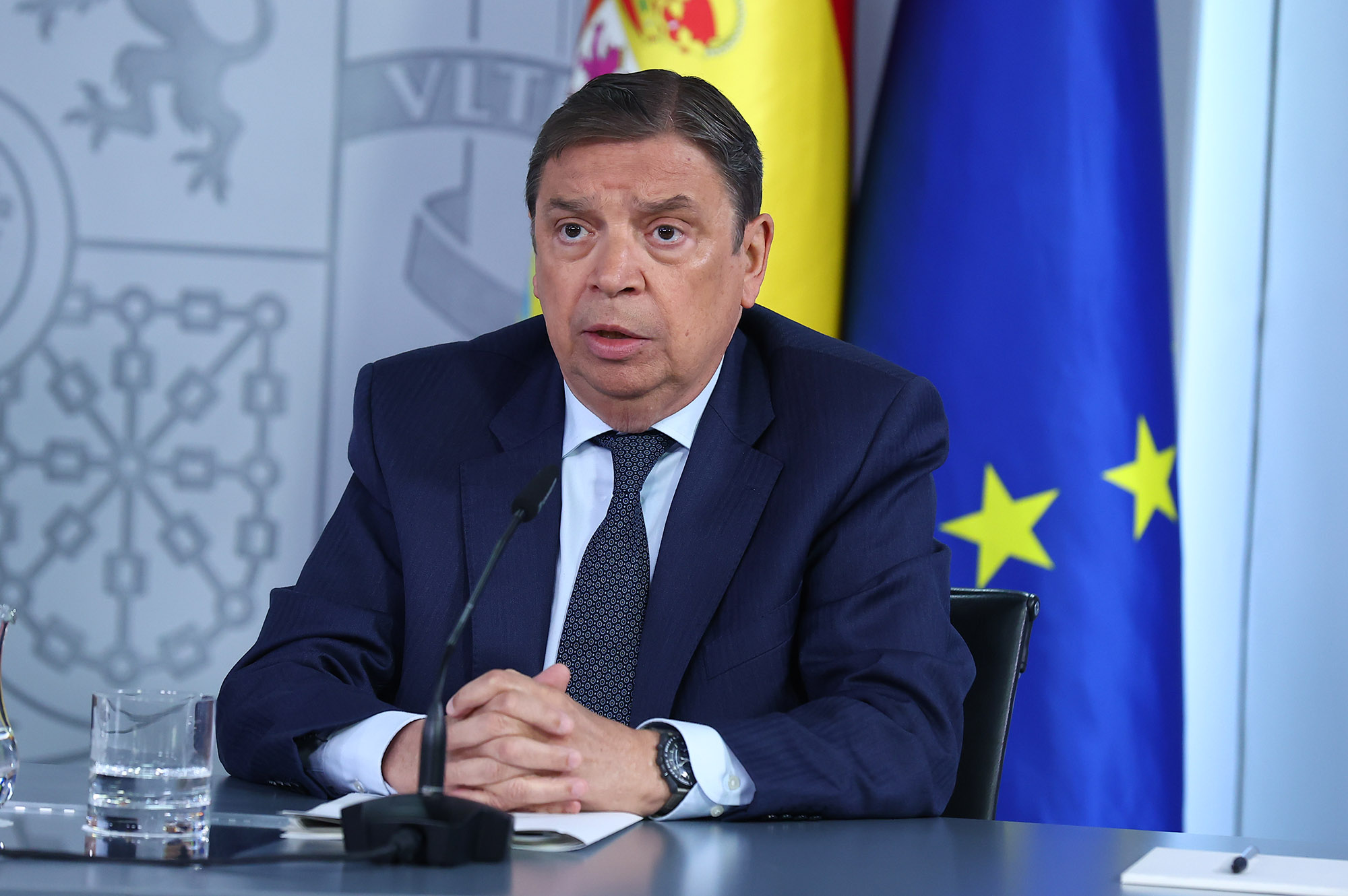 The Minister for Agriculture, Fisheries and Food, Luis Planas, speaks at the press conference after the Council of Ministers | Pool Moncloa / Fernando Calvo
The Council of Ministers has authorised the signing of an agreement between ENESA, the national agricultural insurance company, and Agrupación Española de Entidades Aseguradoras de los Seguros Agrarios (Agroseguro), to implement the 2026 agricultural insurance scheme. The Government is allocating €315 million to subsidise the contracting of these policies, 50% more than the amount allocated in 2010.
The Minister for Agriculture, Fisheries and Food, Luis Planas, has stressed the importance of insurance in agricultural policy: "It is a risk management mechanism which, in short, allows us to address some of the problems faced by our farmers and stockbreeders, particularly those related to extreme weather events and climate change". The minister pointed out that together with agricultural markets and the geopolitical situation, these issues are the most important determinants of agri-food production and prices.
Planas stressed the priority that the 2026 agricultural insurance scheme gives to certain groups, such as young people and professional farmers, estimating the insured capital at around €19 billion. As for the outlook in this area, the minister advocated for the inclusion of a reinsurance mechanism in the next Common Agricultural Policy (CAP), post-2027, so that national insurance schemes are not destabilised by extreme situations such as the droughts suffered in Spain in 2023.
Extraordinary aid for farmers and stockbreeders
The Executive has increased by €64 million the budget earmarked for restoring the agricultural capacity affected by the 2024 DANA, bringing the total investment for repairing roads, infrastructure and irrigation structures to €257 million. "Often the impression is given that when an extraordinary event occurs, aid is provided, an action is taken and that's the end of it; and that is not the case, quite the contrary," said Luis Planas. The minister estimated that his department's total investment in the Valencian Community in relation to the DANA will exceed €400 million.
In relation to another of these adverse events - the series of storms at the beginning of this year - Planas referred to two Government measures, for a combined amount of €28 million. First, the possibility of increasing the subsidy up to the legal maximum allowed under European regulations, i.e., 70% of the insurance premium; and second, the Executive will take over the excess relating to the incident that triggered the insurance claim.
Commitment to real and effective equality for LGTBI+ people
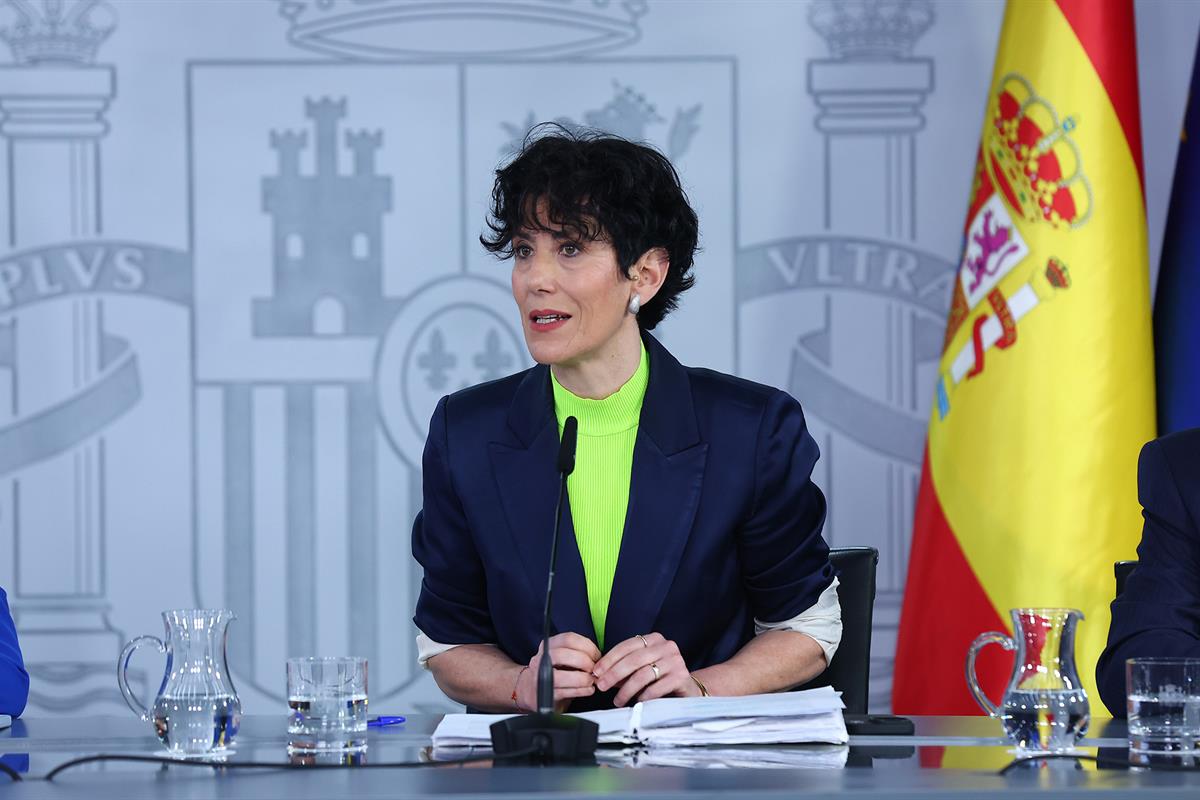 The Minister for Inclusion, Social Security and Migration and Government Spokesperson, Elma Saiz, during her speech at the press conference after the Council of Ministers | Pool Moncloa / Fernando Calvo
The Minister for Inclusion, Social Security, Migration and Government Spokesperson, Elma Saiz, announced the approval of an Institutional Declaration on the occasion of the "International Day against LGTBIphobia", which has been celebrated every 17 May since 2004.
The government spokesperson emphasised that with this initiative "the Government of Spain is reaffirming its commitment to real and effective equality. Spain - and this is another source of pride - ranks fifth in terms of countries with a legal and political environment that protects LGTBI+ rights".
Elma Saiz also stressed that despite the progress made in this area, "rights can never be taken for granted", especially given the "erosion of freedoms" which, in her opinion, is taking place "beyond our borders".
"Spain is a safe place, but we also know that there is more work to be done. That is why the Government is committed to adopting measures to make progress in eradicating the discrimination and violence that LGTBI+ people continue to face in different areas of their lives", insisted the spokesperson.
Current affairs
The government spokesperson began her address by paying tribute to the two Civil Guards who died on 8 May 2026 in Huelva as a result of an operation to combat drug trafficking.
On behalf of the entire government, Elma Saiz expressed her condolences to the families and friends of the officers, and wished a speedy recovery to the other two officers who were injured during the chase.
Saiz also ratified the Government's commitment to the fight against drug trafficking in our country. "This fight has been reflected in the reinforcement, since 2018, of the personal, material and technological resources for our State law enforcement forces and agencies," she said.
The President of the Government concluded by assuring, "We will not take a single step backwards in the defence of security, the rule of law and the protection of those who risk their lives every day to ensure this".
At the beginning of her speech, Elma Saiz also took the opportunity to offer her condolences to the relatives and friends of the civil guard who died in Tenerife (Canary Islands), during the operation to disembark the passengers of the ship affected by the hantavirus outbreak. In this case, the death was caused by a heart attack.
Non official translation