Council of Ministers
The Government of Spain approves the extraordinary regularisation of migrants already residing in Spain
Council of Ministers - 2026.4.14
Moncloa Palace, Madrid
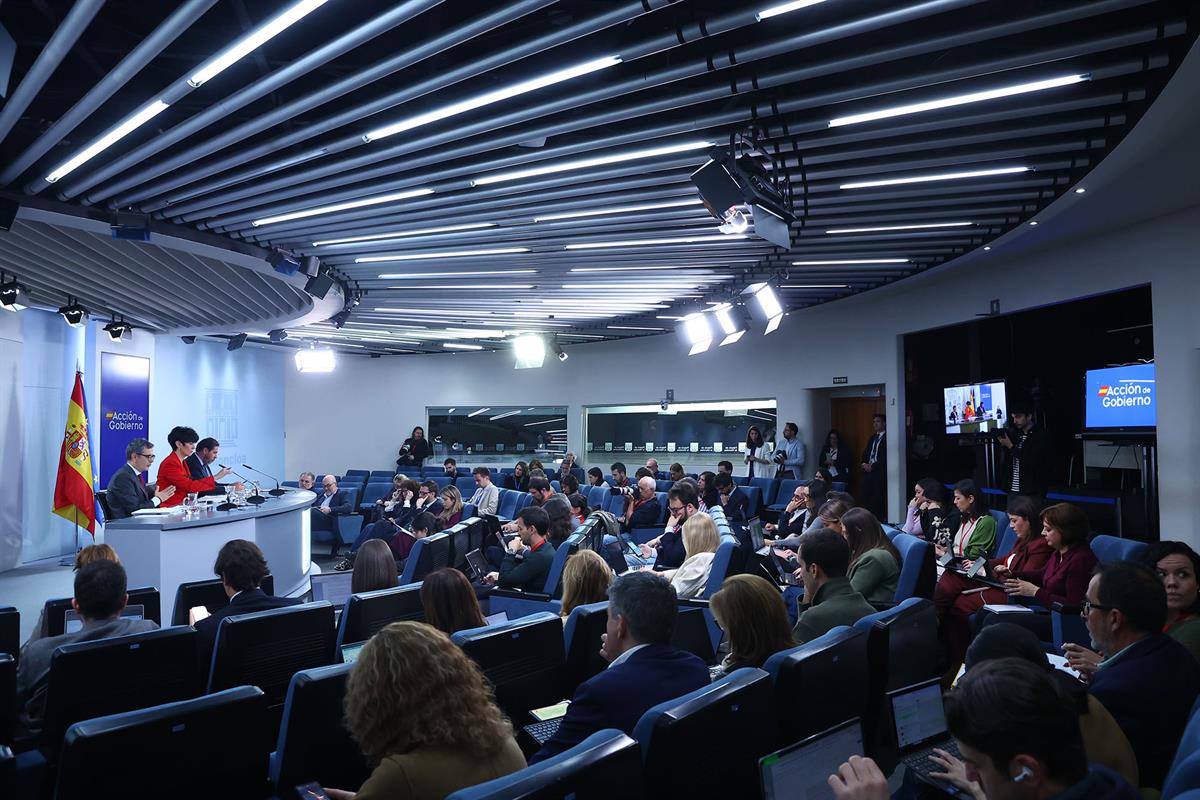 The Minister for the Presidency, Justice and Parliamentary Relations, Félix Bolaños, the Minister for Inclusion, Social Security and Migration, Elma Saiz, and the Minister for Transport and Sustainable Mobility, Óscar Puente, at the press conference (Pool Moncloa/Fernando Calvo)






The Minister for Inclusion, Social Security and Migration and Government Spokesperson, Elma Saiz, has announced the approval of the royal decree that launches the extraordinary regularisation of migrants already residing in Spain, which she considers "one of the major milestones of this legislative term."
Saiz stressed that the beneficiaries "are people who live among us, with sons and daughters who attend school with our children, who bring life to our towns and streets, and who, from today onward, will be able to fully enjoy their rights and fulfil their obligations."
The government spokesperson recalled that since 1986, six regularisation processes have been carried out, "by governments of all political persuasions," benefiting nearly 1.3 million people. "The evidence shows that similar processes in the past have yielded benefits in employment, fiscal responsibility, social cohesion, and social sustainability," she maintained.
Saiz also provided other data supporting the relevance of the regularisation process. For example, she explained that the National Office of Foresight and Strategy, in a report prepared by economists and demographers, has stated that if migration in Spain were reduced by 30% by 2075, GDP would decrease by 22%, the population would decline by 15 million, schools would close, and there would be longer waiting lists in the healthcare system.
"Let me give you a statistic: 43% of the jobs created in Spain since the implementation of the labour reform have been filled by foreign workers. Their contribution allows us to grow economically, generate employment and wealth, and maintain our welfare system; a contribution that is not limited to the economic sphere, it also means the rejuvenation of our country's population at a time when we need it more than ever," the Minister for Inclusion, Social Security and Migration emphasised.
An initiative with "social, political and economic legitimacy"
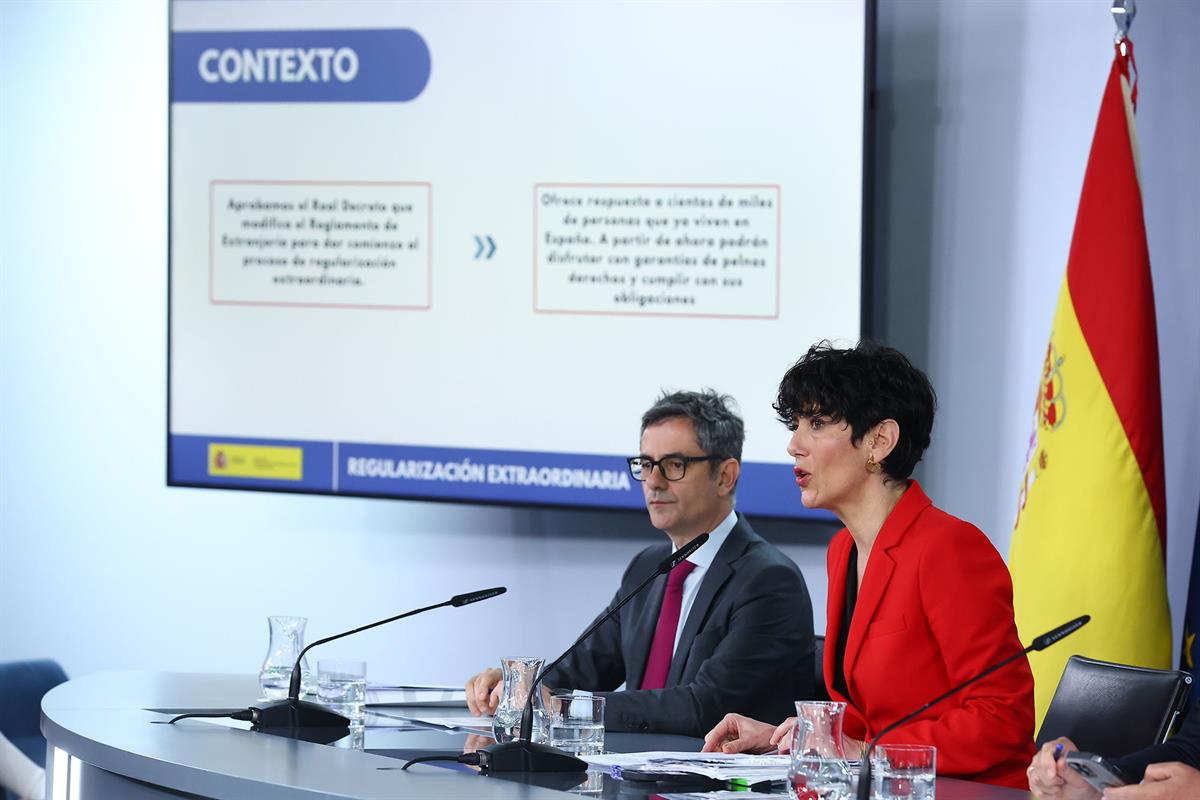 The Minister for the Presidency, Justice and Parliamentary Relations, Félix Bolaños, and the Minister for Inclusion, Social Security and Migration, Elma Saiz, after the Council of Ministers | Pool Moncloa/Fernando Calvo
Elma Saiz highlighted that the regularisation process has "triple legitimacy." On the social front, she recalled that the citizens' legislative initiative that launched it was supported by more than 700,000 signatures, 900 associations, and the Catholic Church. In the political sphere, the proposal received the support of all parliamentary groups in parliament, except one. Finally, on the economic front, it has received the backing of both employers' associations and unions.
"Let me highlight the support of specific economic sectors such as agriculture, construction, and transportation, which have been working for months, if not years, in favour of this historic measure," the government spokesperson remarked.
Elma Saiz also explained that the royal decree has received the endorsement of "important organisations," such as the Economic and Social Council, which, in its report on the migration situation in Spain, stressed that administrative regularisation is a key element for achieving the full and effective integration of migrants.
Furthermore, the regulation has obtained the required opinion from the Council of State, especially regarding the suitability of processing the procedure through regulations, "as we have always advocated." She also noted that this body has positively assessed the general objectives of the regularisation, including social integration, legal certainty, and the reduction of administrative irregularity.
This extraordinary regularisation is the first milestone of the Integration and Intercultural Coexistence Plan, with which Spain reinforces its migration policy model based on human rights, integration and coexistence, compatible with economic growth and social cohesion.
An "operational plan" starting 16 April
The government spokesperson announced that the regulation will be published in the Official State Gazette (BOE) on Wednesday, 15 April, and will come into effect the following day, 16 April. Applications can be submitted from that date until 30 June. She explained that, to access the process, applicants will need to prove their presence in Spain before 1 January 2026, have resided continuously for at least five months, have no criminal record, and not pose a threat to public order. "All supporting documents must be nominative and specify a date to be valid," Saiz emphasised.
Those who meet these requirements will be able to obtain a residence and work permit, as well as access to Social Security and a health card in their region of residence, with an initial validity of one year. "After that period, individuals will be able to apply for the statuses provided for in the Immigration Regulations," she stated.
To submit their regularisation application, citizens can go to the designated Immigration Offices, Social Security or Social Security Treasury offices (at least one per province), and post offices in provincial capitals and towns with more than 50,000 inhabitants.
 The Minister for Inclusion, Social Security and Migration and Government Spokesperson, Elma Saiz, at the press conference after the Council of Ministers | Pool Moncloa/Fernando Calvo
Saiz also noted that applications can be submitted electronically, available 24 hours a day through the website of the Ministry of Inclusion, Social Security and Migration, or in person, in which case an appointment is required. The in-person service will begin on 20 April. Saiz emphasised that the online option will be the fastest and will allow applicants to complete the process directly or through representatives and collaborating entities.
She stressed that the Government has designed a comprehensive system to ensure the smooth running of the process, with nearly 450 offices set up throughout the country and the addition of more than 550 professionals. She indicated that management will be centralised through the Mercurio platform, with the aim of ensuring efficient and orderly processing, without disrupting regular public services.
Support for the transport sector in the face of rising fuel prices
The Government has agreed on new measures to protect the transport sector from the consequences of the war in the Middle East. The royal decree-law containing these measures complements the one approved on 20 March and must be ratified by the Lower House of Parliament within one month of its publication in the Official State Gazette (BOE).
The Minister for Transport and Sustainable Mobility, Óscar Puente, highlighted the importance of the sector for the functioning of the country, both from an economic and social perspective. 95% of domestic freight transport in Spain is carried out by road and by small and medium-sized enterprises (SMEs). As for maritime transport, it plays an essential role for both passengers and goods, especially in the non-peninsular territories. "We're not talking about just another sector; we're talking about a fundamental sector, a pillar of our production model and our territorial cohesion," Puente stated.
The minister explained that the rise in fuel prices is impacting the costs of transport companies, which cannot always immediately pass these costs on to their service prices, making it difficult to maintain operations, employment, and the logistics chain. The war response plan, he added, alleviated the impact of increased energy costs, "but today we are taking another step forward": the new decree-law strengthens the previous one by increasing protection for the transport chain and extending its scope to sectors not initially covered.
The Minister for Transport also emphasised that the set of measures approved today is the result of a process of dialogue and agreement with the sector. Since the beginning of the conflict, he noted, there has been continuous contact with the National Road Transport Committee, representatives of private railway companies, maritime operators, and other actors in the logistics chain.
Road freight transport: automatic contract review
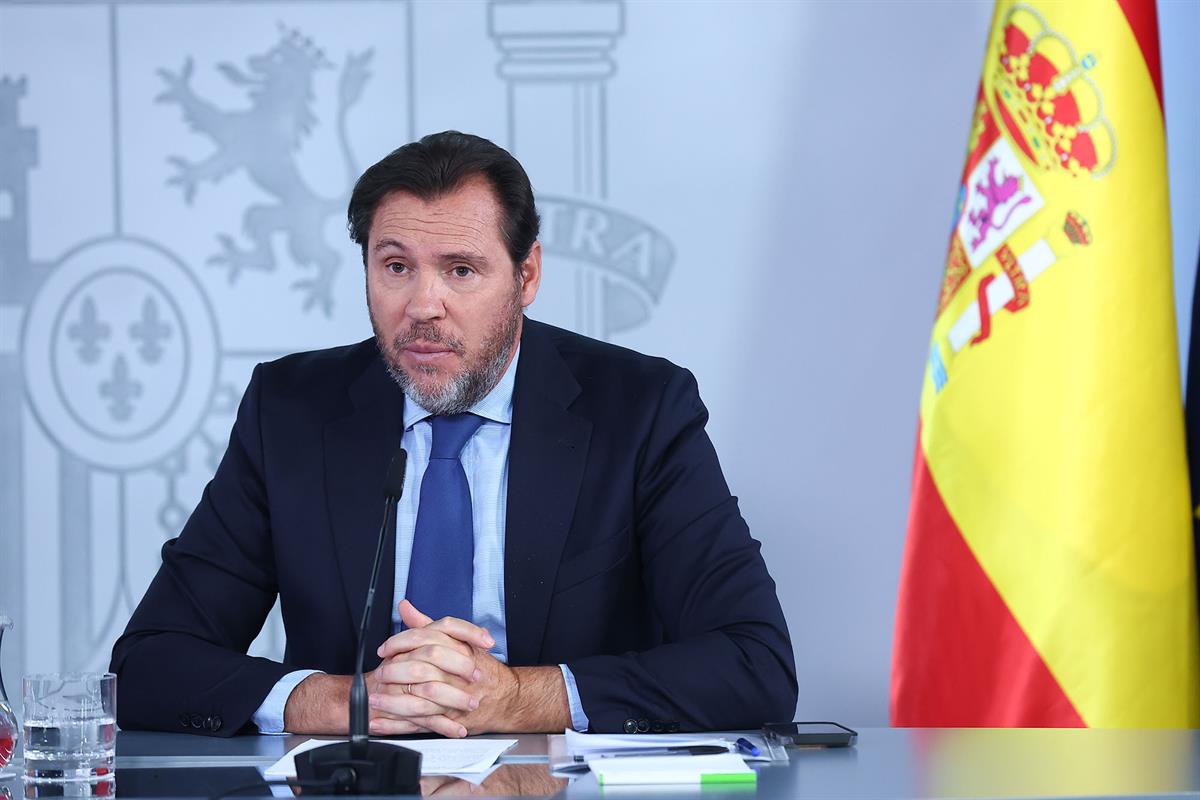 The Minister for Transport and Sustainable Mobility, Óscar Puente, during the press conference after the Council of Ministers | Pool Moncloa/Fernando Calvo
The first area of action focuses on road freight transport, with a clear objective: to ensure that variations in fuel prices are effectively passed on to transport costs. This has been included in regulations since 2022, but some sectors have been unable to implement it. To ensure this pass-through is widespread, the Government is reinforcing the mandatory review of transport costs: once fuel prices increase by 5%, freight contracts with carriers must be automatically reviewed. Furthermore, this variation must be clearly and specifically detailed on the invoice, guaranteeing transparency and facilitating compliance monitoring. A specific penalty system is also being introduced for both one-off and repeated non-compliance.
"We cannot force or allow carriers to operate at a loss and bear the entire burden of transport cost increases, especially considering the business fabric, comprised mainly of small companies and self-employed individuals," stated Puente.
The regulation also updates the formula used to calculate transport price adjustments based on changes in fuel costs, making it dynamic and reflecting the actual price of diesel at the time of transport.
Rail freight transport: subsidies for locomotives
A second key aspect of the regulation consists of specific measures for rail freight transport, which was excluded from the initial decree-law. In addition to the increase in diesel and electricity prices, rail freight is facing the "numerous construction projects" underway on the rail network, as Puente pointed out.
The minister stressed that, although rail freight currently represents only 4% of the total, it is a long-term investment, making it essential to maintain its profitability. The goal is to increase this percentage to 10% by 2030 and, subsequently, to match the European average of 17%.
The aid in this case is non-refundable and will be granted per vehicle: €15,000 for each active locomotive, with a total allocation of €3.15 million.
Maritime transport: connectivity of non-peninsular territories
Maritime transport is the third pillar of the measures, which expand the scope of existing aid to expressly include pure cargo services between mainland ports and those of the Balearic and Canary archipelagos, as well as Ceuta and Melilla, and between ports within the archipelagos. To the €30 million initially allocated, an additional €7 million is thus added to strengthen connectivity and ensure that these territories have an efficient and competitive transport system.
The decree-law, as detailed by Óscar Puente, is completed with clarifications and adjustments to the existing framework, such as the inclusion of more groups in the aid system approved on 20 March and the adaptation of these measures to territories with specific characteristics.
Judicial access to electronic evidence in the European Union
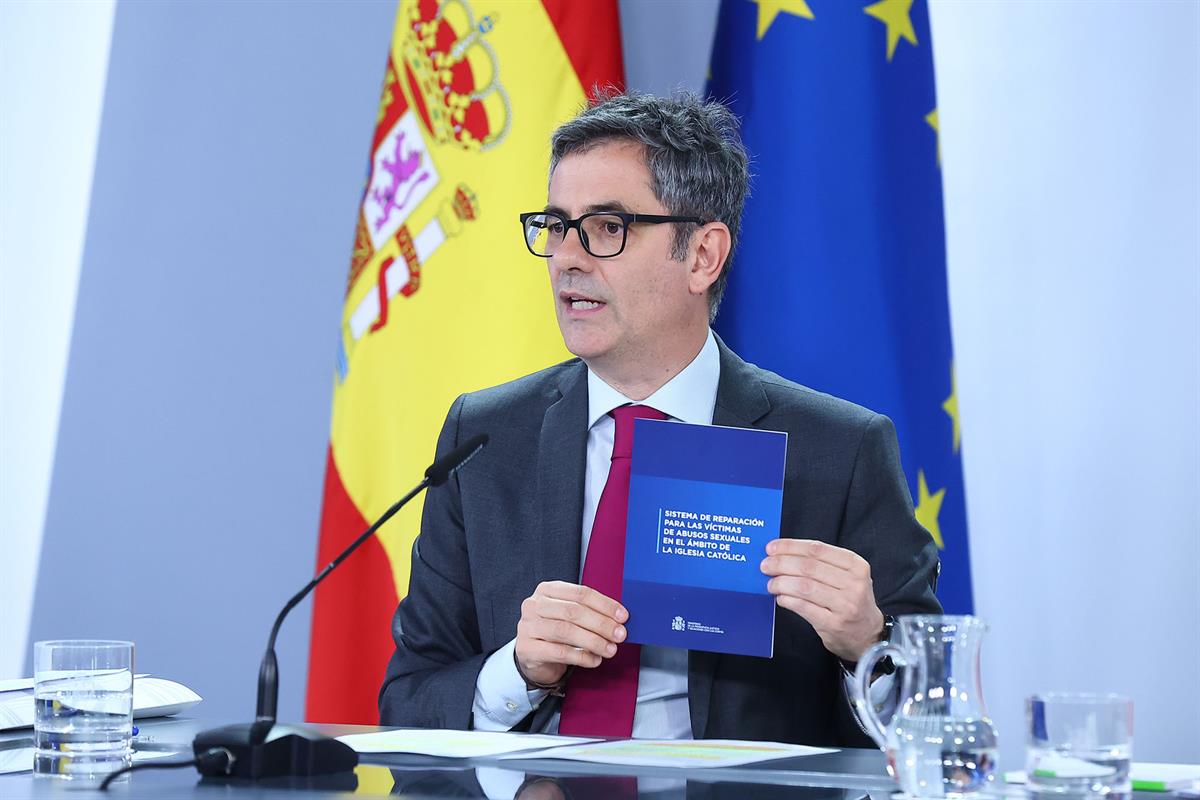 The Minister for the Presidency, Justice and Parliamentary Relations, Félix Bolaños, at the press conference after the Council of Ministers | Pool Moncloa/Fernando Calvo
The Council of Ministers has addressed the future law that will guarantee judges, prosecutors, and police officers quick and reliable access to electronic evidence in cross-border legal proceedings-that is, those involving more than one country within the European Union.
The legislation will incorporate the so-called e-evidence package into the legal system, which includes a European directive and regulation to strengthen judicial cooperation between member states.
The Minister for the Presidency, Justice and Parliamentary Relations, Félix Bolaños, stated that digital evidence is fundamental in any legal proceeding, such that "the justice system must be able to act swiftly, efficiently, and effectively to prevent its loss."
Bolaños added that organised crime operates in several countries simultaneously and that criminal investigations depend on digital evidence that "knows no borders and is not subject to any limitations related to the territory of a single state."
The most significant new aspect of the law, as explained by the minister, is that it allows judges, prosecutors and the forces acting as judicial police - National Police and Civil Guard - to request the preservation or delivery of evidence from the digital service provider in conditions of extreme urgency. Currently, the European model of judicial cooperation requires a judge in one member state to make such a request to a judge in another member state directly or through Eurojust, which "has significant limitations in terms of effectiveness."
The directive requires digital service providers to appoint a representative within the European Union, to whom requests will be addressed. Thus, once this law comes into force, all technology companies providing telephony, messaging, social media, or cloud storage services may be directly requested by judges, prosecutors, and police to deliver or preserve evidence.
They will have 10 days to deliver the documentation, although, exceptionally, this period can be reduced to eight hours. The time limit for them to preserve digital evidence is four hours.
The minister stated that it is a "very ambitious regulation that places all European Union countries at a new level of cooperation regarding the preservation and delivery of digital evidence." Bolaños is confident that it will be approved by the Spanish Parliament, given that it was approved by the European Parliament by a very large majority.
Anti-SLAPP Directive
The Council of Ministers has presented two draft bills to transpose the well-known Anti-SLAPP Directive into Spanish law. This directive is included in the Action Plan for Democracy that the Government approved in September 2024.
Félix Bolaños explained that the directive aims to prevent individuals participating in public debate, such as journalists or activists, from being subjected to police harassment with unfounded charges to prevent them from continuing their work. "Our aim is that, with the final approval of this law, all associations, organisations, unions, and other representative entities can participate in legal proceedings alongside the accused, to support, protect, and accompany them throughout the legal process," he explained.
The Minister for the Presidency, Justice and Parliamentary Relations, Félix Bolaños, the Minister for Inclusion, Social Security and Migration, Elma Saiz, and the Minister for Transport and Sustainable Mobility, Óscar Puente, at the press conference | Pool Moncloa/Fernando Calvo
The minister added that the future law will require significantly higher bonds from plaintiffs to cover potential costs incurred if their claims are dismissed and establishes streamlined procedures for the early dismissal of claims when they are found to be unfounded. The law also incorporates other corrective measures against abusive actions, such as awarding costs without the legal limit, compensation for damages, imposing deterrent fines, and publishing the court ruling in the media.
Office for the Recognition and Reparation of Sexual Abuse within the Catholic Church
The Government has approved the creation of the Office for the Recognition and Reparation of Sexual Abuse within the Catholic Church. The new office will be attached to the Ministry of the Presidency, Justice and Parliamentary Relations and will receive requests for reparation through its website and via email.
The Minister for Justice recalled that on 8 January, the Executive agreed with the Catholic Church to establish a reparation system for victims of sexual abuse, which materialised with the signing of a protocol between the Government, the Church, and the Ombudsman on 30 March. This protocol comes into effect tomorrow.
"From tomorrow, 15 April, all victims of sexual abuse within the Catholic Church will be able to access the new model we have created, which is overseen by the Ombudsman," the Minister announced.
Félix Bolaños announced that the Government will launch an information campaign so that all existing abuse victims' associations in Spain can disseminate information to their members about the application process.
The idea, the minister explained, is that the office will begin receiving claims tomorrow. The system will be in place for one year, renewable for a second, to provide redress to all those who suffered abuse and who can no longer go to court because the statute of limitations has expired or the perpetrator has died.
The applications will be sent to the Ombudsman's Victims Unit, which will prepare the proposed reparations. The minister reiterated that the Catholic Church will respond financially or with any moral, psychological, or restorative reparations that may arise from the reparations process. If disagreements arise, a joint commission will be convened with the participation of the parties involved and the victims' associations to reach an agreement. If consensus is not possible, the Ombudsman will make the final decision.
Current Affairs
At the start of her address to the media, the government spokesperson emphasised that Spain has once again been cited as a role model for its commitment to renewable energy. In this regard, she noted that the New York Times highlighted Spain's success in keeping the influence of gas on electricity prices among the lowest in Europe, a decisive factor in maintaining its position among the countries with the lowest electricity prices per kilowatt-hour amidst the crisis caused by the conflict in the Middle East.
Elma Saiz also condemned the recent cases of gender-based violence: "Each murder of this kind is a collective failure that challenges us as a nation. In this fight, there is only room for greater commitment, greater equality, and greater resolve."
Non official translation