Council of Ministers
The Government expects Spain to maintain moderate tourism growth in a context of international instability
Council of Ministers - 2026.3.31
Moncloa Palace, Madrid
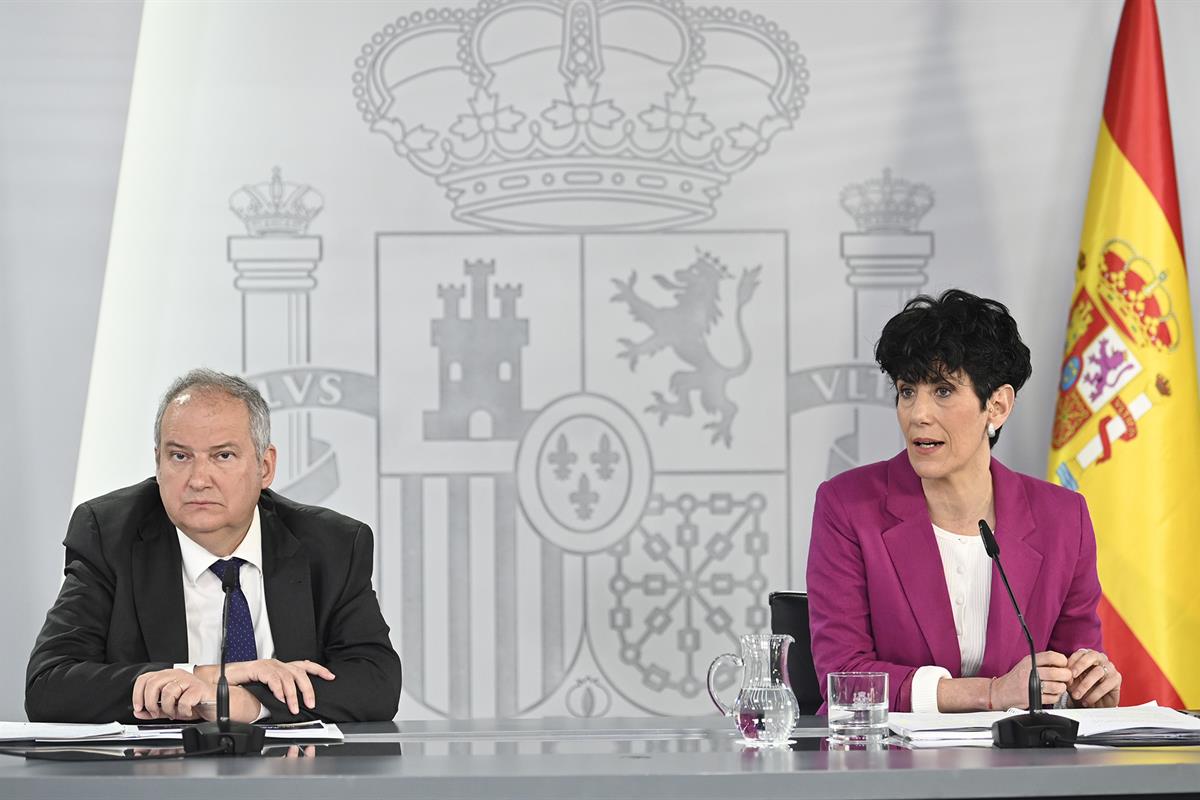 The Minister for Industry and Tourism, Jordi Hereu, and the Minister for Inclusion, Social Security and Migration and Government Spokesperson, Elma Saiz, during the press conference after the Council of Ministers (Pool Moncloa/César P Sendra)





The Government has analysed a report on the current tourism situation and the forecasts for both Easter and the coming months in a context marked by the war in Iran.
During his appearance at the press conference following the Council of Ministers meeting, the Minister for Industry and Tourism, Jordi Hereu, presented the conclusions of the document, which also reflects the Executive's progress in transforming a model that represents 12.3% of Gross Domestic Product and has a significant impact on the economy.
Deseasonalisation, deconcentration, diversification of tourism
Jordi Hereu highlighted that spending by international tourists at their destinations increased by 6.8% last year and is higher than the number of tourist arrivals. The minister also pointed out a trend toward the deseasonalisation, decentralisation, and diversification of tourism, which he considers significant: "What we want to happen is happening".
Hereu explained that tourism is becoming less seasonal, with tourist arrivals and spending increasing during the shoulder and off-season months: "This has very positive effects, for example, on job stability."
Furthermore, tourism is growing more in regions that were not traditionally tourist destinations. "There is greater growth in inland Spain, in 'green Spain,' than in the six traditionally tourist-oriented autonomous communities, and this represents another important qualitative element: decentralisation across the entire Spanish territory," the minister remarked.
The Minister for Industry and Tourism also highlighted that 97 million people have visited Spain for reasons other than the traditional sun and beach holiday. Tourism is now linked to shopping, personal services, culture, gastronomy, and city visits: "We are refining our offerings to attract higher value-added segments."
Tourism employment and visitor satisfaction
In February, the number of people registered with Social Security in the tourism sector reached 2,750,000, a record high. According to the Minister, this figure is further bolstered by the fact that international tourist satisfaction is growing every year. Surveys show that almost 70% of visitors are very satisfied with their experience in Spain, and 67% say they want to return next year.
Favourable tourism forecasts and monitoring of the impact of the war
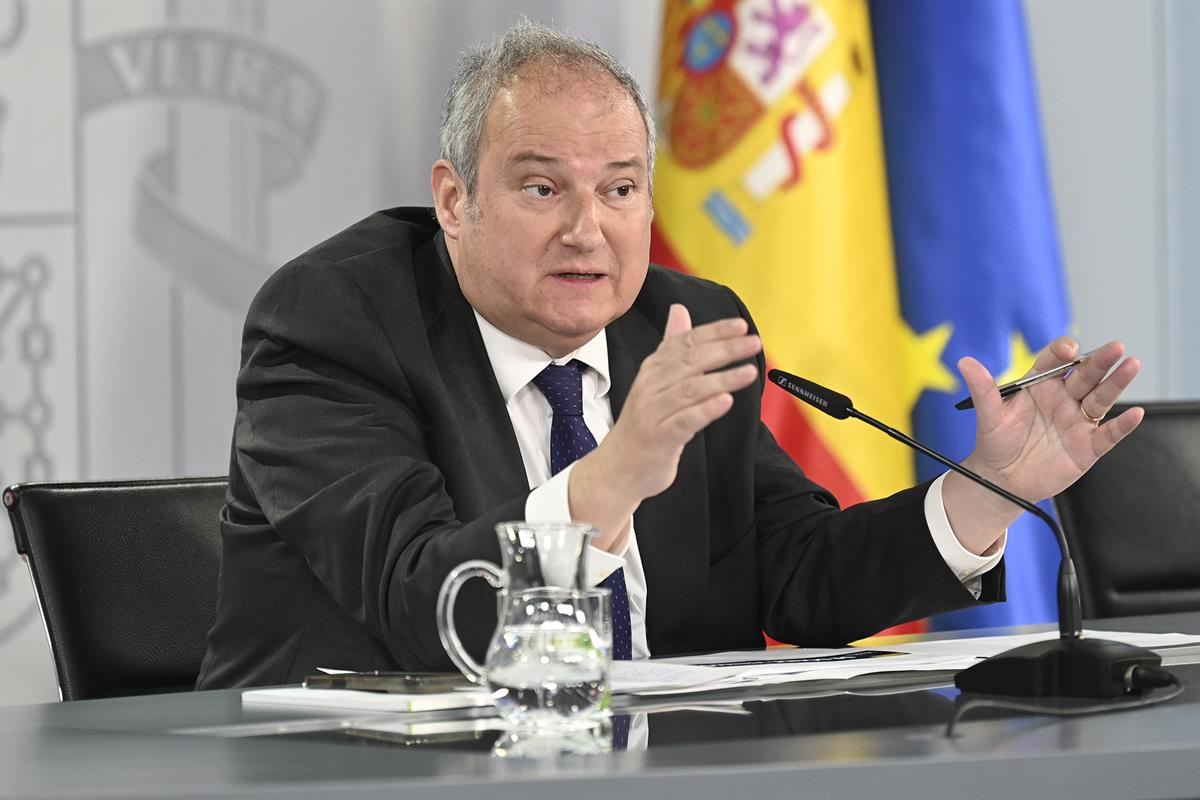 The Minister for Industry and Tourism, Jordi Hereu, during the press conference after the Council of Ministers | Pool Moncloa/César P Sendra
The Minister for Industry and Tourism highlighted the positive forecasts for Easter Week in terms of hotel occupancy across all sectors, from urban and rural tourism to traditional beach tourism. Last-minute bookings have seen a "clear acceleration" in recent days, said Hereu, who noted that domestic tourism is the main focus at this time of year.
In terms of international tourism, forecasts for March and April indicate that tourist spending will grow by 3% and the number of international tourists will increase by 0.2%, figures the minister described as "excellent news in the current context."
Hereu stressed that, although the tourism sector is showing great resilience and adaptability, it is not immune to the effects of war. The minister pointed out that, on the one hand, there could be a shift in tourist flows from the Middle East to the Western Mediterranean, but factors such as the increased cost of energy and, therefore, air travel could negatively impact tourist arrivals.
The minister added that "there are elements that indicate we can maintain stability in a successful model" and that the forecast is for "a trend toward steady growth," but we will have to wait and see what impact the war has.
The Ministry of Industry and Tourism and the sectors that make up the tourism ecosystem in Spain will assess the impact of the armed conflict through a monitoring committee. Furthermore, the department headed by Jordi Hereu is analysing the situation with Spanish tourism offices worldwide. The minister explained that in the United Kingdom, there is a noticeable shift in demand from the eastern to the western Mediterranean; that China is seeking direct alternatives to Spain to avoid the air transport bottleneck in the Middle East; and that in Germany, there are concerns about the medium-term effects of the war on tourism, but that for the moment, the situation remains stable.
Triple sustainability: social, economic and environmental
Given this international context, Hereu emphasised the importance of "persevering in the transformation of the Spanish tourism model." The Government, he explained, is finalising the investment of the €3.4 billion of European funds dedicated to this objective and continues to advance on the "roadmap" that is the Sustainable Tourism Strategy 2030. The goal is to continue implementing the strategies of diversification, decentralisation, and deseasonalisation and achieve triple sustainability: social, environmental, and economic.
Government reinforces its commitment to science
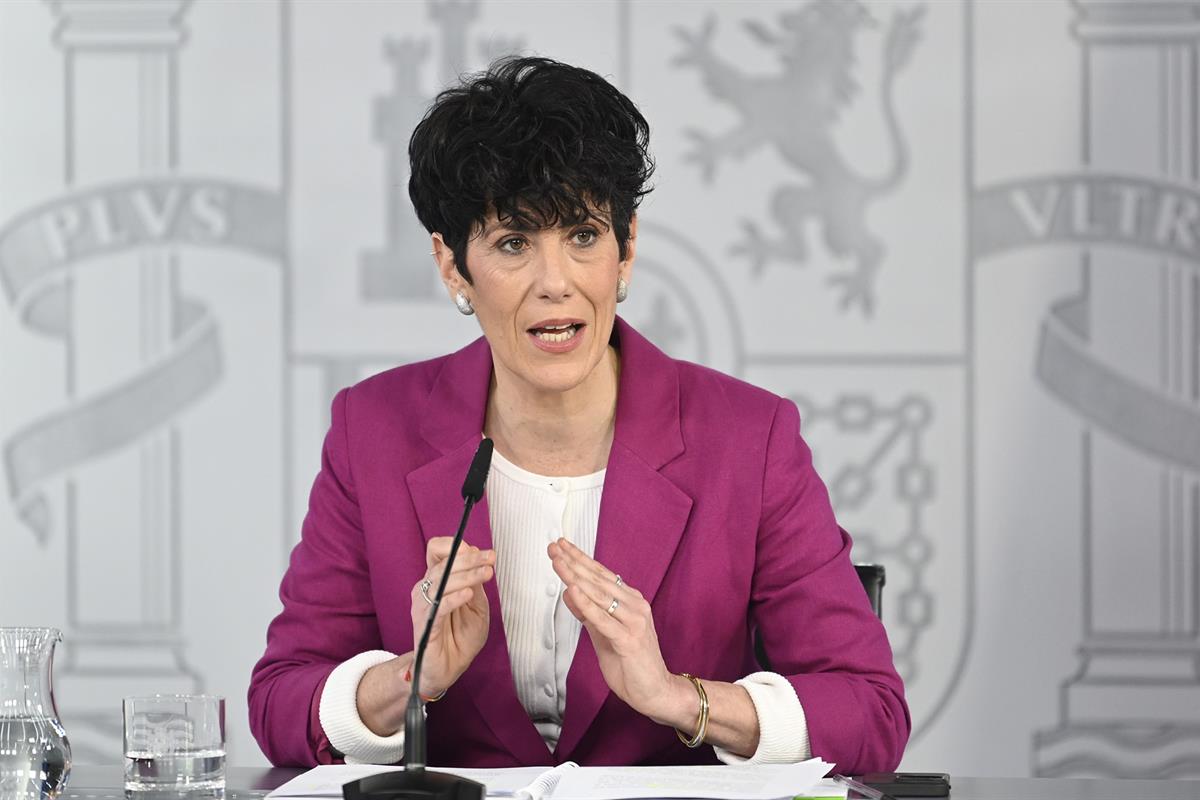 The Minister for Inclusion, Social Security and Migration and Government Spokesperson, Elma Saiz, during her speech at the press conference after the Council of Ministers | Pool Moncloa/César P Sendra
The Minister for Inclusion, Social Security and Migration and Government Spokesperson, Elma Saiz, explained that the Council of Ministers has approved an investment "close to €800 million to strengthen Spain's international scientific leadership."
The investment will be channelled through various programmes, such as the one allocated to the European Space Agency (ESA), with a budget of €625 million. According to Elma Saiz, this funding will allow Spain to "strengthen its strategic autonomy" in this area and develop next-generation satellites.
The fourth call for proposals under the ATRAE 2026 programme, which enables researchers and professionals from international centres to develop their projects in Spain, will also receive €40 million. "The Government is thus reinforcing its firm commitment to science and innovation as fundamental pillars for progress," the government spokesperson stated.
New Observatory for Suicide Prevention
The Government has also approved the creation of the Observatory for Suicide Prevention. Elma Saiz indicated that "at the national level, suicide is not a health problem; it is a social problem with chilling statistics." Therefore, the Government wants to address it "from every possible angle."
The aim of this interministerial body is to strengthen the coordination, analysis, and monitoring of public policies for suicide prevention in Spain. It will be attached to the Ministry of Health, through the Commissioner for Mental Health, and will meet at least twice a year.
In Spain, according to the latest data from the National Statistics Institute (INE) in 2024, suicide has become the second leading cause of external death.
Current affairs: Social Security deficit
During the press conference following the Council of Ministers meeting, the minister also addressed the Social Security deficit figure for 2025, set at 0.4% of GDP, the lowest level since 2011.
Social Security closed 2025 with a deficit of €7.387 billion, compared to a negative balance of €9.834 billion at the same time in 2024.
"This is an example of how economic growth and improved employment are compatible with balanced public finances and social justice," stated the Minister for Inclusion, Social Security and Migration.
Condemnation of the attack on UNIFIL
Elma Saiz began her statement to the media by expressing the government's "unequivocal condemnation" of the latest attack against the United Nations mission in Lebanon, in which three peacekeepers under Spanish command were killed. The minister conveyed the government's condolences to the families of the soldiers and stressed that these types of actions constitute "an unjustifiable aggression" against the international community, which, as UN Secretary-General António Guterres himself has pointed out, could constitute a war crime.
Elma Saiz also emphasised that the conflict is causing millions of displaced people and global economic repercussions, which "directly impact sectors of our country by affecting major trade routes." In this regard, she recalled that precisely to protect 20 million households and 3 million businesses, the government has approved the largest social and economic safety net in the European Union, endowed with €5 billion, which received the support of the Lower House of Parliament.
International Children's Book Day
The Government Spokesperson concluded her remarks by highlighting the approval of an Institutional Declaration on the occasion of International Children's Book Day, which will be celebrated on 2 April.
During her speech, Elma Saiz emphasised the importance of reading in the education of new generations and highlighted initiatives such as the one held in Libros, a small town in the province of Teruel, where a children's book fair was organised with the participation of more than 200 children, despite having barely one hundred inhabitants. She stressed that "a child who reads is an adult who thinks" and argued that promoting reading contributes to the cultural and social development of territories.
Non official translation