Council of Ministers
The Government of Spain declassifies documentation on the attempted coup d'état of 23-F
Council of Ministers - 2026.2.24
Moncloa Palace, Madrid
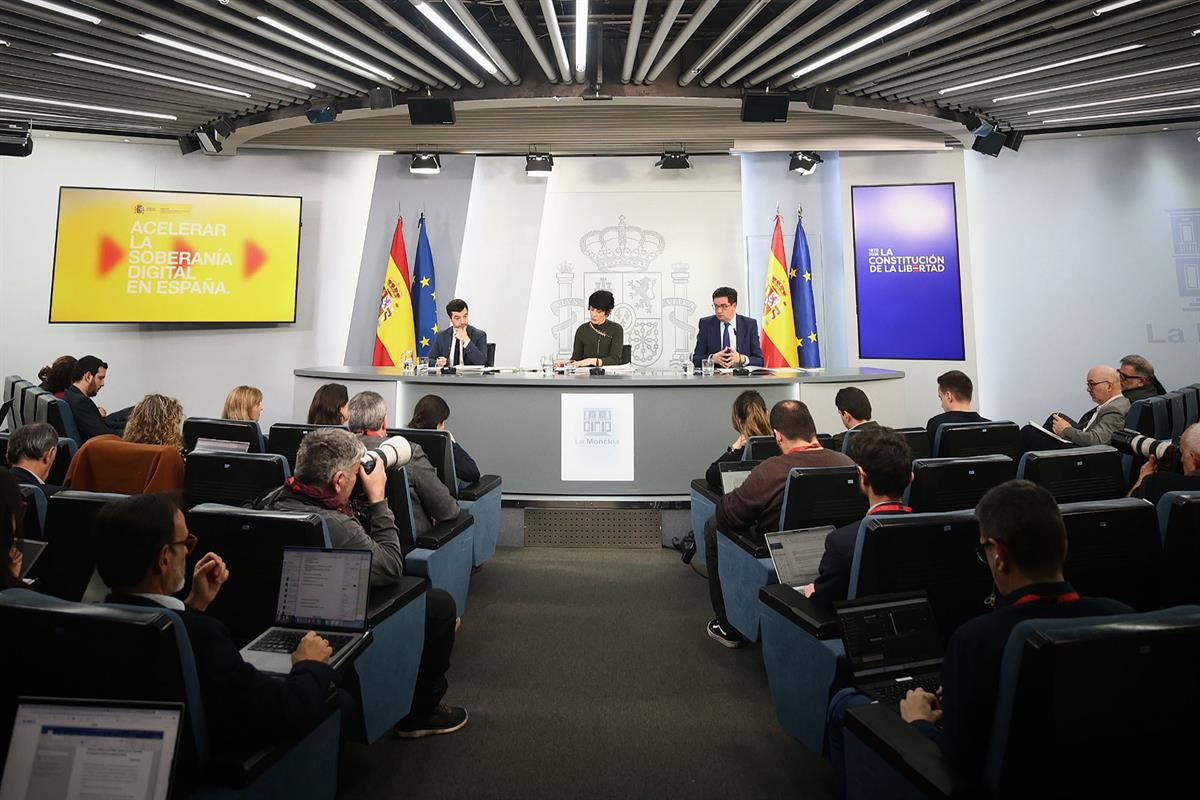 The Minister for Social Rights, Consumer Affairs and 2030 Agenda, Pablo Bustinduy, the Minister for Inclusion, Social Security and Migration, Elma Saiz, and the Minister for Digital Transformation and Civil Service, Óscar López, at the press conference





The Council of Ministers has approved the declassification of documents relating to the attempted coup d'état that took place in Spain on 23 February 1981.
The decision was processed in accordance with the Official Secrets Act and, as detailed by the Minister for Inclusion, Social Security and Migration and Government Spokesperson, Elma Saiz, "will allow the declassification of all the information found to date", on the 45th anniversary of the event.
 The Minister for Inclusion, Social Security and Migration and Government Spokesperson, Elma Saiz, during her speech at the press conference after the Council of Ministers | Pool Moncloa/Javier Amescua
The Government Spokesperson explained that these are "153 documents" that have remained classified as secret for decades and that from now on can be "consulted by historians, researchers, and the public through official channels". The documents will be publicly available from 25 February, on the official website of La Moncloa.
"As President Sánchez said, memory cannot be locked away, and as Javier Cercas wrote in Anatomía de un instante (The Anatomy of a Moment), the past is not the past, it is a dimension of the present. And a full democracy must have access to that dimension", Saiz pointed out.
Elma Saiz also emphasised that this measure puts an end to "an atypical situation in modern democracies regarding the declassification of state information" and that she now hopes "that the draft Law on Classified Information can be passed in Lower House of Parliament so that decisions like this cease to be an exception and become the norm".
Strategy against loneliness and social isolation
The Government has approved the first State Strategic Framework on Loneliness (2026-2030). The Minister for Social Rights, Consumer Affairs and 2030 Agenda, Pablo Bustinduy, stated that the goal is to address, through public policy, the causes and conditions that generate, perpetuate, or worsen the experience of loneliness and social isolation.
The minister pointed out that very few countries have strategies to address loneliness, "a wide spectrum of situations" that affect a growing segment of the population. Bustinduy stressed that solitude is not inherently negative, but it becomes a problem when people have no control over it. "Loneliness, especially when it is unwanted, produces a series of cumulative effects on health, physical and emotional well-being, and social, economic, political, and community participation", the Minister for Social Rights, Consumer Affairs and 2030 Agenda pointed out.
 The Minister for Social Rights, Consumer Affairs and 2030 Agenda, Pablo Bustinduy, during the press conference after the Council of Ministers | Pool Moncloa/Javier Amescua
According to a 2024 barometer, one in five people in Spain experiences loneliness. This situation, which tends to become chronic, disproportionately affects young people, those over 75, women, and the most vulnerable families. Urban planning models, the lack of public spaces, transportation and care systems, the provision of public services, and work organisation are other factors that contribute to loneliness, as the minister explained.
In addition to this strategy, the Government has created an Inter-agency Board on Loneliness, with representatives from all levels of government, the third sector, civil society, and experts, to work on a series of priority areas. The Board will develop strategies to prevent social isolation and loneliness resulting, for example, from teleworking, and will propose interventions from fields such as primary care, urban planning, digital governance, and local public services.
With these initiatives and, in general, with this vision of how social protection should function, the Executive seeks to fulfil the constitutional mandate that public authorities guarantee equality and well-being for all citizens, Bustinduy explained. "Here, no one will be abandoned, no one will be left alone", he assured.
Advances in the autonomy and inclusion of people with disabilities
The government has presented a report on the actions undertaken since the amendment to Article 49 of the Constitution, two years after its approval. This reform, in the words of Pablo Bustinduy, "placed Spain at the forefront internationally in complying with the United Nations Convention on the Rights of Persons with Disabilities". The minister underlined that the assessment demonstrates that this was not merely a matter of terminology, but rather a mandate for all public authorities to guarantee four principles: the social inclusion of people with disabilities, personal autonomy, universal accessibility of all public spaces, and enhanced protection for women and girls with disabilities.
Among the actions taken by the Government, Bustinduy cited the prohibition of automatic dismissal for permanent disability, the strategic framework for changing the care model to promote the autonomy of people with disabilities and those in situations of dependency, the expansion of the Reina Letizia training scholarship programme, and the creation of a specific programme for students with autism spectrum disorder. The Executive has also adopted the first national plan to combat discrimination against women and girls with disabilities, has allocated European funds to guarantee the accessibility of buildings and public spaces, and has created an inclusive emergency protocol, among other measures.
The minister also highlighted that the Council of Ministers today approved the amendment to the Regulations for Bullfighting Events to expressly prohibit situations that demean people with disabilities.
"There are very few places in the world where such decisive interventions are taking place to guarantee the full citizenship, inclusion, and well-being of more than four million of our fellow citizens in this country", Bustinduy stated. The Minister for Social Rights, Consumer Affairs and 2030 Agenda added that this rollout must culminate in the reform of the laws on dependency and disability, whose final approval he expects to occur before the summer.
Future Public Sector Advertising Law
 The Minister for Digital Transformation and Civil Service, Óscar López, during the press conference after the Council of Ministers | Pool Moncloa/Javier Amescua
The Council of Ministers addressed the draft Public Sector Advertising Law. The future legislation responds to the need to adapt Spanish law to European regulations on the matter and will replace the current Institutional Advertising Law, in force since 2005.
The Minister for Digital Transformation and Civil Service, Óscar López, explained that changes in the advertising market following the emergence of digital platforms that compete with traditional media justify updating the law.
Óscar López argued that "public sector advertising plays an essential role in informing citizens, but it can never become a means of buying media". Therefore, he added, the law has two objectives: to guarantee the transparency of public administrations so that citizens know how their tax money is being spent, which campaigns and media outlets it is being used for, and to guarantee the real economic independence of the media.
Main changes
The future law regulates public sector advertising in both traditional media and online platforms, which will have to register in a public media registry if they wish to receive institutional advertising.
The text establishes that a single media outlet or platform cannot exceed 35% of its annual revenue, or that of the group to which it belongs, in public advertising. Óscar López clarified: "If a media outlet receives advertising from the city council, the regional government, and the national government, the sum of all public sector advertising investments cannot exceed 35%".
The minister stressed that this limit will not apply to media outlets or platforms with a turnover of less than two million euros and whose audience is concentrated, at least 70%, within three contiguous autonomous communities: "We have established a clause to safeguard local media because Spain has a very strong local media ecosystem compared to other countries in our region".
The new regulation establishes a transparent audience measurement system, in line with European regulations. The National Markets and Competition Commission (CNMC) will monitor the allocation of advertising spending. "There must be transparency in the advertising rates charged by the media", the minister remarked.
López also stressed that the government will be required to publish the allocation of its advertising investment annually, as will all other public administrations, and will submit an annual advertising report to Parliament.
Roadmap to accelerate digital sovereignty
The government has presented its roadmap to accelerate digital sovereignty, a document that reorganises and maps out the next phase of the digital revolution in Spain.
Óscar López highlighted that in the last four years, more than half a million jobs related to new technologies have been created in Spain, and that it is the leading country in Europe and seventh in the world in the development of artificial intelligence. The Government, he added, has allocated a significant portion of the funds from the Recovery, Transformation and Resilience Plan to strengthening its digital sovereignty and will continue to do so through the Spain Grows fund, presented by the President of the Government of Spain.
The Minister for Digital Transformation explained that two priorities were considered in drafting the document. The first is for Spain to strengthen all critical infrastructure to reinforce its digital sovereignty (the cloud, data, artificial intelligence, and physical infrastructure). The second is to strengthen all those technologies in which Spain is already a leader and has cutting-edge industries, such as biotechnology, neurotechnology, clean energy, digital identity, and cybersecurity-sectors in which we are already very strong.
The document contains ten action proposals, among which the minister highlighted the strengthening of the public digital infrastructure, the space sector and quantum technologies, investment in chips and semiconductors, the use of free software or OpenDesk in public administrations, the promotion of the European cross-border payments system and the positioning of artificial intelligence gigafactories.
Support for the Ukrainian people
On the fourth anniversary of the start of Russia's invasion of Ukraine, the Minister for Inclusion, Social Security and Migration and Government Spokesperson, Elma Saiz, reviewed the actions taken by the Government of Spain to address the humanitarian crisis generated by the conflict.
"Since then, we have granted temporary protection to more than 264,000 people displaced from this country", Saiz stated, making Spain the fourth country in the European Union in terms of granting this type of permit. Furthermore, in the last year, the number of people registered with Social Security from Ukraine has increased by 26.4%.
"These are the examples that make us a global beacon in migration policy", Saiz stated, noting that the protection offered to Ukrainian citizens has been extended until 4 March, 2027, and that the Government will continue "to support the Ukrainian community and, above all, to demand a just and lasting peace once and for all".
Recent cases of gender-based and vicarious violence
The Government Spokesperson began her remarks after the Council of Ministers meeting by condemning the recent cases of gender-based and vicarious violence that have occurred in Spain and expressing her solidarity with the victims' families.
"2026 is proving to be an unbearable year in terms of gender-based violence", Saiz stated, also reminding citizens of the existence of the 016 helpline and calling for unity: "We need to come together in the State Pact against gender-based violence, appealing to the unity of all institutions, all levels of government, and society as a whole".
Non official translation