Council of Ministers
The Government of Spain approves the revaluation of pensions and social shield measures for 2026
Council of Ministers - 2026.2.3
Moncloa Palace, Madrid
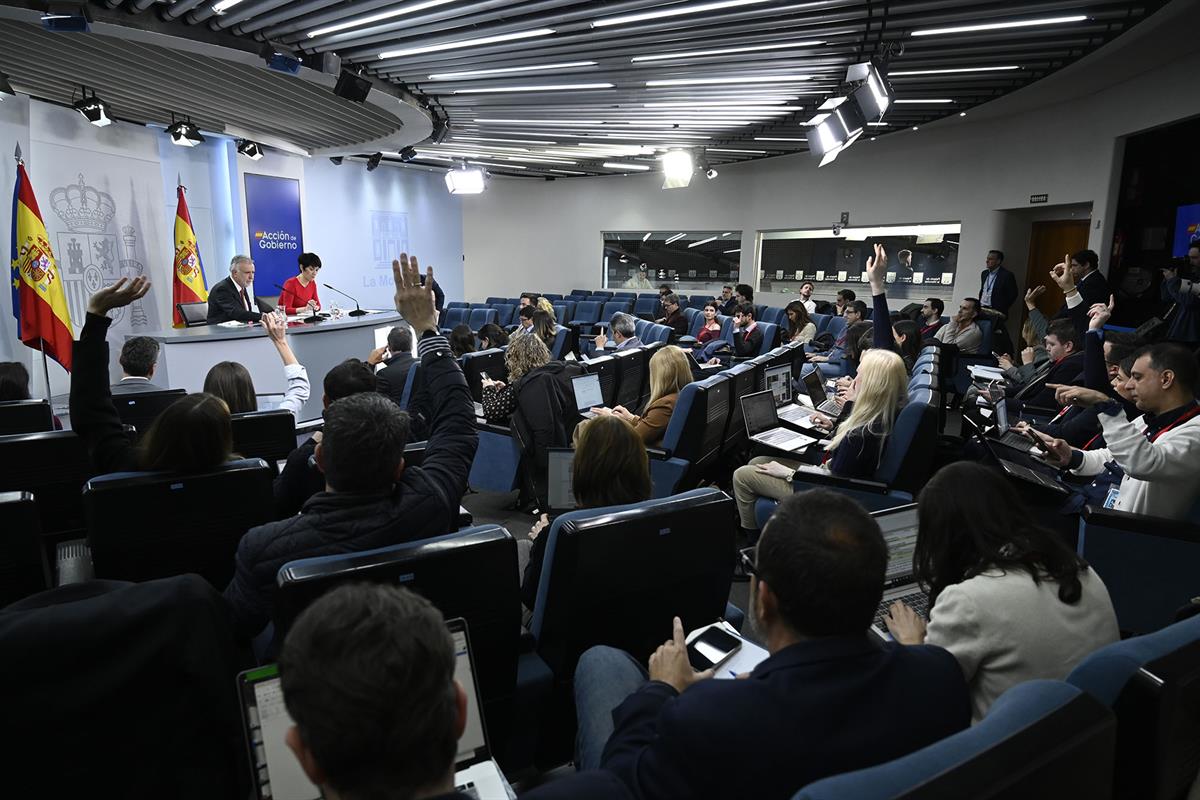 The Minister for Territorial Policy and Democratic Memory, Ángel Víctor Torres, and the Minister for Inclusion, Social Security and Migration and Government Spokesperson, Elma Saiz, address the media during the press conference (Pool Moncloa/José Manuel Álvarez)






The Council of Ministers has approved a Royal Decree-Law that includes the revaluation of pensions within the Social Security system, State Pension Schemes, and other public benefits for 2026, as well as other relevant Social Security measures. The rise, effective since 1 January, represents a 2.7% increase in contributory pensions across the board.
The Minister for Inclusion, Social Security and Migration and Government Spokesperson, Elma Saiz, emphasised that with this royal decree-law, which reinstates the increase approved in December 2015 but not ratified by the Lower House of Parliament, the government "protects the purchasing power of pensioners" with a rise that amounts to an average of 50 euros more per month for each pensioner.
The spokesperson reminded everyone that the increase is greater for the most vulnerable: minimum pensions will increase by more than 7%, a percentage that, in the case of some pensions, such as minimum pensions with a dependent spouse or widow's pensions with dependent family members, will reach up to 11.4%. Non-contributory pensions and the Minimum Basic Income will also increase by 11.4%.
Guarantee of basic supplies and a ban on evictions in properties owned by large landlords
 The Minister for Inclusion, Social Security and Migration and Government Spokesperson, Elma Saiz, during her speech at the press conference after the Council of Ministers | Pool Moncloa/José Manuel Álvarez
The Executive has approved another royal decree law with social shield measures, among which Saiz highlighted the extension of bono social energy discounts throughout 2026 and the guarantee of water, natural gas, and electricity supply for vulnerable consumers. The minister also mentioned in this context, the incentives and tax benefits for those affected by the DANA storm and the forest fires of last summer.
The same text includes the update of advance payments to the autonomous communities and local entities during 2026. "In the case of the autonomous communities, these advance payments will be made through supplementary credits worth more than 3 billion euros. For local entities, they will be identical to those established in 2025, also financed through supplementary credits worth approximately 3.8 billion euros", explained the Government Spokesperson.
Furthermore, in the area of housing, certain measures are being extended to address situations of social vulnerability, such as the extension until 31 December 2026, of the suspension of evictions for vulnerable households without alternative housing. As a new measure, as the minister explained, in the case of owners of three or more properties, eviction will not be carried out if there is a prior contract and the owner is not considered vulnerable. In addition, owners of one or two properties will not be affected by the extension of this social shield, and social services will be responsible for finding emergency housing alternatives.
Strengthening coordination in response to DANA storm damage
The Council of Ministers has created the Joint Commission for Reconstruction and Recovery following the damage caused by the DANA in the Valencian Community. The Minister for Territorial Policy and Democratic Memory, Ángel Víctor Torres, stated that this fulfils the commitment made by the President of the Government of Spain, Pedro Sánchez, to the President of the Generalitat, Juan Francisco Pérez Llorca, on 17 December last year.
 The Minister for Territorial Policy and Democratic Memory, Ángel Víctor Torres, during the press conference after the Council of Ministers | Pool Moncloa/José Manuel Álvarez
The minister indicated that this body complements other "permanent coordination" procedures established from the outset by the Government of Spain with the Valencian Generalitat, such as working groups between various ministries and regional departments, and meetings with the mayors of the affected municipalities.
"All of this is unique and extraordinary in the Valencian Community compared to previous events, for example, the volcano on the island of La Palma," said Ángel Víctor Torres, who added that the date and agenda for the inaugural session of the Joint Commission will be announced shortly.
Nearly 1,000 unaccompanied migrant children resettled in five months
The Minister for Territorial Policy and Democratic Memory also presented a report on the relocation of unaccompanied foreign minors from regions experiencing migration crises: The Canary Islands, Ceuta and Melilla.
Ángel Víctor Torres stated that, in just five months, nearly a thousand minors have been relocated to the mainland, "without any problems of coexistence". The minister expressed his gratitude for the coordination with the Ministries of Youth and Children, Inclusion, Social Security and Migration, and Home Affairs, a collaboration that has enabled these minors "to move out of overcrowded conditions, attend school, and lead normal lives".
 The Minister for Territorial Policy and Democratic Memory, Ángel Víctor Torres, and the Minister for Inclusion, Social Security and Migration and Government Spokesperson, Elma Saiz, during the press conference | Pool Moncloa/José Manuel Álvarez
The minister explained that the 693 unaccompanied foreign minors seeking asylum are currently in the international protection reception system under the Ministry of Inclusion. Of these, 440 are already on the Spanish mainland. The remaining 127 are in the Canary Islands, of whom almost 100 have applied for residency based on roots in the archipelago, as they have been there for some time and wish to remain; the rest are eligible for relocation. The government thus considers the Supreme Court rulings regarding unaccompanied asylum-seeking children to have been fulfilled.
The remaining relocations of minors are being carried out through the regulations for the reception of unaccompanied migrant children, which the government approved in March 2025 and the Lower House of Parliament ratified the following month. By region, 174 minors have been relocated from the Canary Islands, representing 33.3% of the cases completed by the Government of Spain. 260 minors have been relocated from Ceuta, representing 77.3% of the cases resolved; and 52 from Melilla, representing 82.5%.
Torres has offered his support to the regional governments and autonomous cities to ensure compliance with legal deadlines regarding relocations. The government, for its part, has reinforced staff and resources to respond to the situation, "prioritising the best interests of the child and the defence of human rights", as the minister emphasised.
Bicentenary of Goya's death
In the cultural sphere, Elma Saiz announced the creation and regulation of the National Commission for the Commemoration of the Bicentenary of the Death of Francisco de Goya in 2028. "Celebrating his bicentenary is an opportunity to take a look in the mirror, understand where we come from, and decide what kind of Spain we want to be in the 21st century", the minister stated. Chaired by the head of the Executive and attached to the Ministry of Culture, this National Commission is responsible for promoting and coordinating the activities planned for the commemoration, in collaboration with the relevant administrations and entities.
 Pool Moncloa/José Manuel Álvarez
The year 2028 will mark two centuries since the death of Francisco de Goya y Lucientes, who died in Bordeaux on April 16, 1828. Born in Fuendetodos (Zaragoza) in 1746, he is internationally recognised as one of the most important painters in the history of art.
Other current affairs
The Government Spokesperson began her remarks by highlighting the President of the Government of Spain's announcement that legislation will be reformed to hold digital platform executives legally accountable, to make algorithm manipulation a criminal offence, and to prohibit access to social media for those under 16. "Spain is once again leading the way internationally with a progressive measure in which we will partner with five other European countries", Saiz stated.
Finally, Elma Saiz addressed the latest economic data. The minister highlighted that inflation has moderated by 0.5 percentage points, to 2.4%, which "is particularly noticeable in the price of electricity, 30% lower than the European average, and in the price of olive oil, which has fallen by 50% since its peak in 2014". Furthermore, the unemployment figures and Social Security affiliation data for January show, according to Saiz, "a solid labour market that leads job creation in the eurozone".
Non official translation