Council of Ministers
The Government of Spain reinforces strategic priorities and reduces the administrative burden of the Recovery Plan
Council of Ministers - 2025.12.9
Moncloa Palace, Madrid
 Pool Moncloa / José Manuel Álvarez





The Council of Ministers has approved the Addendum to the Recovery, Transformation and Resilience Plan, the set of reforms and investments that channel European funds to overcome the COVID-19 crisis and modernise the economy.
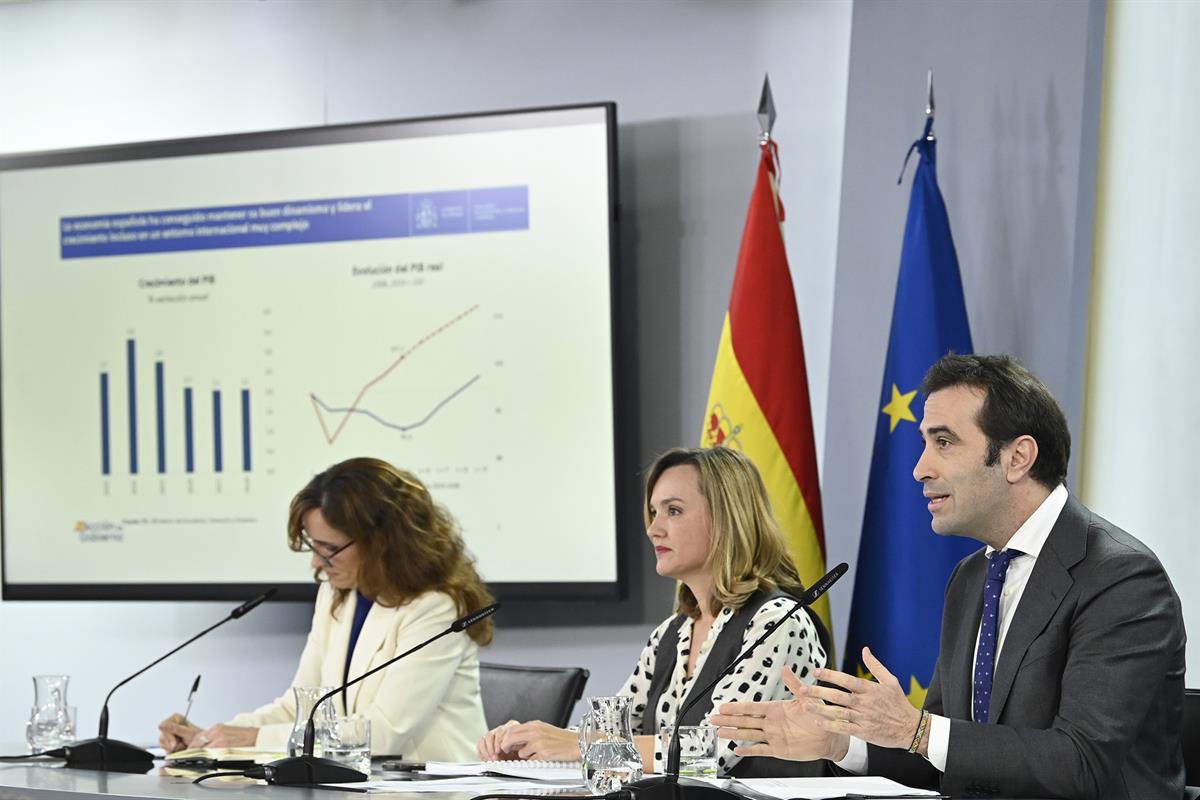
The Minister for Economy, Trade and Business, Carlos Cuerpo, reviewed the benefits that this initiative has brought to the Spanish economy in terms of employment, growth, business competitiveness, sustainability, reduction of inequality, and fiscal consolidation. Furthermore, he highlighted Spain's leadership in implementing the Plan: it is the country that has received the most transfers (€55 billion, out of the €71 billion that have arrived in total disbursements) and is the second country in terms of completed reforms, with more than 260.
Simplification, strengthening, and acceleration of the Recovery Plan
The addendum adopted today responds to the European Commission's request to the 22 Member States to expedite national plans and optimise available resources.
To this end, the Council of Ministers has simplified the Spanish plan by reducing administrative burdens: the verification of milestones is facilitated by consolidating the required documentation and eliminating duplication, among other measures. A second key element is the strengthening of the strategic priorities of the Plan, with new investments in areas such as supercomputing, decarbonisation, and the energy transition. Thirdly, the implementation of milestones and targets is accelerated to access 100% of the €80 billion in transfers allocated to Spain.
 Pool Moncloa / José Manuel Álvarez
The minister noted that access to loans is reduced to €22.8 billion thanks to the strong performance of the Spanish economy. While financing through these loans was less expensive than doing so through the Public Treasury when the Plan was first launched, there is now hardly any difference, and national financing involves less administrative burden and greater flexibility in terms of repayment deadlines.
Another new feature of the addendum is the injection of €13 billion in capital into the Official Credit Institute (ICO) to consolidate its capacity to respond to potential financing needs of the economy beyond 2026.
Investor confidence in Spanish public debt
The government has approved the Public Treasury Financing Strategy for 2026, marked by the strong performance of the economy and fiscal responsibility, as explained by Carlos Cuerpo.
The minister stressed that both the government and analysts expect Gross Domestic Product (GDP) to rise this year by around 2.9%-3% and that growth will remain above 2% over the next three years. The recovery of the Spanish economy has been faster, more sustained and more sustainable than after the 2008 financial crisis. Furthermore, it has outperformed that of the other major economies in the Eurozone, allowing it to converge in per capita terms with countries like Germany, France, and Italy.
On fiscal responsibility, Carlos Cuerpo underlined the continued improvement in the public deficit, which will fall to 2.5% this year and to 2.1% next year. Moreover, Spain is registering a primary surplus, meaning that debt interest payments are excluded, and for the first time in a long time, its deficit is lower than that of the major European powers. Public debt, meanwhile, has been reduced by more than 21 percentage points since the pandemic; the government's objective is to bring it below 100% of GDP by the end of its term in 2027.
 Pool Moncloa / José Manuel Álvarez
According to the minister, the strong performance of the Spanish economy and the positive outlook have generated "enormous confidence" in Spanish debt among markets, investors, and rating agencies. The high demand is reflected in the fact that the risk premium compared to Germany has halved in the last two years and is now at 2009 levels.
In this context, net debt issuances planned for 2026 total €55 billion, the same figure as in 2025. This is a "prudent but also flexible" strategy that takes into account the "volatile" international context, said Cuerpo, who also emphasised the continued commitment to the "green bond" programme.
Carlos Cuerpo pointed out that this week marks an important milestone in the Treasury's strategy, as on the 11th Spain will surpass 75% of the repayment of the loan for the bank bailout, thus ending the two annual visits by experts from the European Commission, the European Stability Mechanism, and the European Central Bank.
Protecting public health
The Council of Ministers has addressed the first report prepared by the Ministry of Health on private healthcare within the National Health System. The Minister for Health, Mónica García, explained that the report first compiles the scientific evidence on the consequences of privatising healthcare systems: increased preventable mortality, lower staff numbers, and reduced access to healthcare for the most vulnerable groups, among others.
The public health system, the minister stressed, "continues to enjoy the trust of the majority of Spanish citizens", especially for the treatment of complex illnesses and serious health problems. The data reflects a significant increase in specialist consultations in private healthcare, but primarily for specific cases, as the follow-up of illnesses is mainly carried out within the public healthcare system.
 Pool Moncloa / José Manuel Álvarez
Private insurance, on the other hand, has grown by almost 90% in recent years and now covers 32% of the population. Two-thirds are individual policies, and one-third correspond to company insurance. The percentage varies considerably among the autonomous communities: Madrid leads the way with 44% of its population having private insurance, compared to Navarre, which doesn't reach 20%.
The Minister for Health explained that the National Health System has grown in the last decade through privately managed hospitals that receive public funding. The type of agreement varies from one autonomous community to another, but in all of Spain there are only seven private hospitals-five of them in the Community of Madrid-that fall under a "substitute model," meaning that they replace a public hospital in some way in the area of healthcare.
Mónica García stressed that "the healthcare system, including the private one, relies on public funding": most of the equipment and healthcare services, from emergency care and outpatient consultations to major outpatient surgery and operating rooms, are financed by the public health system. For example, in hospital stays, the public sector accounts for nearly 90% of care; this percentage exceeds 93% in the case of day hospitals, where patients receive treatments that are not cost-effective. And in the most expensive procedures, such as care for low birth weight newborns or transplants, 100% of cases are handled by the public healthcare system.
This report, according to the minister, serves not only as a diagnosis, but also as a roadmap: "We need a law that protects and safeguards public services and that is managed according to public criteria, so that no one can prioritise economic considerations over health."
Mónica García announced that her department is working on drafting this legislation. Furthermore, the Ministry of Health has officially requested detailed information from the Community of Madrid regarding the privately managed public hospital in Torrejón and the hospitals managed by Quirón Salud, in order to "guarantee transparency, assess whether there has been proper use of public money and protect the proper functioning of our National Health System."
Partial cancellation of regional debt
 Pool Moncloa / José Manuel Álvarez
The Minister for Education, Vocational Training and Sports and Government Spokesperson, Pilar Alegría, has indicated that the Council of Ministers has sent to Parliament the Draft Organic Law on Exceptional Measures for Financial Sustainability for the Autonomous Communities under the Common Regime, a law she described as "fundamental," since it will allow for the cancellation of €83.252 billion of debt for all the autonomous communities.
With this measure, she maintained, all communities that wish to access this debt forgiveness will directly benefit, allowing them, on the one hand, to correct the over-indebtedness resulting from the financial crisis of the 2010-2013 period and, on the other hand, to improve their position in the markets. This action will result in savings of approximately €6.7 billion in interest, "which will allow the communities to strengthen their public services," the minister added.
Pilar Alegría noted that the partial debt relief comes on top of the government's "historic" financial support for the autonomous communities, which have received €300 billion more in the last seven years than under the previous administration. Alegría reiterated that in 2026, the autonomous communities will receive €157 billion in advance payments, representing a 7% increase over this year's amount. Together with the 2024 settlement, this means the communities will receive a total of €170 billion, financial support that, as the minister affirmed, "must translate into a clear improvement in public services across all regions."
Guarantee to facilitate access to rental housing
The government spokesperson announced the approval by the Council of Ministers of a royal decree regulating coverage for potential rent defaults on residential rental contracts. The aim of this coverage, which will be managed by the autonomous communities, is to facilitate access to housing for certain groups, such as young people and vulnerable individuals.
To qualify for this guarantee, landlords must meet the following requirements: sign a contract with tenants under 35 years of age or vulnerable individuals (as established by each autonomous community); charge a rent that does not exceed the national reference index; deposit the legally required security deposit for the rental contract, as well as any subsequent adjustments; and, finally, sign a rental guarantee agreement with the tenant, according to the model approved by the government.
 Pool Moncloa / José Manuel Álvarez
The compensation will cover unpaid rent, as well as other potential costs, such as damage to the property or unpaid utilities. Coverage will be limited to potential defaults and damages arising from contracts in force as of 30 January 2025.
Support for the automotive sector and the new Asia-Pacific Strategy
Pilar Alegría also indicated that the Council of Ministers has approved the extension of the Automotive RED mechanism until 30 June 2026. The Minister assured that this measure has allowed and will allow the protection of more than 5,000 workers and "will also guarantee the competitiveness of a strategic sector for Spain."
Finally, on the international front, the Minister noted that the Ministry of Foreign Affairs, European Union and Cooperation has presented the new Spanish Strategy for Asia-Pacific 2026-2029 to the Council of Ministers, a roadmap that seeks to strengthen Spain's role in this region given its economic dynamism and strategic importance.
Non official translation