Council of Ministers
The Government of Spain tightens criteria for the creation, recognition and authorisation of universities
Council of Ministers - 2025.10.7
Moncloa Palace, Madrid
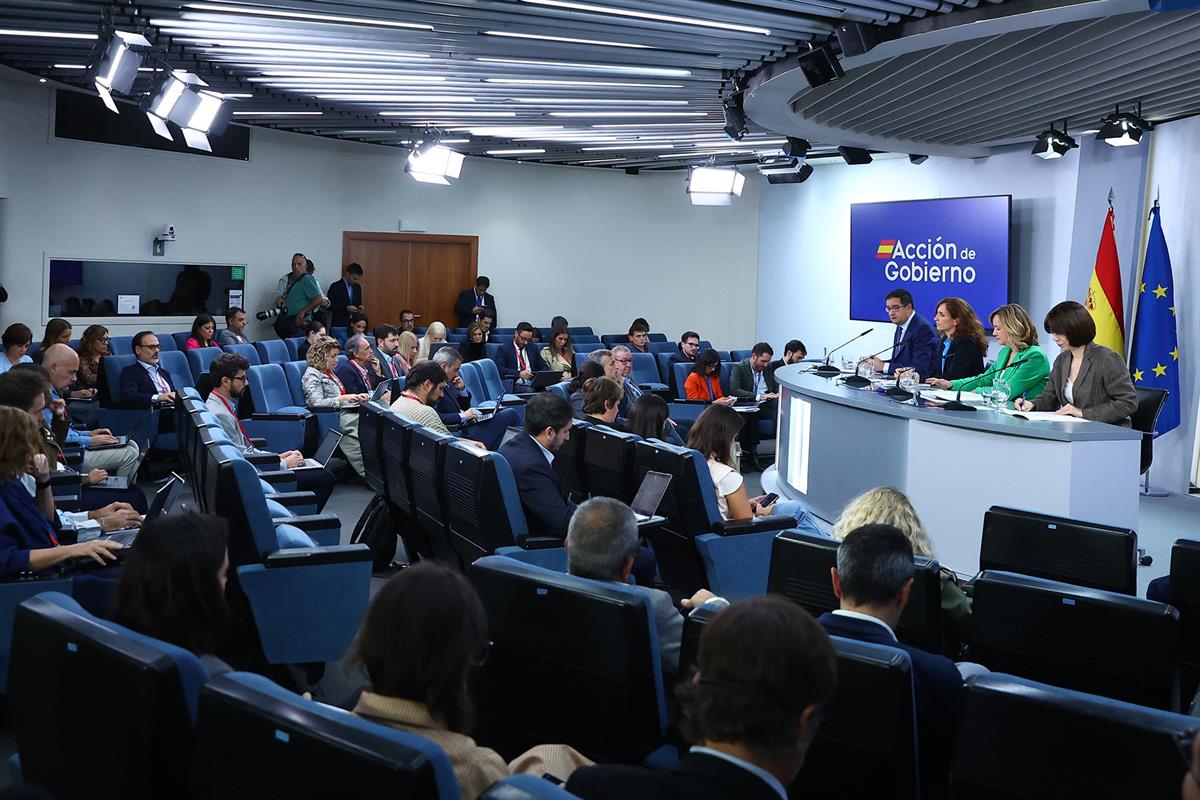 Ministers Óscar López, Pilar Alegría, Mónica García, and Diana Morant, during the press conference after the Council of Ministers






The Council of Ministers has tightened the criteria for the creation, recognition and authorisation of universities and university centres. The measure responds to the commitment expressed by the President of the Government of Spain, Pedro Sánchez, on 31 March during a visit to the National University of Distance Education (UNED).
The Minister for Science, Innovation and Universities, Diana Morant, stressed that the reform reinforces the quality requirements that universities operating in Spain must meet and improves the mechanisms for transparency, accountability, oversight and control of compliance with quality requirements.
Morant explained that the reform focuses on protecting students from the risk posed by the proliferation of poor quality universities. It also aims to assure society that those who go on to obtain university degrees have received the necessary training to be able to carry out the functions of their professions.
The minister went on to say that this regulation establishes the quality criteria that "determine whether an institution can be called a university or not, or whether it is something else". According to the minister, the three missions that universities must fulfil are training, research and the transfer of knowledge to society.
New lines of action for universities
The rule approved today requires universities to invest at least 5% of their budget in research and to raise external resources equivalent to 2%. It also requires that at least 50% of the contracted teaching staff must hold a doctorate and at least 60% of them must have accredited research experience. In addition, it requires a university's management team to have proven experience in university management.
Diana Morant anticipated that, in order to guarantee the comprehensive and multidisciplinary nature of universities, they will have to offer a minimum number of degrees (10 bachelor's degrees, 6 master's degrees and 3 doctorates) in at least three branches of knowledge, and have a minimum of 4,500 students.
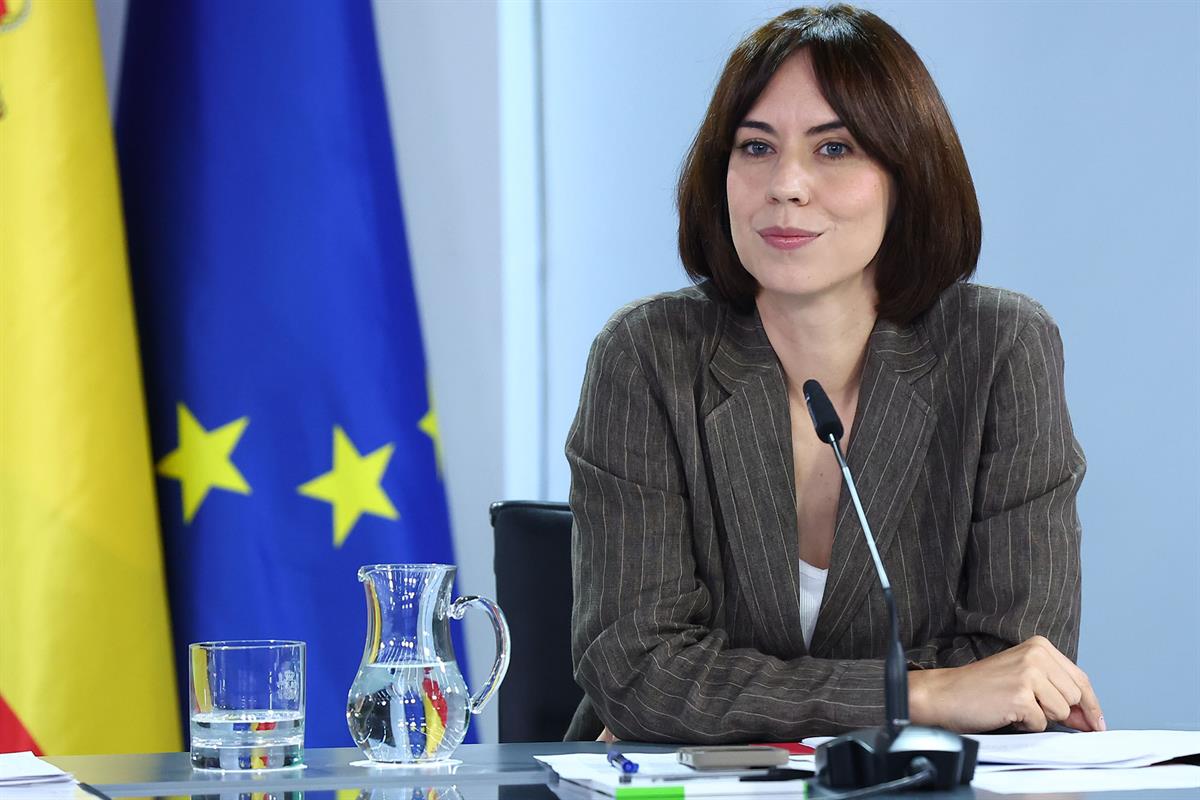 The Minister for Science, Innovation and Universities, Diana Moran, during her speech at the press conference after the Council of Ministers | Pool Moncloa/Fernando Calvo
Another requirement is that newly established universities must prove their financial solvency by means of a guarantee. "We do not want any student in our country to be left stranded because of the lack of economic viability of the promoting companies," said the minister.
The regulation also establishes the obligation for each university that is created to have accommodation places equivalent to 10% of its student body. It also establishes a transparent system of accountability. Thus, universities will have to provide annually to the Integrated University Education System detailed information on their degree of compliance.
Morant added that newly established universities will need a mandatory and binding report from the National Agency for Quality Assessment and Accreditation (ANECA) or the regional quality agencies. All these requirements will also apply to newly established online universities, which will become state universities because their impact, according to the minister, is nationwide. This requirement will not apply to online universities that have already been established, nor to those located in autonomous communities from which they receive at least 20% of their funding, nor to those in which at least 50% of the teaching is in a co-official language.
The minister assured that these agreements will be applied to all universities, both public and private, which "will have sufficiently long adaptation periods to be able to guarantee this quality in the coming years".
129% more students at private universities in the last decade
During her appearance, the minister also outlined the main conclusions of the report "Key data on the Spanish university system", which states that in the 2025-2026 academic year, Spain has reached an all-time record of nearly 1.9 million students.
The minister pointed out that this is good news, but that the increase is being absorbed almost exclusively by private universities. In the last decade, the number of students in public universities has grown by 2%, while in private universities it has grown by 129%. "As a result, 30% of students study in private universities. Ten years ago it was only 15% and twenty years ago it was 10%", the minister specified.
Diana Morant indicated that the students' first choice is still the public university, but this "does not have enough places to offer due to underfunding by regional governments". For this reason, she urged the autonomous communities to adequately fund their public universities. She also recalled that since Pedro Sánchez has been President of the Government of Spain, the communities are receiving 50% more funding from the Government of Spain.
Funding of public places in medicine
In the field of education, the Council of Ministers has also agreed to allocate 26.7 million euros to public universities to finance 1,783 places for undergraduate medical degree courses in the 2025-2026 academic year.
The Minister for Health, Mónica García, reported that the aim of the measure is to have more medical students in order to guarantee generational replacement and avoid a shortage of professionals in the future. "With this economic boost, we are giving oxygen to the public universities so that they can continue to expand the number of places without losing quality, because we know that today's training is the excellence of our National Health System".
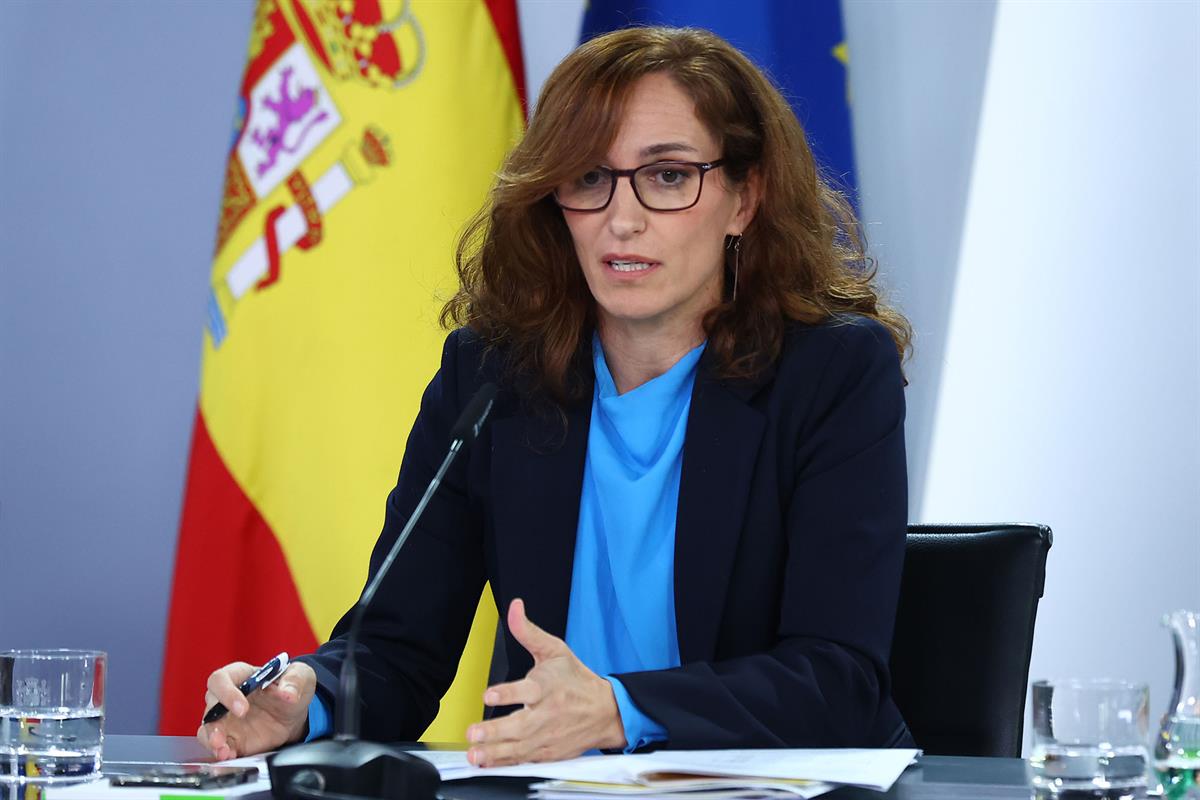 The Minister for Health, Mónica García, during her speech at the press conference after the Council of Ministers | Pool Moncloa/Fernando Calvo
The Government has asked the autonomous communities to make an effort to finance new places in both medicine and nursing and to guarantee the quality of public universities, according to the minister.
Abortion in the public health system
Mónica García also presented to the Council of Ministers the 2015-2024 report on the voluntary termination of pregnancy (VTP), which evaluates the evolution and current situation of this health service in the public health system.
The Minister for Health stressed that the report concludes that "integrating abortion into public health care is not only possible, but that it also works", that there is territorial inequality in access to the public network and that best practices have been identified.
During her appearance at the conference following the Council of Ministers, the minister explained that one of the government's challenges is to standardise access throughout the country. In this regard, she urged the autonomous communities lagging furthest behind to comply with the law and integrate abortion into the public health system.
The report reflects that it is key for abortion to be carried out in public health care in order to prevent communities from paying private clinics to perform abortions, and so that women are not pushed out of the public system and their right to choose is guaranteed. "Women have the right to decide whether we want the procedure to be carried out in a public or accredited private centre, and this decision cannot depend on the territory where we live or where we have our residence", the minister remarked.
Mónica García added that public health care can guarantee continuity of care and break the paradox that three out of four women seek information in public centres and four out of five end up having abortions in the private sector.
The document shows that 21.2% of voluntary terminations of pregnancy were performed in public facilities in 2024, compared to 78.8% in private facilities. And that in four autonomous communities (Cantabria, Galicia, La Rioja and Navarra) over 75% of abortions are carried out in public centres, while in 11 communities and in the autonomous cities of Ceuta and Melilla the figure is less than 10%.
The minister pointed out that in the Madrid region only 0.47% of abortions are carried out in public centres and in Andalusia only 0.2%. If these two communities, she pointed out, were to reach an average level of public provision like the rest - around 50% on average - the national percentage would double to over 40%: "With the change in these two communities, the country as a whole would make a historic leap in the integration of abortion into public health care".
The report shows that the majority of voluntary terminations of pregnancy - 77 per cent - are performed before eight weeks. Abortions performed at more advanced stages are concentrated to a greater extent in public centres, "which guarantees continuity of care in these clinical cases, which are the most serious and complex", said Mónica García.
The report also states that in communities where abortion is integrated into a public system, the pharmacological method of terminating a pregnancy predominates, while in those where the service is provided by private centres, the surgical method predominates.
On the other hand, the Minister for Health stressed that the report identifies good clinical practices, such as good management of the registers of conscientious objectors and a balanced distribution of staff so that there is no shortage of professionals in any centre. It also recommends using the pharmacological method for early abortions, guaranteeing women's freedom of choice, organising networks of centres spread throughout the country to provide closer and more continuous care, and ensuring that abortions at more advanced gestational ages are carried out in public hospitals.
Grants to purchase glasses and contact lenses
The Council of Ministers has regulated the direct granting of aid of up to 100 euros per beneficiary for the purchase of glasses, prescription lenses and contact lenses for children under 16 years of age.
This aid will partially cover the cost of essential optical products, such as basic frames with anti-reflective organic prescription lenses, contact lenses and maintenance solutions for one year. The programme has a budget of 47.77 million euros and will apply to purchases made until December 2026, in collaboration with the General Council of Optometry, which will be responsible for coordinating and verifying the documentary requirements with the participating opticians and managing reimbursements.
The Minister for Health stressed that this is a universal measure and a tool for justice and equity. She also pointed out that refractive problems affecting children, such as myopia or astigmatism, affect up to a third of the school population and can have an impact on learning, well-being and development.
Medical use of cannabis
The government has regulated the medicinal use of cannabis in standardised preparations as a therapeutic alternative in cases where conventional treatments are not effective.
Mónica García recalled that the regulation was demanded by the Lower House of Parliament, by medical professionals and by patients. The regulation will ensure that patients with chronic, refractory pain, severe epilepsy, spasticity due to multiple sclerosis or suffering from nausea and vomiting after chemotherapy will have access to standardised cannabis preparations with the precise dosage and maximum guarantee.
The minister said that the preparations will be prescribed by medical specialists and will be dispensed in the hospital setting with individualised clinical follow-up. The Spanish Agency of Medicines and Medical Devices will be in charge of registering and supervising these preparations.
Future law on Open Government
The Council of Ministers has presented the Draft Bill on Open Government, which responds to the Government's commitment to democracy and transparency. The regulation is part of the Action Plan for Democracy and the State Plan to Combat Corruption.
The Minister for Digital Transformation and Public Function, Óscar López, pointed out that "Spain is one of the most advanced democracies in the world", but the Government's commitment is to "more democracy, more transparency and more exemplariness". He also recalled that yesterday the fifth Open Government Plan was approved and that every six months the report 'Cumpliendo' shows how the Executive fulfils its investiture commitments.
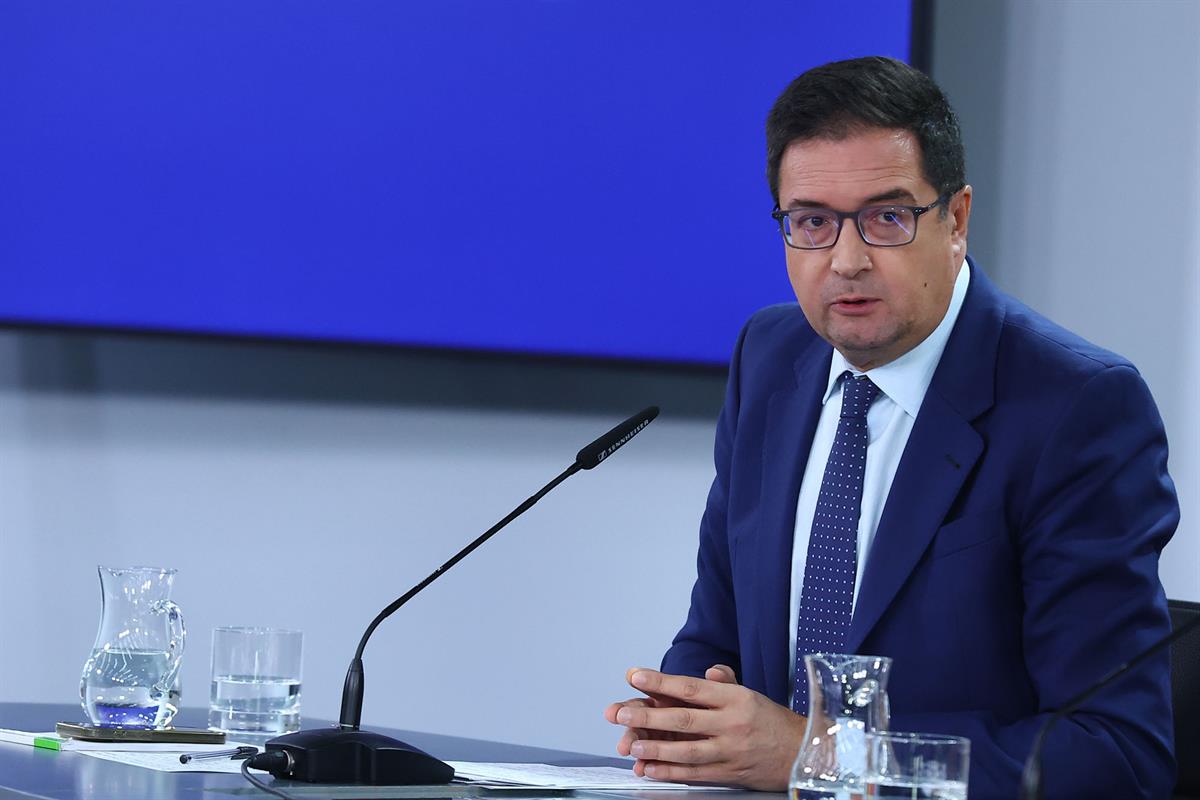 The Minister for Digital Transformation and Public Function, Óscar López, during the press conference after the Council of Ministers | Pool Moncloa/Fernando Calvo
Accountability, transparency, citizen participation
Óscar López announced that the future law includes the obligation to publish the institutional and official travel agendas of government officials up to the level of deputy director general. It shall also provide information on the number and remuneration conditions of temporary staff and the salaries of the heads of cabinets and senior management. To this end, the Transparency Portal will be reformed.
The minister also announced that a conflict detection and prevention regime will be implemented, which will also apply to temporary staff, including the submission of a declaration of assets and activities.
The future regulation also establishes the possibility that companies bidding for public contracts may be obliged to sign an integrity pact that can be monitored throughout the procurement process. Another new element is the possibility of establishing citizen audits of different government procurement processes. López also indicated that the regulation establishes a system of infringements and sanctions for high-ranking staff who fail to comply with transparency obligations.
Equality Plan of the General State Administration
The Government has approved the IV Plan for Gender Equality in the General State Administration and in the public bodies linked to or dependent on it.
Óscar López stated that "this plan is the result of social dialogue and agreement with the main trade unions and the most representative groups in the public administration, and contains measures that are included in the new Pact against Gender Violence".
The plan establishes actions that aim to transform organisations, raise awareness, train, improve working conditions, co-responsibility and work-life balance, and prevent violence against women.
Óscar López outlined some of the most relevant measures to improve equality between men and women and to combat wage discrimination and gender violence in the public administration. Among them, he highlighted that a study of the gender gap will be conducted and a plan to combat it will be drawn up, the protocol for action against sexual harassment will be reinforced and jobs will be reserved for six months to a year for public servants who have been victims of gender-based violence. In addition, equality units will be strengthened.
Recognition of the UME on its 20th anniversary
The Minister for Education, Vocational Training and Sports and Government Spokesperson, Pilar Alegría, announced that the Council of Ministers has approved an institutional declaration to recognise the work of the Military Emergency Unit (UME) on the 20th anniversary of its creation.
"To speak of the UME is, above all, to speak of a source of pride for the whole of Spanish society," said Alegría, who stressed that in these 20 years of history the unit has established itself as "an essential point of reference" in emergency response, both nationally and internationally.
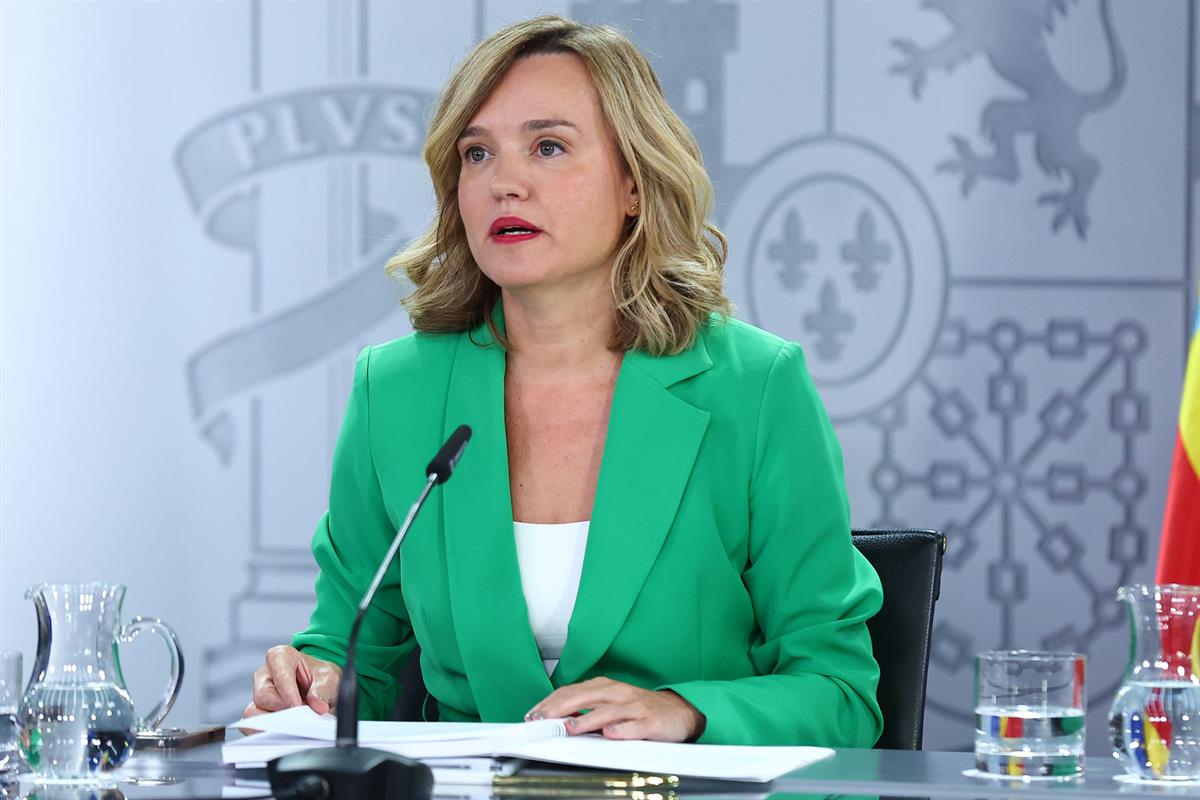 The Minister for Education, Vocational Training and Sports and Government Spokesperson, Pilar Alegría, during her speech at the press conference after the Council of Ministers | Pool Moncloa/Fernando Calvo
Since its creation in 2006, the UME has taken part in nearly 800 missions tackling fires, floods, snowfalls and the COVID-19 pandemic. More than 3,500 men and women form part of this unit, which is available 24 hours a day, 365 days a year to act in emergency situations.
Grand Cross of the Order of Charles III for Lambán and Fernández Vara
The spokesperson for the Executive also confirmed that the Council of Ministers has approved the posthumous awarding of the Grand Cross of the Order of Charles III to the former presidents of Aragón and Extremadura, Javier Lambán and Guillermo Fernández Vara.
Pilar Alegría stressed that with this distinction the Government wishes to pay tribute to the two recently deceased Socialist regional leaders, whose lives were defined, according to the spokesperson, by a "profound vocation for public service" and a legacy that "remains an example of dedication, responsibility and commitment to the welfare of all".
Non official translation