Council of Ministers
Government of Spain boosts fight against vicarious violence
Council of Ministers - 2025.9.30
Moncloa Palace, Madrid
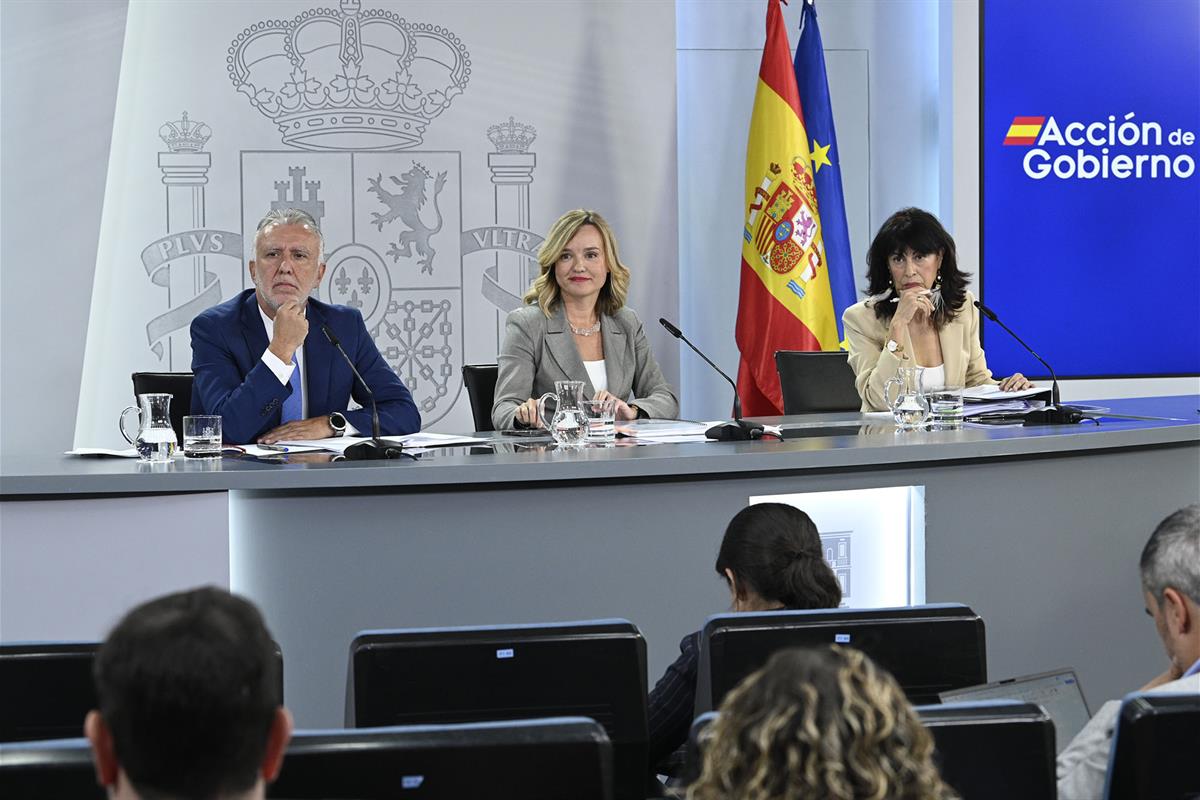 The Minister for Territorial Policy and Democratic Memory, Ángel Víctor Torres, the Minister for Education, Vocational Training and Sports, Pilar Alegría, and the Minister for Equality, Ana Redondo, at the press conference after the Council of Ministers (Pool Moncloa/José Manuel Álvarez)





The Council of Ministers has dealt with the draft bill of the organic law on measures in the area of vicarious violence.
The Minister for Equality, Ana Redondo, highlighted the timeliness of the law in a "political context of a reactionary wave", and framed it as part of the Government's commitment to continue advancing real equality and to respond to the requests of victims' associations. Redondo recalled the figures of this "harsh reality": since 2013, a total of 65 children have been killed by vicarious violence, 9 last year and 3 in 2025.
Typification of vicarious violence
According to the minister, the objectives of the future law are threefold: to comply with the renewed State Pact against Gender Violence in the area of vicarious violence; to define it and incorporate it into the legal system; and, above all, to protect victims and raise awareness in society against "such radical, savage and absolutely inconceivable violence".
Ana Redondo explained that the text amends other laws that affect vicarious violence, mainly the Comprehensive Law against Gender Violence, which recently celebrated its 20th anniversary, and also the Criminal Code, the Civil Code and the laws on civil prosecution, the judiciary and the legal protection of minors.
 The Minister for Equality, Ana Redondo, during her speech at the press conference after the Council of Ministers | Pool Moncloa/ Cesar Porras
The draft bill identifies vicarious violence as violence perpetrated against a woman by her partner or ex-partner through an interposed person with the aim of violating her moral integrity. These interposed persons may be minors, descendants, disabled adults with parental authority or custody, ascendants, siblings or the victim's current partner.
With the reform, this violence is typified by a new article in the Penal Code that establishes two types of violence, following the case-law of the Constitutional Court: a general type of vicarious violence in the context of domestic violence, with prison sentences ranging from six months and a day to three years, and an aggravated type in the context of gender violence, with sentences ranging from one and a half to three years. In addition, a ban on carrying weapons for between three and five years is incorporated as an accessory penalty.
Ancillary measures, awareness raising and specific training
The Minister for Equality highlighted another accessory penalty that has been incorporated into the Penal Code: the judge will assess the prohibition to publish content directly related to the criminal acts that may affect the moral integrity of the victim.
The reform also reinforces the obligation to listen to the child before agreeing on a guardianship and custody regime. The only exception, which will require a special reasoning by the judge, will be in cases where the hearing is impossible or clearly and directly interferes with the best interests of the child.
The draft bill also incorporates awareness-raising plans against vicarious violence, in line with those that exist with regard to gender-based violence. It also affects the training of judges and prosecutors on vicarious violence, including it in the training offered by the General Council of the Judiciary and in access to and promotion in the judicial and prosecutorial careers.
 The Minister for Equality, Ana Redondo, at the press conference after the Council of Ministers | Pool Moncloa/ Cesar Porras
In the words of Ana Redondo, the set of measures aims "to place Spain once again at the forefront of policies to defend real equality of opportunity, when gender violence continues to be one of the biggest problems facing women, Spanish society and democracy".
Searching for, locating, exhumation and identification of victims of the Spanish war and dictatorship
The Government has regulated the direct granting of €2.4 million to search for, locate, exhume and identify the remains of victims of the war in Spain and the dictatorship. The Minister for Territorial Policy and Democratic Memory, Ángel Víctor Torres, has specified that €1 million will be distributed to the Spanish Federation of Municipalities and Provinces, which will allocate it "to the analysed graves where there is presumably certainty of finding remains of people", and the rest will be distributed among different local entities.
Specifically, they will be allocated to the provincial councils of Cáceres, Badajoz, Jaén, Seville and A Coruña, to the town councils of Seville, Jaén, Huelva and Córdoba, and to the town councils of Nerva (Huelva) and Víznar (Granada).
Assessment of the four-year plans
During his appearance at the press conference following the meeting of the Executive, Ángel Víctor Torres reviewed the achievements of the two four-year plans deployed by the Government since 2019 to exhume mass graves throughout the country. According to the minister, the studies and reports issued in 2019 reflected the possibility that up to 20,000 people could be recovered from graves, pits and ditches. In 5 years, 8,941 exhumations of victims have been carried out throughout Spain; the figure is close to 50% of those planned.
The minister specified that once the DNA checks requested by the relatives of the deceased found in these graves and pits and in places such as the Cuelgamuros Valley had been carried out, 70 victims had already been handed over to their families.
 The Minister for Territorial Policy and Democratic Memory, Ángel Víctor Torres, during his speech at the press conference after the Council of Ministers | Pool Moncloa/ Cesar Porras
Ángel Víctor Torres also recalled that the Law of Democratic Memory of 2022 establishes a deadline for the children and grandchildren of Spanish exiles in America to obtain Spanish nationality. In this respect, he said that 876,321 applications had been received by the end of July, of which 24,000 have already been granted. A total of 40% of the requests come from Argentina.
The head of Democratic Memory has assured that the Government will continue with the exhumations as long as there is "a single grave where there is a victim of the repression of the dictatorship and totalitarianism in our Spain".
Appeal on the grounds of unconstitutionality against the Canary Islands Budget Law
The Council of Ministers has authorised the President of the Government, Pedro Sánchez, to appeal to the Constitutional Court against certain precepts of the General Budget Law of the Canary Islands for 2025.
Ángel Víctor Torres explained that there were discrepancies between the Spanish and Canary Islands governments on some aspects of the Canary Islands budgets, but an agreement was reached. However, there was no consensus on two issues: the remuneration of the manager of the Canary Health Service and marinas, and the opinion of the State Council was requested.
 The Minister for Territorial Policy and Democratic Memory, Ángel Víctor Torres, at the press conference following the Council of Ministers | Pool Moncloa/ Cesar Porras
As for the Canary Islands Health Service, Torres reported that the Canary Islands law establishes that those who are appointed as managers or managing directors will not receive lower salaries than those of the post they held previously, whether in the public or private sector, which is in breach of state competence.
Regarding the concessions for marinas, the minister pointed out that the Canarian law establishes that the investment will be "no less than 20%", while the state regulation establishes that it must be over 50%. Similarly, the state regulation requires investments to be made within six months, while the Canarian budget law stipulates a period of 4 to 6 years.
The minister reiterated that in the absence of agreement on these points, it will be the Constitutional Court that will end up deciding.
Spanish Office for the Reconstruction of Ukraine
The Minister for Education, Vocational Training and Sports and Government Spokesperson, Pilar Alegria, has announced the creation by the Council of Ministers of the Office for the Reconstruction of Ukraine, a body that will report to the Ministry of Economy.
 The Minister for Education, Vocational Training and Sports and Government Spokesperson, Pilar Alegría, during her speech at the press conference after the Council of Ministers | Pool Moncloa/José Manuel Álvarez
The government spokesperson explained that the new office will act as a one-stop shop for Spanish companies interested in developing projects in Ukraine, facilitating access to the procedures and instruments available for reconstruction and providing advice and support.
The creation of this entity, which will have a budget of €1.3 million, fulfils one of the commitments announced by the President of the Government, Pedro Sánchez, to the President of Ukraine, Volodímir Zelenski, last July, within the framework of the actions announced by Spain to support the Ukrainians.
Non official translation