Council of Ministers
Government of Spain agrees to rebury Francisco Franco's remains in El Pardo on 10 June
Council of Ministers - 2019.3.15





Moncloa Palace, Madrid
The Vice-President of the Government and Minister for the Presidency, Parliamentary Relations and Equality, Carmen Calvo, announced that the reburial of the remains of dictator Francisco Franco will take place in the morning of 10 June at the Mingorrubio-El Pardo Pantheon, which is owned by the State, meets the necessary security requirements and is suitable for receiving mortal remains with decorum and respect. Furthermore, she recalled that the remains of the dictator's wife are buried there.
Carmen Calvo explained that the Government of Spain decided on this date so that it would not interfere with the electoral processes on 28 April and 26 May, and because it has concluded the procedure that was launched with Royal Decree-Law 10/2018 and the agreement by the Council of Ministers of 31 August 2018. Furthermore, she stressed that the decision is "legal and must be implemented".
The Council of Ministers agreed on 15 February to give the family a period of 15 days to decide on a future resting place for the remains of Franco, albeit stating that they could not be buried at the Catedral de la Almudena for public order reasons and because it would go against the Historical Memory Act.
The Vice-President of the Government said that, considering that the family has not proposed a viable alternative, the Government of Spain has decided on the date and location, as per the agreement in February.
Carmen Calvo announced that the rights of the dictator's relatives to be present will be respected during the exhumation, relocation and reburial process of the remains and, if they so wish, they will be able to organise a brief and private reburial ceremony. Furthermore, she stressed that all the necessary measures will be adopted to avoid the use of image and sound recording and reproduction devices, and no members of the public will be allowed to attend.
Investments for developing the rural environment
150 million euros for reducing the digital gap
The Council of Ministers authorised the disbursement of subsidies totalling 150 million euros for ultra-fast broadband network expansion projects with speeds in excess of 100 MB.
The forecast is that 93.5% of the population should be able to benefit from this broadband by June 2021 and that the so-called white areas will be covered. These are areas where there is no coverage at the moment and no coverage is planned for the next three years.
Carmen Calvo underlined the importance of this measure for "continuing to close the digital gap between the rural and urban environments", which she described as a main objective for the Government of Spain.
Support for rural women's organisations
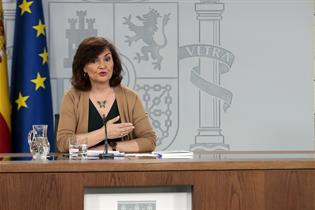 Pool Moncloa/J.M. CuadradoIn order to promote their role in rural development, the Government of Spain has drawn up the regulatory bases for the disbursement of subsidies to rural women's organisations.
This measure seeks to strengthen participation and entrepreneurship by women in the rural environment, communicate the opportunities offered by the instruments contained in the Common Agricultural Policy and curb depopulation. It also aims to publicise the Shared Ownership of Agricultural Enterprises Act and foster access by women to the governing bodies of entities related to agricultural activity.
This law includes a new possibility to announce multi-annual subsidies, as well as a series of improvements for effectively responding to the needs of rural women.
50 million euros for the digital transformation in the manufacturing industry
The Government of Spain approved the announcement of reimbursable loans for implementing digital solutions at manufacturing companies under the programme of financial support for R&D+i projects in the field of Connected Industry 4.0 in 2019.
The Vice-President of the Government explained that 50 million euros will be allocated to this action, an amount that will be added to other funds that were released last summer. Hence, the Government of Spain will allocate a total of 80 million euros to industrial research, experimental development and innovation in organisation and processes. "It is important to further develop the reindustrialisation of our country and this means being close to all the improvements of modernisation", said Carmen Calvo.
Appeal against the Board of Inquiry into the Monarchy
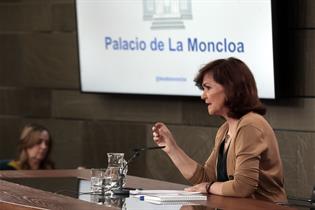 Pool Moncloa/ J.M. CuadradoThe Council of Ministers agreed to lodge an appeal before the Constitutional Court against the Resolution by the Regional Government of Catalonia to create the Board of Inquiry into the Monarchy. The entirety of the Resolution is contested because both its purpose and its basic content are unconstitutional.
"This government cannot accept that, with no power to do so whatsoever, attempts are made to investigate the figure of Head of State", said Carmen Calvo.
The Vice-President of the Government also said that an appeal against the unconstitutional nature of the Provincial Council law of Navarre contravening State legislation governing the dispensation of plastic bags at points of sale and the dates established for banning such activity has been lodged.
Taxation and financial agreement for Gibraltar
Spain and the United Kingdom have reached an International Agreement on Taxation and Protection of Financial Interests regarding Gibraltar, which was approved by the Council of Ministers.
Carmen Calvo underlined its importance for "eliminating tax fraud and settling tax residency conflicts", as well as for preventing the use of companies subject to the tax regime of Gibraltar by tax residents of Spain or for engaging in economic activities in Spain.
The approved text also establishes a regime of cooperation between the competent departments of the respective tax authorities, as well as the exchange of information on certain income categories and assets of particular significance for the fight against fraud in the region.
Standing Committee against Disinformation
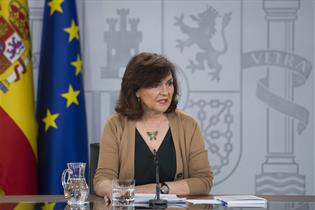 Pool Moncloa/ J.M. CuadradoThe Council of Ministers examined a report on disinformation and the global threat it poses to freedom and democracy.
Carmen Calvo said that a response to the "fake news" phenomenon is essential because it hinders people's constitutional right to obtain truthful information, "which is the fundamental basis for how citizens take part in democratic societies".
To that end, she explained that Spain is coordinating with the other European countries on the European Commission Action Plan against Disinformation, which has set up a system of early warnings so that the public can receive an almost instantaneous denial whenever such information is detected.
In Spain, the government has set up an inter-ministerial working group - the Standing Committee against Disinformation - to liaise with Europe and place special emphasis on Spain's reputation with regard to the territorial crisis in Catalonia and the upcoming elections.
Institutional declaration against racial discrimination
The Council of Ministers approved an institutional declaration in support of the International Day for the Elimination of Racial Discrimination due to be held on 21 March.
Carmen Calvo announced that "it is a firm statement against this kind of ancestral discrimination that sadly is still with us in today's world".
Condolences from the Government of Spain on the attack in New Zealand
The Vice-President of the Government began her press briefing following the Council of Ministers by expressing her condemnation of the attack on two mosques in the city of Christchurch, New Zealand, killing dozens of people. She conveyed the Government of Spain's solidarity with the families and friends of the victims and the authorities of New Zealand.
"We understand these situations very well", she said, after saying that last Monday was the 15th anniversary of the terrorist attack on 11 March 2004 in Madrid, which led to the deaths of almost 200 people.
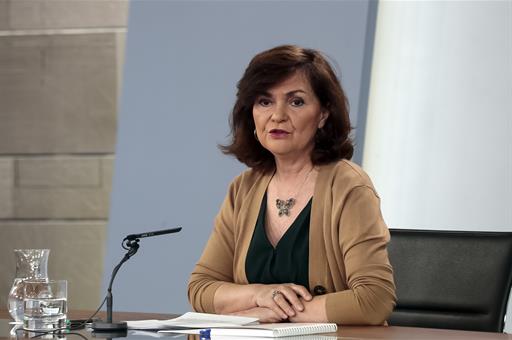
Pool Moncloa/ J.M. Cuadrado