Council of Ministers
Government approves renewal of Board of Directors of RTVE Corporation
Council of Ministers - 2018.6.22





Moncloa Palace, Madrid
The Council of Ministers approved a Royal Decree-Law, with immediate effect, for the transitory regulation of RTVE. The Minister for Education and Vocational Training, and Government Spokesperson, Isabel Celaá, stated that the regulation, approved on the day that the mandate of the current Chairman of RTVE, José Antonio Sánchez, expires, means that all the directors will be removed immediately.
Isabel Celaá explained that Parliament must elect the 10 members of the Board of Directors within 15 calendar days: six by the Lower House and four by the Upper House. They must be elected by a two-thirds majority of the House; if this is not possible, a simple majority of Members of the respective House is sufficient in a second round of voting. During the following fortnight, the Lower House will elect the Chair of RTVE from among them.
The Government Spokesperson highlighted that this decree strengthens and maintains the mandates under Act 5/2017, also called on "to recover the independence of the body and pluralism in the parliamentary election of its directors". This rule establishes that a committee of experts is required to implement the competitive selection of the Board and subsequently elect the chair.
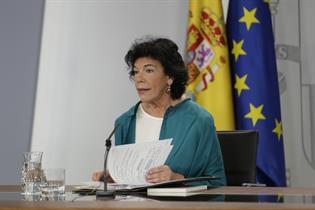 Pool Moncloa/César P. Sendra This process, stated Isabel Celaá, thus involves a long period for its completion and "Spain, its RTVE, its public media has a problem of certain urgency" since the mandates of all of the directors and the chair have expired. She also added that there are "a great many complaints lodged and general discontent among workers and professionals".
Independence and pluralism
The decree acts "to fill a power vacuum" while remaining "wholly respectful of all legal provisions". In fact, underlined the Government Spokesperson, the effects of the decree will cease as soon as the process undertaken by the committee of experts and the competitive selection bears fruit.
"Spain deserves to have a public media trusted by its citizens, which does not serve any particular ideology, however legitimate this may be, and which serves the general interest", argued Isabel Celaá. In short, she declared, the question is for RTVE "to strictly comply with the body's fundamental principles: independence, plurality, neutrality, impartiality and the truth".
Isabel Celaá stressed that the government has sufficient parliamentary support to validate the decree-law.
European agenda and meetings with regional presidents
The Council of Ministers also reviewed the government's European agenda, explained the Government Spokesperson. The President of the Government, Pedro Sánchez, will meet on Saturday, 23 June, with the French President, Emmanuel Macron, and will travel to Brussels to attend a preliminary summit on Sunday prior to the upcoming European Council on migration and asylum.
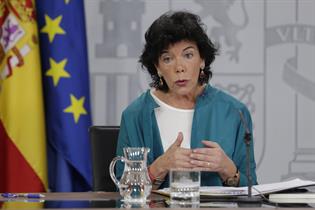 Pool Moncloa/César P. SendraThe minister added that Pedro Sánchez will hold a working lunch on Tuesday, 26 June, with the German Chancellor, Angela Merkel, and take part in the European Council on 28 and 29 June, which will focus on migration policies. Subsequently, on 2 July, he will travel to Lisbon to meet with the Portuguese Prime Minister, António Costa.
At a domestic level, the President of the Government will begin a round of bilateral meetings on Monday with all of the regional presidents, which will take place in order of the age of their respective statutes. Accordingly, the first meeting will be held with the President of the Regional Government of the Basque Country, Íñigo Urkullu, and the second, on 9 July, with the President of the Regional Government of Catalonia, Joaquim Torra. On 17 July, Pedro Sánchez will meet with the President of the Regional Government of Galicia, Alberto Núñez Feijóo, and on 23 July with the President of the Regional Government of Andalusia, Susana Díaz.
'La Manada' ruling
Isabel Celaá declared that the government respects the decision handed down by the High Court of Navarre to allow the five members of 'La Manada' out on probation, but considers that "the proven facts and convictions are extremely serious".
In this regard, she argued that the government was surprised by the order granting probation because the convicts had not even served out half of their sentence and, furthermore, there is social alarm, particularly from women.
Accordingly, the Government Spokesperson announced that the government will study whether the State legal services should intervene as a party in the defence of the victims, although there are already other parties in her defence. "We want to protect the women and young people of this country", she underlined.
This measure is in addition to the draft Constitutional Law proposed by the Socialist Group on "urgent measures in application on the State Pact to Combat Gender-based Violence" which is in its passage through the Lower House. It will also propose to analyse the classification of the offences related to sexual violence and sexual integrity contained in the Criminal Code.
Immigration
Pool Moncloa/César P. Sendra In relation to immigration, Isabel Celaá pointed out that the government's action in the case of 'Aquarius' was "a true wake-up call, an electric shock to the obligations that Europe must address".
As regards potentially assisting a new vessel that Italy refuses to take in, she announced that the Minister for Foreign Affairs, the European Union and Cooperation, Josep Borrell, has spoken with the Italian and Maltese authorities - to provide, should this prove necessary, humanitarian aid to the vessel's crew in the coming hours - and with the French authorities, a country that has shown "great empathy and solidarity with Spain", in the case of 'Aquarius'.
The President of the Government, remarked Isabel Celaá, is working on a preferred project from Spain, France and Germany to resolve this issue.
Regional financing
When asked about improvements to the regional financing system announced by the President of the Government last Tuesday in the Upper House and on Wednesday in the Lower House, Isabel Celaá recalled that, following the meetings that Pedro Sánchez will hold with the regional presidents, certain aspects of financing that are particularly serious will be improved.
Meanwhile, after analysing the current system, it is the government's intention to lay the foundations for the creation of a new system that "satisfies all the elements this financing may require" in the following legislature, she added.
According to the Government Spokesperson, Pedro Sánchez has been "very open and honest" in telling society what is feasible before elections and what will need to be put off until the next legislature.
Normalisation of relations with Catalonia
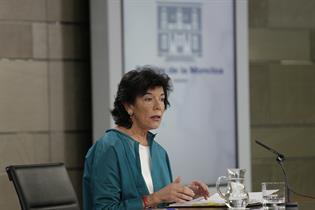 Pool Moncloa/César P. SendraAs regards the inauguration of the Mediterranean Games to be held on Friday in Tarragona, a ceremony that will be attended by the King, the President of the Government and the President of the Regional Government of Catalonia, Isabel Celaá said that "the Government of Spain has never made politics out of an event like this, and will not do so now".
Regarding the position maintained by the Regional Government of Catalonia over the presence of the King, the Government Spokesperson pointed out that should it not wish to invite him to future events, that will not be a problem for the King, but for the Regional Government of Catalonia, because it would mean that "it does not represent all" of the people of Catalonia.
Isabel Celaá reiterated that the government wishes to normalise relations with this region and avoid raising tensions. "The diagnosis was made and legal action was brought; it is now time to start the healing process. That is why we will maintain this position of détente which we feel is so important for opening up a dialogue process with the Constitution in one hand and dialogue in the other".
Non official translation
Pool Moncloa/César P. Sendra