Council of Ministers
The Government approves Stability Programme and National Programme of Reforms
Council of Ministers - 2012.4.27





Moncloa Palace, Madrid
The Council of Ministers approved, for submission to the European Union and to the European Commission, the National Programme of Reforms for Spain 2012 and the Stability Programme for Spain 2012-2015.
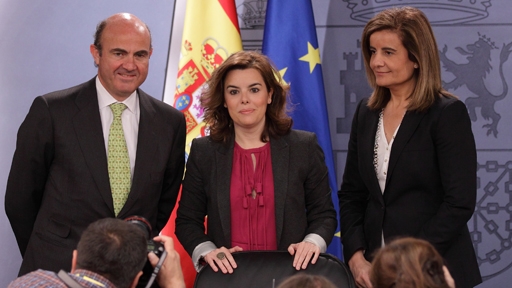
The Vice-President of the Government, Soraya Sáenz de Santamaría, underlined that the Stability Programme "maps out the path to definitively establish budgetary stability along with the adjustments to the public accounts in our country".
The update to the Stability Programme presents the macro-economic table with the data forecast by the Government for the period 2012-2015, according to the Minister for Economic Affairs and Competition, Luis de Guindos.
This table sets out the figures for reaching a public deficit in 2012 of 5.3% of GDP, maintaining the objective of 3% of GDP set for 2013 and reaching a deficit in 2015 of 1.1%; attaining a primary surplus as from 2013 and initiating a path towards reducing the percentage of public debt/GDP as of 2014. The minister forecast that budgetary stability could be reached by the year 2016.
The programme sets out the measures to be adopted at all administrative levels to meet these objectives as well as the time-line and the anticipated results.
Luis de Guindos also estimates that as of the year 2014 the process to redirect the weight of public debt in the Spanish economy will start to take effect. He also indicated that in the years 2012 and 2013 there will be slight positive growth in GDP. Job losses "will be very moderate next year, around 0.4%" or will even stabilise, in the opinion of the minister.
The Minister for Economic Affairs and Competition added that Spain's accounts with the European Union clearly show that our country "is gaining in competitiveness". The Spanish economy is competitive and has the capacity for growth in the future, and therein lies the main reason for optimism", he said.
Luis de Guindos recounted the measures adopted by the Government to reach budgetary consolidation. Among them he mentioned the Constitutional Law of Budgetary Stability, the draft bill of the Transparency Act, the setting up of an ICO (Official Credit Institute) Maturity Line and the fund to finance and pay suppliers, as well as other Central Government initiatives to make public expenditure sustainable.
He also announced that in 2013 an increase in Personal Income Tax (Spanish acronym: IRPF) of 1 billion euros is forecast. "We are planning to reduce the tax and charges on work while increasing the tax on consumption with a net gain in revenue of around 8 billion euros", he said.
The effort at fiscal consolidation in 2012 will slightly exceed 30 billion euros and move towards 20 billion euros in 2013, according to the figures expressed by the minister.
National Programme of Reforms 2012-2015
The National Programme of Reforms for Spain 2012 includes the following objectives: fiscal consolidation, driving growth and competitiveness, the fight against unemployment, reactivating credit, the improvement and efficiency in the provision of essential public services, and the modernisation and streamlining of public authorities to avoid duplication, according to Luis de Guindos.
The Vice-President of the Government, Soraya Sáenz de Santamaría, made it clear that the Government is also planning to deregulate certain services in order to allow the entry of private capital, as well as to reform the real estate sector and the rental market.
In this respect, the Minister for Economic Affairs and Competition announced that the Government will present a privatisation plan in the coming weeks that aims to streamline and simplify the various administrative bodies.
Luis de Guindos underlined that the raft of measures agreed for the years 2012-2020 will result in an 8.6 point increase in the Spanish economy, or close to 100 billion euros of national revenue, which represents potential growth of one point per year. It may also lead to the creation of two million jobs in eight years.
Plan to combat employment fraud
The Minister for Employment and Social Security, Fátima Báñez, explained that the main objective of the Plan to combat undeclared work and Social Security fraud, approved by the Council of Ministers, is "to avoid behaviour that impinges on the rights of workers and negatively affects unfair competition between companies that meet their obligations and companies that do not".
Fátima Báñez, in her appearance in the press briefing following the Council of Ministers, recapped the different aspects contained in the plan such as actions to foster institutional collaboration and regulatory modifications to be undertaken.
The minister also announced the approval of certain complementary measures in matters of employment and social security that aim to protect older workers from dismissal and promote the extension of working life to ensure the sustainability of the system. Along these lines, she indicated that companies with more than 100 workers (previously it was more than 500), which declare a profit, must make contributions to the system if they include workers over the age of 50 in mass layoffs. It is also forbidden to include forced retirement in collective bargaining agreements, she added.
Objectives of the Plan
Fátima Báñez stated that the objectives of the Plan include exposing the black economy, correcting the fraudulent receipt of social security benefits - particularly in cases of fictitious companies - and combating the undue receipt of discounts and reductions in employers' contributions.
To that end, the Government will carry out a series of actions including the more efficient organisation of employment and social security inspections, the incorporation of 53 new inspectors and 60 deputy inspectors, the oversight, control and monitoring of situations of fraud uncovered, as well as enhancing institutional collaboration.
Moreover, in order to enhance compliance with the Plan, the Government will have to make certain necessary regulatory changes, including amendments to the Criminal Code, the Law Regulating Employment and Social Security Inspections, the Law on Breaches and Penalties in the Social Order and the Workers' Statute.
Other agreements
The Council of Ministers agreed to establish obligatory arbitration to resolve the conflict between Iberia and the pilots' trade union Sepla. The measure, according to the Vice-President of the Government, seeks to bring an end to a conflict that is causing significant loss of revenue and prejudicing our citizens.
The parties must appoint an arbitrator and, in the event that no agreement is reached, one will be appointed by the Ministry of Public Works. The decision arrived at shall be obligatory for all parties.
Current affairs
When asked about the suspension of provincial councils and the merger of small municipalities, the Vice-President of the Government commented that Spain has significantly more local councils than other European countries, and hence we need to introduce streamlining and efficiency measures and reduce public expenditure. These measures, she said, will be announced by the Ministry of the Treasury in the coming weeks.
As regards the plan to reintegrate ETA prisoners, Soraya Sáenz de Santamaría said that "this Government does not negotiate nor will it negotiate with the terrorist organisation ETA. Prisoners cannot expect anything and their situation will not in any way depend on the situation of the terrorist organisation". She added that individualised treatment will be afforded to those terrorists who clearly decide to leave the terrorist organisation, but "there will be no negotiations, they shouldn't expect anything of that nature".
As regards the economic situation and employment trends, the Vice-President of the Government said that this Government has three very important features: political stability, with an ample majority to support that, time to make reforms and a decisive will to carry them through.
Pool Moncloa