Council of Ministers
The Government of Spain plans a record investment of nearly €13 billion in Spanish airports
Council of Ministers - 2026.9.15
Moncloa Palace, Madrid
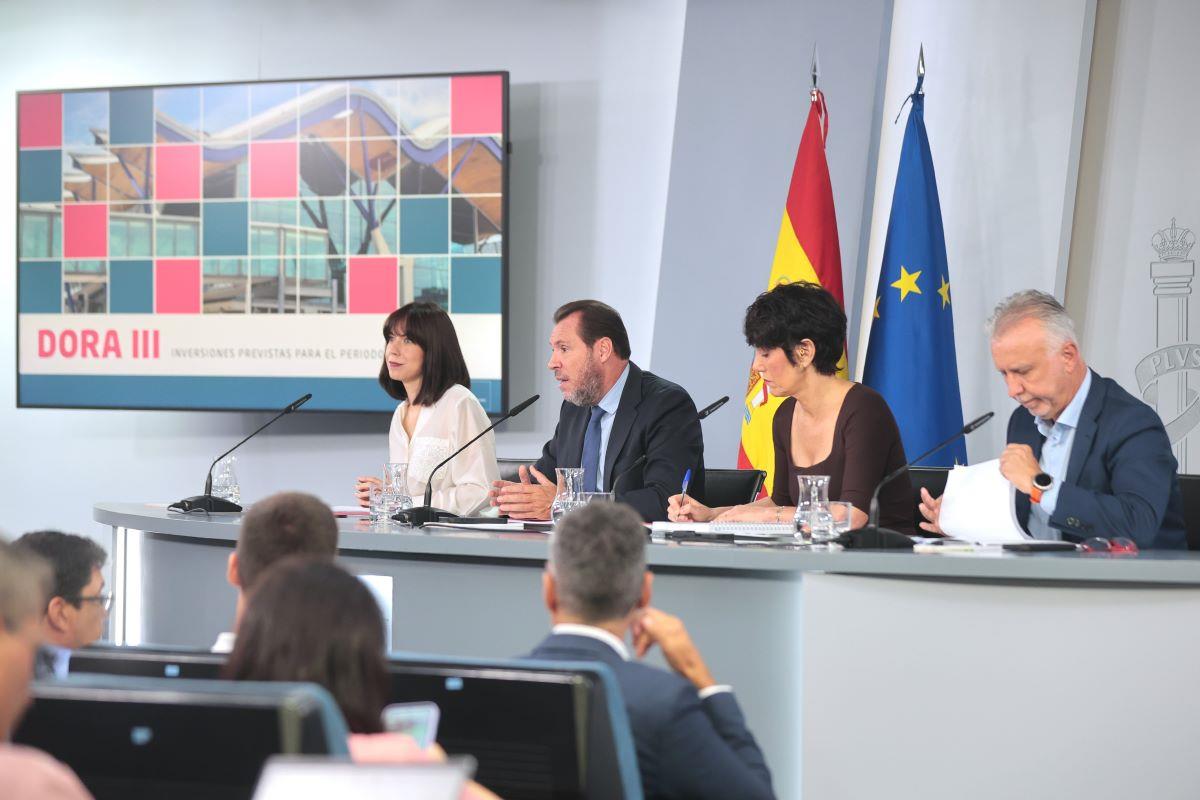 Ministers Diana Morant, Óscar Puente, Elma Saiz and Ángel Víctor Torres announce the measures adopted in the Council of Ministers (Pool Moncloa/Sandra Armada)






The Council of Ministers has approved the Airport Regulation Document (DORA) for the period 2027-2031. This document establishes the regulatory tariff framework and projects an investment of nearly €13 billion in the airport network managed by Aena - a state-owned company under the Ministry of Transport and Sustainable Mobility.
The airport sector accounts for almost 6% of gross domestic product (GDP), generates some 600,000 direct and indirect jobs, and is the point of entry for 80% of tourists, according to the head of the ministry, Óscar Puente. Furthermore, Spain is the only country in the European Union that has not only recovered pre-pandemic passenger traffic levels but has seen them increase by around 20%. With the new DORA, "Spain will continue to be a global leader in the airport sector", according to Puente.
Airport self-financing and fee containment
The minister emphasised that Spanish airports are funded through their own resources: "Not a single cent of the money to be invested and spent on Spanish airports - on their upkeep, maintenance and improvement - comes from the General State Budget or from any tax". He explained that these funds come from public charges - that is, the airport charges paid by passengers - and other revenue streams generated by Aena. Specifically, €9.9 billion of the investment will come from airport charges, while the remainder will be generated through the airports' commercial activities, such as space rentals and retail outlets.
With regard to tariffs, the document sets out an average annual increase of 0.33% over the next five years. "Our rates will continue to be among the most competitive, if not the most competitive, in Europe, as the increase is clearly very modest", said Óscar Puente. In determining this increase, account has been taken of the passenger forecast - an average annual increase of 1.8% - the level of investment required to bring the airports into line with demand, the spending required to provide the services, and the financing costs needed to ensure sufficient liquidity to fund the investments. "It is a comprehensive, open process that is subject to very strict regulation", said the minister, who pointed out that a large number of organisations and public authorities had been involved in it.
Improved passenger service and progress towards sustainability
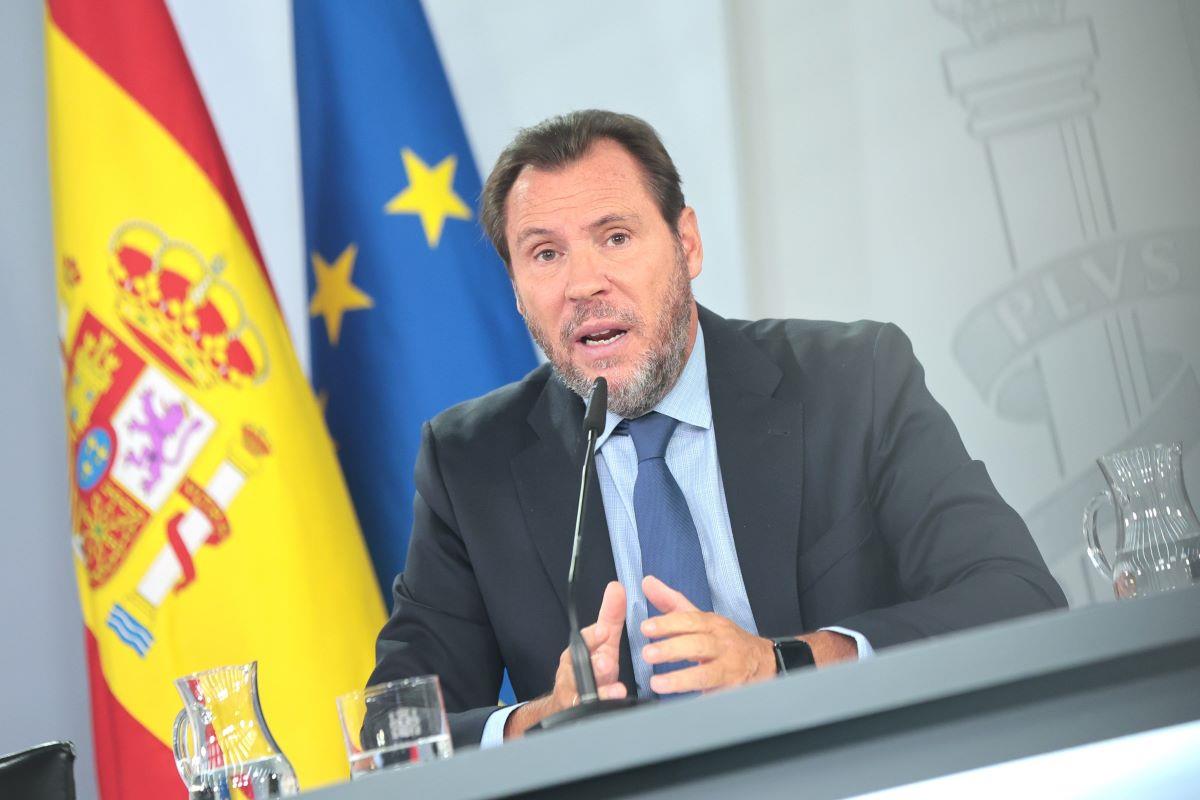 The Minister for Transport and Sustainable Mobility, Óscar Puente, during his speech | Pool Moncloa/Sandra Armada
Óscar Puente also highlighted the "major leap in investment" represented by this DORA: while the average annual investment over the last five-year period was €450 million, the figure for the upcoming period will be around €2 billion euros - derived solely from airport charges. A large proportion of the funding will be allocated to modernising infrastructure: €2.851 billion for terminal buildings and €937 million for runways.
The Minister for Transport explained that, with the exception of Josep Tarradellas Barcelona-El Prat Airport, all airports will adhere to the capacity limits set out in their already approved master plans and their environmental impact statements. Other notable items include maintenance and upkeep (€3.240 billion), enhanced security (€1.650 billion), connections with other modes of transport (€660 million) and baggage handling systems (almost €400 million).
The investment is therefore focused on improving the quality of service received by passengers: "It is not just about serving more people or accommodating more travellers, but above all about serving those people better", said Puente.
Sustainability is another key aspect: Aena has a plan to develop solar power plants and generate energy through renewable energy systems to ensure that by 2030 all airports in Spain are 'zero-emission'.
Recruitment of research staff and project funding
The Council of Ministers has approved major calls for proposals from the State Research Agency, one of Spain's science funding bodies. When combined with other calls that do not require this formal approval process due to their size, the total investment exceeds €1.2 billion. This funding targets two fundamental elements of scientific work - in the words of the Minister for Science, Innovation and Universities, Diana Morant: recruiting scientists and ensuring they have the funds to finance their projects.
Morant highlighted the increase in the budget for these calls for proposals: 13% more than last year and 74.5% more than in 2018. The minister also emphasised that the funding comes entirely from the General State Budget and not from the 'Next Generation' European funds. "Through the national budget, we are continuing to make the largest investment in science ever made in our country's history", she said. The Minister for Science argued that this increase in investment has made it possible to reach a record number of researchers - 184,000, a 31% increase since 2018 - and that this talent pool is increasingly well-qualified. Evidence of this includes Spain ranking second in the EU for the number of research projects selected in the European Commission's latest "ERC Advanced Grants" call, as well as the country being one of only eleven worldwide that manufactures rockets to launch satellites into orbit.
New features and improvements to the calls
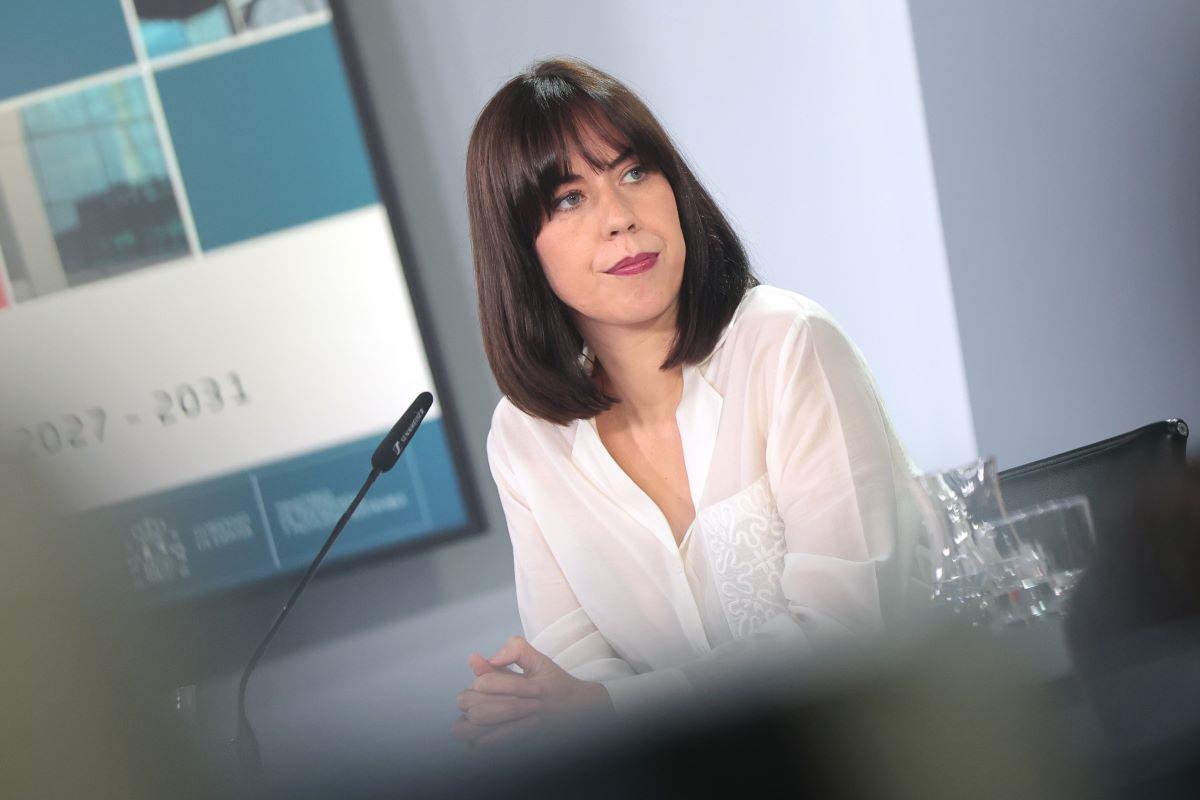 The Minister for Science, Innovation and Universities, Diana Morant, explains the measures adopted by her ministry | Pool Moncloa/Sandra Armada
This year's nine calls for proposals will generate 3,300 direct contracts for pre-doctoral and post-doctoral researchers. In addition, 3,700 projects will be selected, leading to the recruitment of a further 17,700 researchers. The Minister for Science highlighted the fulfilment of two long-standing demands from the scientific community: the establishment of annual timetables for calls for proposals and bringing their launch dates forward (last year they were approved at the end of October).
Diana Morant reviewed the three most important calls. Firstly, the "Knowledge Generation" projects, backed by an investment of €724 million - nearly 50% more than in 2018. One in three projects will include the recruitment of a young researcher. Furthermore, the call includes, for the first time, a mechanism to end the discrimination women face in health research, as announced by the President of the Government of Spain, Pedro Sánchez.
The second major call concerns the training of university lecturers. In this case, investment has risen by 76% compared to 2018, resulting in 850 pre-doctoral contracts. The key change this year is that the call is being issued by the State Research Agency rather than the Ministry of Universities, as was previously the case.
The Ramón y Cajal postdoctoral recruitment programme is the third featured call. Morant emphasised the value of this initiative in attracting scientific talent: in recent calls for applications, around 30% of those selected came from abroad. The Government is set to allocate €240 million to this funding scheme - almost four times as much as in 2018 - and is introducing a new approach: not only will the researcher be selected and appointed, but they will also be provided with a minimum of €200,000 to carry out their project.
"Once again, we are helping to improve the lives of so many researchers so that they can continue to assist us - through science - in improving our country and the lives of its citizens", Morant concluded.
Ceuta: provision of facilities and expediting administrative procedures
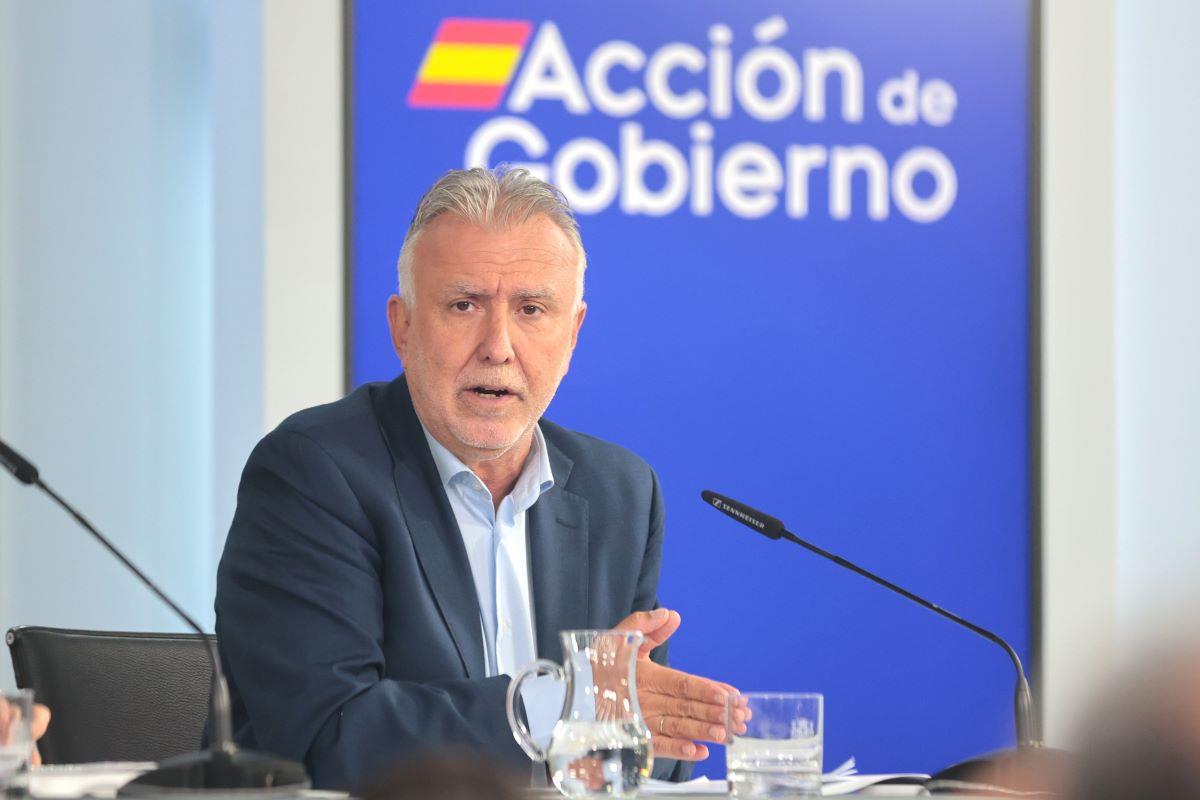 The Minister for Territorial Policy and Democratic Memory, Ángel Víctor Torres, during the press conference | Pool Moncloa/Sandra Armada
In his review of the measures taken by the ministries in Ceuta over the past week, the Minister for Territorial Policy and Democratic Memory, Ángel Víctor Torres, highlighted three priorities: the provision of facilities for migrants, the situation in schools, and expediting administrative procedures.
On the first point, the minister pointed out that around 900 people were moved on Sunday to a centre situated on land owned by the Ministry of Housing. Furthermore, he reiterated that the return to Morocco of individuals who do not have the right to remain in Spain requires that they first be formally identified and registered. At present, he added, 4,160 people are in temporary accommodation, undergoing triage and identification procedures. "We will press ahead with the new measures already planned by the Government of Spain to ensure that these people no longer have to sleep on the beaches and streets of Ceuta", he stated.
With regard to minors, the minister pointed out that the autonomous city is the competent authority and that the law prohibits adults and unaccompanied minors from being housed in the same accommodation facilities. He also emphasised that the Government had allocated two million euros to fund legal representation for minors during the processing of their files, which began yesterday. In total, there are 2,048 registered minors; of these, 1,612 arrived in the city on or after 30-31 July. As for how many remain on the streets of Ceuta, Ángel Víctor Torres put the figure at between 700 and 1,000 minors.
The Minister for Territorial Policy pointed out that school attendance has risen to 90.43%, and the focus now is on the start of the academic year at universities and non-formal education programmes.
With regard to administrative procedures, the minister explained that around a hundred National Police officers are assisting with the triage of migrants. Processing - including initial screening - has already begun for 1,822 cases. Additionally, 5,482 people have voluntarily returned to Morocco, and 307 expulsions have taken place. Torres emphasised that the majority of migrants currently in Ceuta will be returned to Morocco and that only those who can prove they have the right to remain, and minors who cannot be reunited with their families, will be allowed to stay in Spain.
Free guarantees, direct aid and EU funding
The minister also highlighted the assistance requested by the Ministry of Home Affairs from Frontex, the European agency responsible for protecting the external borders; the resources provided by the Ministry of Defence; the deployment of judicial officials; and the forthcoming relocation of some 300 migrant women.
On the economic front, he reported that the Council of Ministers had today approved a fund of up to €50 million for free guarantees and that the application period for direct aid for the self-employed and businesses had opened yesterday. Within the Ministry of Foreign Affairs, European Union and Cooperation, José Manuel Albares reported at the Cabinet meeting that the European Commission had approved the €114.7 million requested by the Government. He also highlighted the push for Ceuta to join the Committee of the Regions and the Customs Union, and to have its unique status as Europe's southern border recognised.
Areas affected by civil protection emergencies
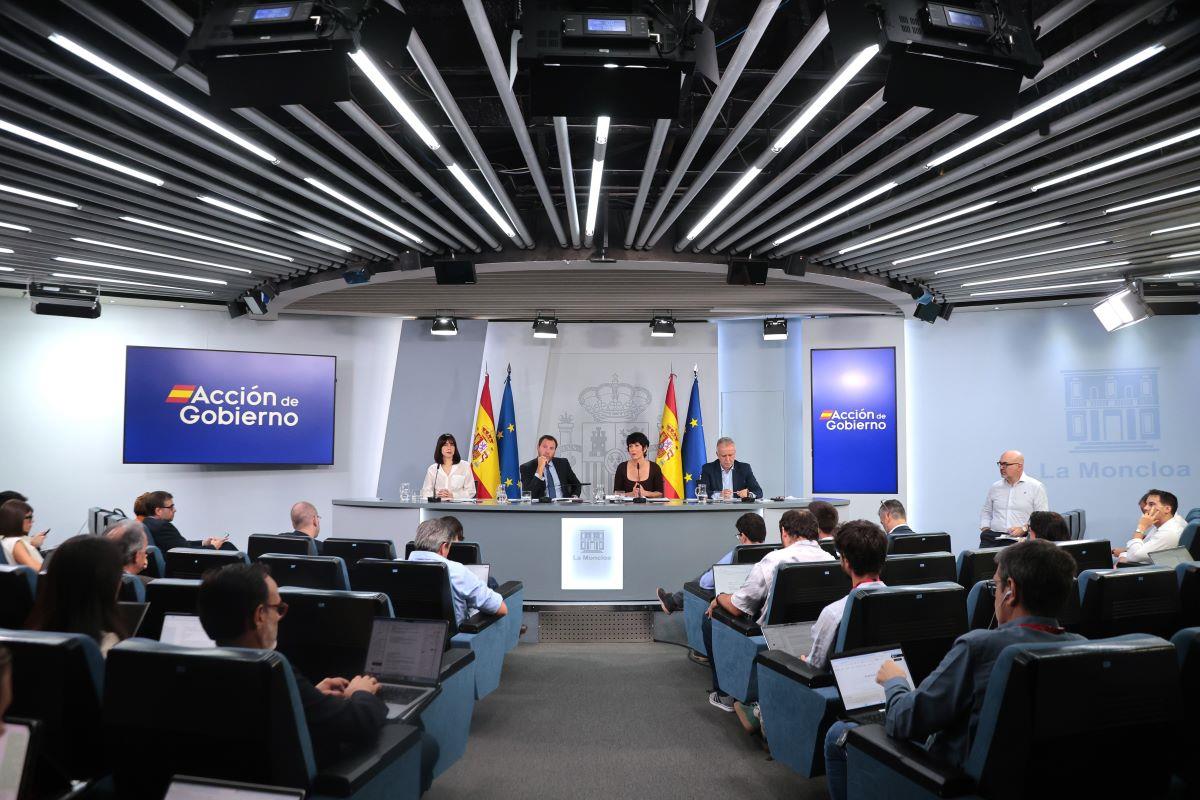 The ministers appear before the media after the Council of Ministers held at Moncloa Palace | Pool Moncloa/Sandra Armada
The Minister for Inclusion, Social Security and Migration and Government Spokesperson, Elma Saiz, reported that the Council of Ministers has designated territories affected by 112 adverse events, recorded across 14 autonomous communities between 27 July and 31 August 2026, as areas seriously affected by a civil protection emergency.
The government spokesperson highlighted that these incidents include the series of earthquakes that affected the province of Granada during August, as well as the various forest fires recorded in Andalusia, Aragon, Castile-La Mancha, Castile and León, Catalonia, the Community of Madrid, the Chartered Community of Navarre, the Valencian Community, Extremadura, Galicia, the Balearic Islands, La Rioja and the Region of Murcia. The agreement also covers various adverse weather phenomena, such as episodes of high temperatures, heavy rainfall and flooding.
The minister explained that individuals and entities able to prove damages may apply for aid to mitigate personal injury and damage to homes and household goods, cover expenses incurred by local authorities and address losses in industrial, commercial and service establishments, as well as to provide compensation for personal services or the use of assets during emergencies.
Saiz also stated that the agreement enables other ministerial departments to adopt measures, including tax relief, possible rebates and exemptions from Social Security contributions, and grants of up to 50% to local authorities for the repair of municipal infrastructure, facilities and equipment.
The Government Spokesperson stated that these measures may be extended once a more comprehensive assessment of the damage is available, with the aim of "facilitating recovery and a return to normality".
234 million for staff training
The Minister for Inclusion, Social Security and Migration announced that the Council of Ministers has approved, on the proposal of the Ministry of Education, Vocational Training and Sports, the allocation of €107.4 million euros amongst the regional governments for staff training.
Elma Saiz also announced the launch of four calls for proposals, with a total budget of €126.7 million, aimed at the same objective: training workers - particularly the most vulnerable - "for the sectors facing the greatest shortage of skilled workers".
Other current affairs
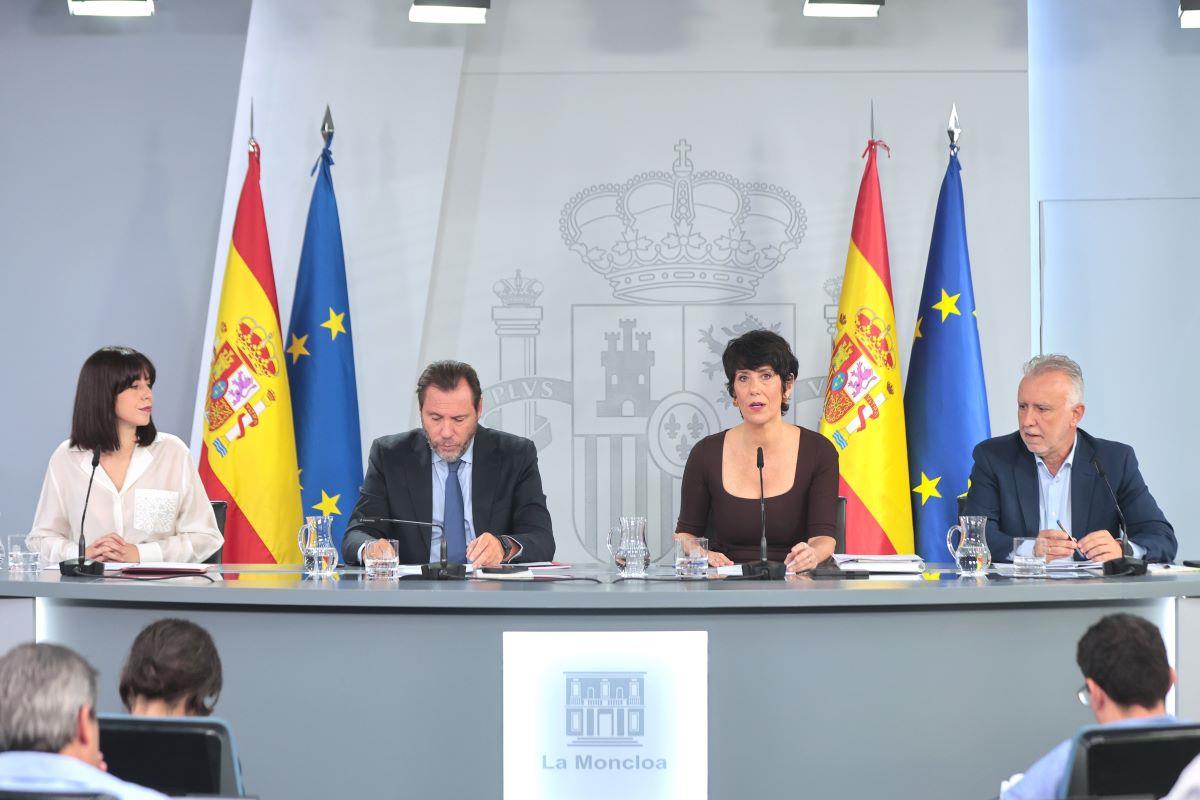 Ministers Diana Morant, Óscar Puente, Elma Saiz and Ángel Víctor Torres, during the press conference held after the Council of Ministers | Pool Moncloa/Sandra Armada
The Government Spokesperson expressed the Executive's "strongest condemnation" of the gender-based murder of a woman in the province of Madrid on 11 September. With this case, 37 women have been murdered due to gender-based violence in Spain so far in 2026, and 1,378 since 2003.
Elma Saiz also expressed the Government of Spain's condolences to the relatives of the Spanish student murdered in Mexico and stated that the Spanish Embassy and Consulate-General are doing everything they can to support the family and help shed light on the circumstances of the incident.
Non official translation