Council of Ministers
The Government of Spain allocates €309 million to support the economy and strengthen security, services and reception facilities in Ceuta
Council of Ministers - 2026.9.1
Moncloa Palace, Madrid
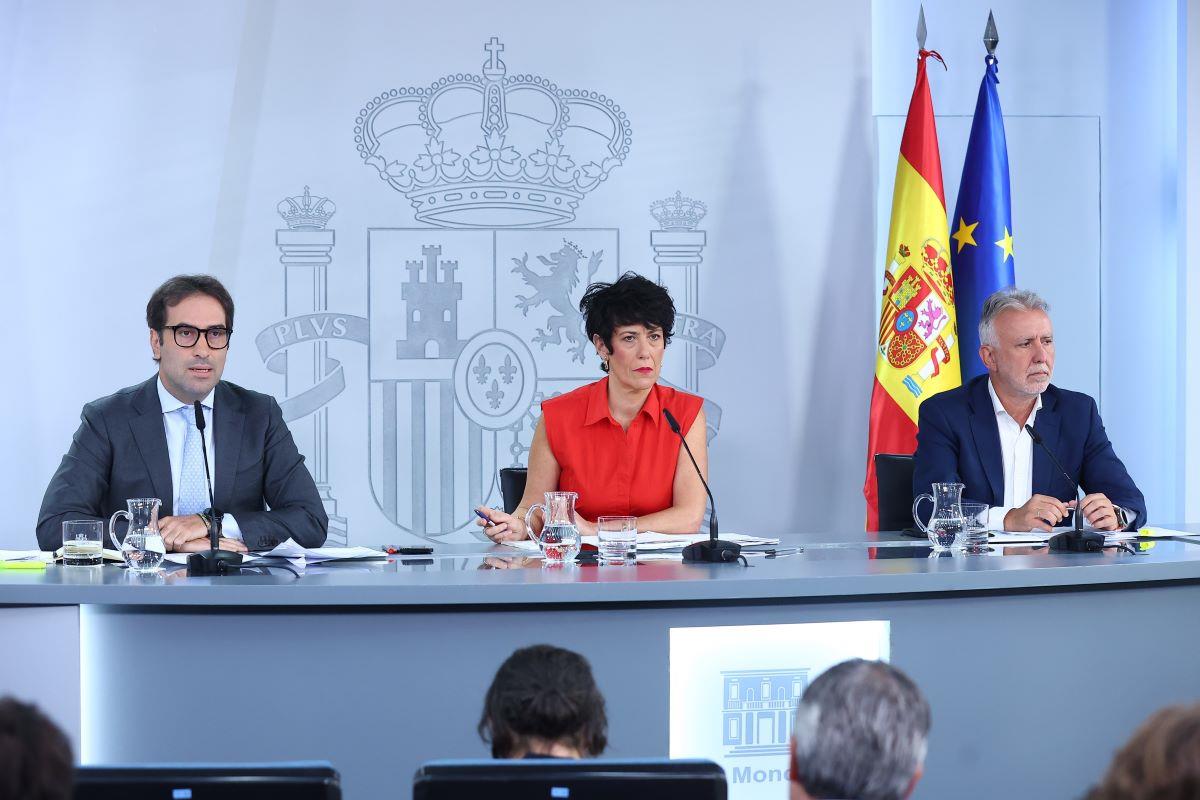 The Minister for Economy, Trade and Business, Carlos Cuerpo, the Minister for Inclusion, Social Security and Migration and Government Spokesperson, Elma Saiz, and the Minister for Territorial Policy and Democratic Memory, Ángel Ví (Pool Moncloa/Fernando Calvo)





The Council of Ministers has approved a Royal Decree-law on urgent social and economic measures to support the autonomous city of Ceuta. This measure complements the State's commitment to Ceuta, as outlined in the 2022 Comprehensive Socio-Economic Development Plan.
The First Vice-President of the Government of Spain and Minister for Economy, Trade and Business, Carlos Cuerpo, stated that the aim of the regulation is to address the requests made by the city's social partners and business associations, with whom the Government has maintained constant contact over the past month, whilst also monitoring the situation in the city. The aim, he added, is "to instil confidence and provide reassurance to both businesses and workers in the city of Ceuta".
Carlos Cuerpo has announced that the Executive will allocate €309 million during the remaining four months of 2026 - an amount equivalent to 16% of the autonomous city's Gross Domestic Product - to meet the needs of Ceuta's residents and boost the city's economy.
This emergency plan is structured around four pillars: strengthening essential services (€21 million), reinforcing security (€90 million), humanitarian reception (€118 million) and supporting economic activity (€80 million).
Support for economic activity: measures for workers and businesses
 The First Vice-President of the Government of Spain and Minister for Economy, Trade and Business, Carlos Cuerpo, during his speech at the press conference after the Council of Ministers | Pool Moncloa/ Fernando Calvo
The Government is allocating €80 million - comprising direct aid, support for commerce, tax measures and social security contribution relief - to support economic activity. The Minister for the Economy emphasised that this injection of liquidity represents 4% of Ceuta's GDP - to be disbursed over four months - and far exceeds the estimated losses or impact calculated by the Chamber of Commerce, which stood at slightly over €30 million. "We want to provide sufficient funds to cushion the blow being felt by the economy, business owners, small retailers and the tourism sector in the city of Ceuta", the minister emphasised.
Cuerpo explained that, of the €80 million, €36.6 will be allocated to direct aid for businesses and the self-employed. It is estimated that 2,500 self-employed workers and the 1,500 businesses currently operating in Ceuta will benefit from the measure. The self-employed will receive €5,000 and companies between €10,000 and €150,000, depending on their turnover.
Applications for the grants can be made from Monday 14 September via the Tax Agency's website, and payments will begin in early October.
The minister also specified that €14 million will be allocated to boosting local trade and tourism through consumer vouchers and transport discounts for non-residents, with a view to encouraging tourist arrivals.
With regard to labour relations, measures are being implemented to ease the burden of social security contributions on businesses. Carlos Cuerpo announced that, as was the case in response to the DANA, businesses whose operations have been interrupted or restricted and which have to resort to temporary redundancy (ERTE) will benefit from a 100 per cent exemption from Social Security contributions. In addition, there is a one-off payment for self-employed workers who have ceased trading, and the option to defer payments at a minimal interest rate of 0.5%.
Permanent measures
During his presentation, the minister highlighted that, regarding taxation, the regulation approved today increases the Corporate Tax rebate from 50% to 60% for companies resident in Ceuta and Melilla, as well as for those maintaining operations and jobs in these autonomous cities. For their part, self-employed workers will find it easier to claim deductions for provisions and expenses that are difficult to justify on their personal income tax returns.
Furthermore, the reduction in the employer's Social Security contribution is being permanently increased from the current 50% to 75% for workers on permanent contracts who are undertaking training activities. The Government is allocating a total of €12.2 million to these two structural measures.
Structural support extended to Melilla
The Minister for the Economy announced that the structural measures relating to social security contribution relief and tax incentives will also apply to companies operating in Melilla, given that the economic challenges facing Ceuta are very similar to those facing Melilla.
The minister put the figure for the support the State will allocate to Ceuta and Melilla in the medium and long term at €507.5 million, aimed at "bridging structural gaps, beyond resolving the current crisis".
Strengthening essential services, security and reception facilities
During his remarks at the press conference following the Council of Ministers meeting, Carlos Cuerpo also referred to the strengthening of essential services in the autonomous city of Ceuta, particularly in the areas of healthcare, legal services and water supply - a vital resource for the city. The Royal Decree-law approved today allocates €21 million to this priority area.
The text also stipulates that €90 million will be allocated to bolstering security, covering human resources, material resources and investment. In addition, a total of €118 million will fund measures for the accommodation and basic care of migrants, with special attention paid to unaccompanied minors.
Carlos Cuerpo gave an assurance that the Government will spare no effort to restore, as soon as possible, the peace of mind and confidence that Ceuta's citizens need.
Review of Ceuta's Comprehensive Socio-Economic Development Plan
The minister reviewed the progress the city has made in recent years, noting that it reflects the State's "firm and sustained commitment" to revitalising the city and narrowing the structural gaps that had historically existed there. In this regard, he pointed out that unemployment, inequality and the risk of poverty have all fallen.
By way of example, Carlos Cuerpo pointed out that €430 million have been allocated to strengthening and funding public services and €70 million to investment in infrastructure. He also praised the efforts of teachers and healthcare professionals to modernise the city and revitalise the economy, adding that the laying of the power cable from Algeciras marks a turning point for the city.
A comprehensive response to the humanitarian and migration crisis
 The Minister for Territorial Policy and Democratic Memory, Ángel Víctor Torres, speaks at the press conference after the Council of Ministers | Pool Moncloa/ Fernando Calvo
The Minister for Territorial Policy and Democratic Memory, Ángel Víctor Torres, emphasised in his speech that the Government "maintains its full operational deployment in Ceuta". Whilst the initial priority was to ensure the return of as many people as possible who had crossed the border from Morocco on 30 and 31 July, to prevent a recurrence of such an influx and to address the humanitarian response, the goal now is to restore normality in Ceuta "as soon as possible".
The minister, who is the official responsible for coordinating these measures, also emphasised that two meetings of the National Security Council have already taken place and that the third session of the Specialised Committee will be held tomorrow, with the Autonomous City of Ceuta represented at all times. In addition, eight senior ministers have appeared before the Lower House of Parliament to explain their actions, and on 3 September the President of the Government of Spain, Pedro Sánchez, will do the same.
New premises and facilities for reception and processing
With regard to the facilities required to receive migrants, register their details and process their return in accordance with the law, Ángel Víctor Torres explained that on 30 and 31 July, there were approximately 500-600 places available at the Temporary Immigrant Reception Centre (CETI) in Ceuta; since then, more than 3,400 additional places have been set up in other locations. Yesterday, around 800 people were moved to two of these cordoned-off areas, and the operation will continue over the coming days with the cooperation of the local authorities.
The Council of Ministers today amended the list of sites designated for this purpose: sports centres, the Military Hospital and the former flour mill have been removed, whilst plots in the port of Ceuta - situated away from urban centres - and land belonging to the Ministry of Housing have been added, alongside the K-8 barracks. Torres emphasised the consensus reached between the Government of Spain and the local authorities, who share a desire to "minimise the impact on the day-to-day lives and community life of Ceuta's residents", whilst shortening the timeframes for the procedure required to return the migrants. The Government is preparing another 3,000 places in the facilities designated under the amendment.
In addition, the Ministry of Defence has made facilities available to accommodate these people, as well as shelters and workspaces for National Police officers.
Food distribution, healthcare and the start of the school year
In his review of the measures taken by the ministries, Ángel Víctor Torres explained that, as of yesterday, the Ministry of Inclusion, Social Security and Migration had distributed 109,600 food 'kits'. The minister pointed out that on 26 August, it was not possible to carry out the food distribution because Red Cross volunteers felt threatened. Torres called for the right to protest to be exercised peacefully and asked for the media's assistance: "If we want to achieve normality in Ceuta, violence is certainly not the way to do it".
On the health front, the minister indicated that there are currently 104 hospital beds occupied in Ceuta - 50% of those available - with 15 of these occupied by migrant patients. In addition, the Ministry of Health has launched a vaccination campaign, with 45,000 vaccine doses available.
The Government is also working to ensure that the school year gets off to a normal start. A total of 1,749 teachers have taken up posts today in state and state-subsidised schools, and meetings have been held with all the school management teams.
Strengthening identification processing and child protection
The Ministry of Home Affairs has bolstered staffing levels in Ceuta with a further 50 National Police officers - assigned to the asylum office in anticipation of a large number of asylum applications - and a further 11 civil servants. Torres thanked all the authorities for their cooperation in ensuring that these people can be accommodated in Ceuta for as long as their work requires.
The minister stated that 3,519 migrants returned voluntarily to Morocco between 10 and 31 August; in addition, there were 214 deportations. With regard to minors, the Ministry of Children and Youth puts the number of registered minors in Ceuta at 1,612: 1,129 arrived after 31 July, whilst the remainder - around 500 - were already in the autonomous city before 30 July. Torres added that it is impossible to know how many minors have yet to be registered, and that the Government of Spain and the Ceuta authorities are prioritising the provision of facilities to complete the registration process and enable the relevant administrative procedures to be carried out, with the aim of family reunification.
The Minister for Territorial Policy and Democratic Memory highlighted the €63 million earmarked for policies relating to children, which are included in the emergency plan for Ceuta approved today by the Council of Ministers. He also referred to the measures to strengthen the judiciary set out in the plan, with the aim of reducing processing times for cases, asylum applications and the provision of care for minors.
"We will continue to work with the autonomous city in a spirit of absolute loyalty", said Torres. He expressed confidence that Ceuta would return to normality and conveyed the Executive's empathy "with the entire city of Ceuta and all its men and women" in the face of an unprecedented situation that demands equally unprecedented measures.
New Framework Statute for Statutory Staff in the Health Services
Elma Saiz, Minister for Inclusion, Social Security and Migration and Government Spokesperson, announced the approval, at the second reading, of the Framework Statute Bill for statutory health service staff. The reform is now being sent to the General Courts for consideration, where, as Saiz has pointed out, "political groups will have the opportunity to state their positions".
 The Minister for Inclusion, Social Security and Migration and Government Spokesperson, Elma Saiz, during her speech at the press conference after the Council of Ministers | Pool Moncloa/ Fernando Calvo
The government spokesperson emphasised that this reform "had been pending for 23 years", as the current Framework Statute has been in force since 2003. She also stated that the initiative "represents a substantial improvement in basic conditions for all professionals" and brings the regulations "into line with the present and future of the healthcare model".
One of the main changes concerns the organisation of working hours, improving upon the 48-hour weekly limit laid down by European legislation. Furthermore, on-call shifts may not exceed 17 hours, and the health services of the autonomous communities will be able to negotiate reductions to this duration, alongside other measures aimed at promoting work-life balance.
Distribution of funds for healthcare cohesion and transplants
Also in the healthcare sector, Elma Saiz noted that the Council of Ministers had authorised a proposal to distribute €50.27 million among the autonomous communities and the National Institute of Health Management (INGESA) for the development of healthcare cohesion and quality improvement programmes.
The planned measures include programmes to improve pharmaceutical care for patients with chronic conditions, frailty or complex medication regimens; to promote deprescribing and electronic prescribing; to strengthen pharmacovigilance and the fight against antibiotic resistance; and to improve plasma self-sufficiency and access to high-impact therapies. The funds will also be allocated to the ongoing training of healthcare professionals in the rational use of medicines and to public health education. They will also enable the implementation of initiatives to raise awareness of and promote bone marrow donation, improve the quality and safety of organ procurement and transplantation, and optimise the information systems managed by the National Transplant Organisation (ONT).
Promoting cognitive accessibility and programmes of social interest
The minister also announced the approval of a royal decree on cognitive accessibility, which sets out how this right must be guaranteed in key areas such as healthcare facilities, telecommunications, public spaces, transport, the administration of justice and electoral processes. The regulation stipulates that information and communication must be easy to understand and provided in accessible formats, such as plain language, easy-to-read text, audio, pictograms, visual aids or technological resources, at no extra cost and without delay.
Saiz also pointed out that the Council of Ministers has authorised the distribution of €432 million amongst the regional governments, derived from the 0.7% tax allocation from personal income tax and corporation tax, to fund programmes of social interest. This amount represents a 15% increase compared to the previous year.
Non official translation