Council of Ministers
The Government of Spain approved a bill against vicarious violence
Council of Ministers - 2026.7.14
Moncloa Palace, Madrid
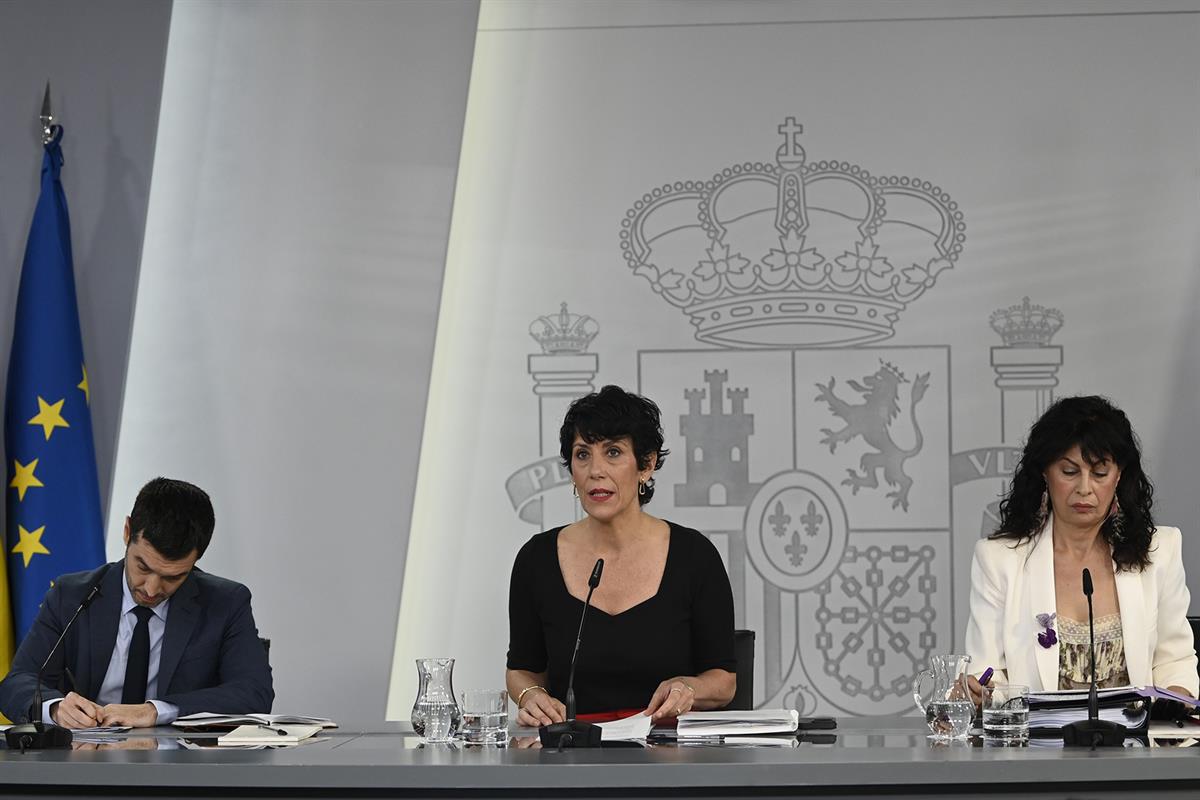 The Ministers for Social Rights, Consumer Affairs and Agenda 2030, Pablo Bustinduy, for Inclusion, Social Security and Migration and Government Spokesperson, Elma Saiz, and for Equality, Ana Redondo, at the press conference after the Council of Ministers (Pool Moncloa/César P. Sendra)





The Council of Ministers has approved referring the draft Organic Law on measures relating to vicarious violence to Parliament. The Minister for Equality, Ana Redondo, has described the legislation as a rigorous initiative that is attuned to the experiences of victims and which once again places Spain at the forefront of the fight against sex-based violence.
Redondo emphasised that the text makes it clear that "vicarious violence is sex-based violence", against a backdrop of denial of such violence and a "rollback of rights". The Minister for Equality pointed out that 68 children have been killed as a result of vicarious violence since 2013 - three this year alone - and that vicarious violence also involves abuse, assaults and constant threats. Ana Redondo has also emphasised that the future law complies with the State Pact against Sex-Based Violence: "We hope that, given that these measures have already been agreed upon with such broad consensus and social agreement, they will also follow an appropriate legislative process and that this bill can be brought before Parliament during this parliamentary term."
Comprehensive protection against vicarious violence
The bill amends a total of ten pieces of legislation, including the Comprehensive Law against Sex-Based Violence, with the aim of providing comprehensive protection for victims. The text defines vicarious violence as violence perpetrated against a woman by her partner or ex-partner through an intermediary. Redondo has highlighted the expansion of the group of people who may be direct victims of such violence: sons and daughters, other descendants regardless of age, adults who are under the care or custody of that partner or that woman, mothers and fathers, brothers and sisters, and the victim's current partner.
From a criminal law perspective, the bill amends the Criminal Code to specify that the aggravating circumstance of committing the offence on the basis of sex shall apply in cases of vicarious violence. In addition, an ancillary penalty is introduced to prohibit the publication or dissemination of material directly related to the unlawful acts.
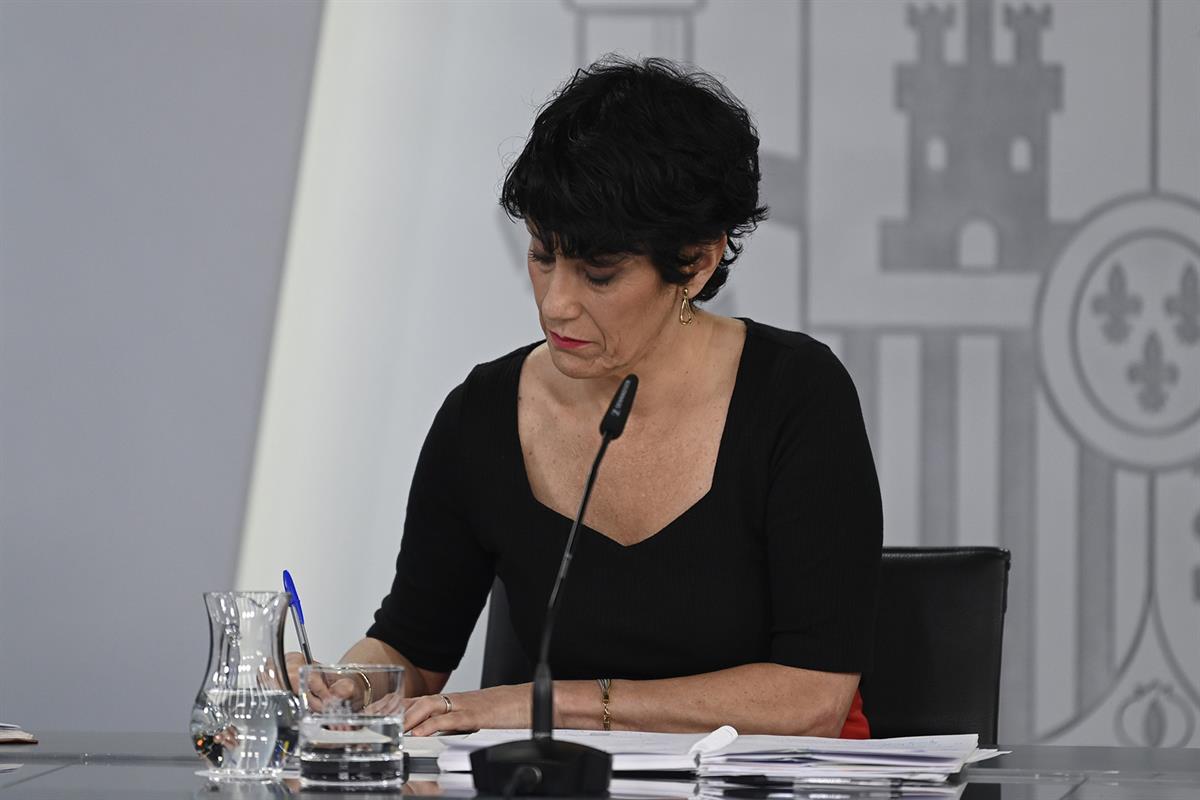
 The Minister for Equality, Ana Redondo, speaks at the press conference after the Council of Ministers | Pool Moncloa/César P. Sendra
In terms of the Civil Code, the provision aims to bring civil jurisdiction into line with criminal jurisdiction. To this end, automatic deprivation of parental responsibility is introduced in cases where a final conviction has been handed down for serious offences committed against the mother or the children. "The premise is clear: an abuser, a violent person, can never be a good parent," said the Minister for Equality. Parental authority may only be restored once the criminal record has been completely expunged.
With regard to custody and access arrangements, the forthcoming law also introduces very significant restrictions, as these are suspended where proceedings relating to sex-based violence or vicarious violence are ongoing, or where there are reasonable grounds to believe that such violence is taking place within the family. Furthermore, there is an obligation to listen to children; only where this is not feasible or not in the child's best interests will the process be carried out through legal representatives, close relatives or individuals with specialist training.
The text also sets out measures to raise awareness; training for judges, prosecutors and magistrates, both on entry to the judicial profession and in relation to potential promotions; the option for victims to change their surnames; and a guarantee that the perpetrator cannot benefit from social security payments made by the victim.
More resources to support people in need of care
The Council of Ministers has approved a sum of 904 million euros to be distributed amongst the regional governments in accordance with the agreed level of funding for long-term care.
Pablo Bustinduy, the Minister for Social Rights, Consumer Affairs and 2030 Agenda, has emphasised that this funding is conditional upon meeting certain criteria, such as reducing waiting lists and improving working conditions in the sector. Furthermore, it includes a clause whereby, if a regional government reduces its funding for long-term care, it also receives fewer resources from the General State Administration.
 The Minister for Social Rights, Consumer Affairs and Agenda 2030, Pablo Bustinduy, at the press conference after the Council of Ministers | Pool Moncloa/César P Sendra
If the approved allocation is added to the funds provided for under the decree-law on extraordinary financing - which is pending ratification by the Lower House of Parliament - the total will reach a record figure of 5.513 billion euros this year and 7.239 billion next year. Bustinduy reiterated his call to all political groups to support this ratification, as well as the new laws on long-term care and disability, so that the same consensus can be reached as that which made possible the reform of Article 49 of the Constitution, the adoption of the ELA Act, and the extension of maternity and care leave.
The minister has argued that these laws, which are also due to be voted on in the Lower House this afternoon, represent "the re-establishment of the care system", a change he has compared to the establishment of the public pension, healthcare and education systems. The aim is to move away from a welfare system characterised by precariousness, underfunding and large care homes, towards a model based on citizens' rights that provides the necessary support to enable people to age in their own homes independently and with the greatest possible well-being. Pablo Bustinduy also emphasised that these laws safeguard funding by stipulating that the General State Administration must contribute 50% of the resources.
Digitalisation and modernisation of the financial sector
Elma Saiz, Minister for Inclusion, Social Security and Migration and Government Spokesperson, has announced the approval of the draft bill on the digitalisation and modernisation of the financial sector. As she explained, the regulation brings Spanish legislation into line with the European framework and updates key areas of the financial system in order to "capitalise on the opportunities offered by digitalisation without compromising on consumer protection or financial stability".
The text completes the implementation in Spain of the European legislation on crypto-asset markets (MiCA), strengthens the financial system's cybersecurity and operational resilience through the implementation of the European DORA Regulation, and modernises the payment system. It will also enable payment institutions and electronic money institutions to access payment systems directly, thereby fostering greater competition, and will strengthen the protection of strategic infrastructure such as Iberpay.
The Government spokesperson also emphasised that the law will promote greater transparency in the financial markets through connection to the Single European Access Point and will give new impetus to the financial sandbox, the controlled testing environment for innovative projects, which will feature a permanent open-door policy and a reduction in administrative burdens to encourage innovation.
New National Strategy for Territorial Equity and the Demographic Challenge
 The Minister for Inclusion, Social Security and Migration and Government Spokesperson, Elma Saiz, during her speech at the press conference after the Council of Ministers | Pool Moncloa/César P. Sendra
The Council of Ministers has approved, on the proposal of the Ministry of Ecological Transition and Demographic Challenge, the Second National Strategy for Territorial Equity and Demographic Challenge, a roadmap designed to continue promoting the development of rural areas and to ensure equality of opportunities.
Elma Saiz highlighted the shift taking place in rural Spain. As she pointed out, towns with fewer than 5,000 inhabitants continue to gain residents: specifically, 79% of the 6,832 Spanish towns with fewer than 5,000 inhabitants recorded in 2018 currently have a positive net migration balance.
The minister explained that the strategy is the result of a broad participatory process and will enable further investment in digitalisation, mobility, the green transition, innovation and public services, much of which is financed by European funds. She emphasised that the aim is to strengthen territorial cohesion and open up "new opportunities for our towns and villages".
60 million for towns affected by the DANA
Furthermore, the Council of Ministers has approved, on the recommendation of the Ministry of Ecological Transition and Demographic Challenge, a budget of 60 million euros in direct aid for the 78 towns affected by the DANA, to strengthen their resilience to the risk of flooding.
As the spokesperson explained, this will enable the financing of measures aimed at adapting municipal buildings, infrastructure and services located in areas at risk of flooding, with the aim of reducing the damage caused by future extreme weather events and improving public safety.
Current affairs: the Los Gallardos fire
Elma Saiz began her speech by expressing, on behalf of the Government, her "deepest condolences" for the 13 people who lost their lives as a result of the wildfire that broke out in Los Gallardos (Almería), as well as her solidarity with their families and with all those affected by this tragedy.
 The Minister for Inclusion, Social Security and Migration and Government Spokesperson, Elma Saiz, at the press conference after the Council of Ministers | Pool Moncloa/César P Sendra
The spokesperson explained that the Council of Ministers had taken note of a report drawn up by the General Secretariat for Civil Protection and Emergencies on the progress of the fire, in the extinguishing of which more than 438 state personnel have been involved, including 220 members of the Military Emergency Unit (UME), 184 Civil Guard officers, 61 National Police officers and 34 Civil Protection personnel, as well as numerous ground and air resources.
According to the minister, the fire has affected some 7,000 hectares of woodland, farmland and forest tracks. Based on the data available so far, this is one of the three most serious forest fires in Spain's history in terms of the number of victims, and the deadliest ever recorded in Andalusia. She also emphasised that the way the fire had developed had highlighted "the great importance of preventive forest fuel management", as the areas affected by previous fires had helped to partially limit its spread.
The spokesperson concluded by thanking all the professionals who had taken part in the fire-fighting, rescue, safety and support efforts for the affected population - both in Almería and at the other active wildfires across various autonomous communities - for their "exemplary work".
Gibraltar: a new phase of cooperation
The government spokesperson also highlighted the imminent removal of the border fence with Gibraltar. In Saiz's view, this marks the beginning of "a historic new era for Spain, for Andalusia and for the Campo de Gibraltar". As she pointed out, this new situation allows us to "look to the future with optimism" and is "good news for Spain, good news for Europe" and, in particular, for the more than 15,000 people who cross the border in both directions every day.
Within the scope of her remit, the minister explained that this new phase will enable the implementation of the Social Security coordination protocol between Spain and Gibraltar to ensure administrative cooperation, the exchange of information, the processing of applications and the effective coordination of Social Security benefits. As she emphasised, the protocol will protect cross-border workers and their families in areas such as healthcare, maternity benefits, temporary disability benefits and pensions.
Non official translation