Council of Ministers
The Government of Spain updates measures to mitigate the effects of the war in the Middle East and raises its growth forecast to 2.6%
Council of Ministers - 2026.6.29
Moncloa Palace, Madrid
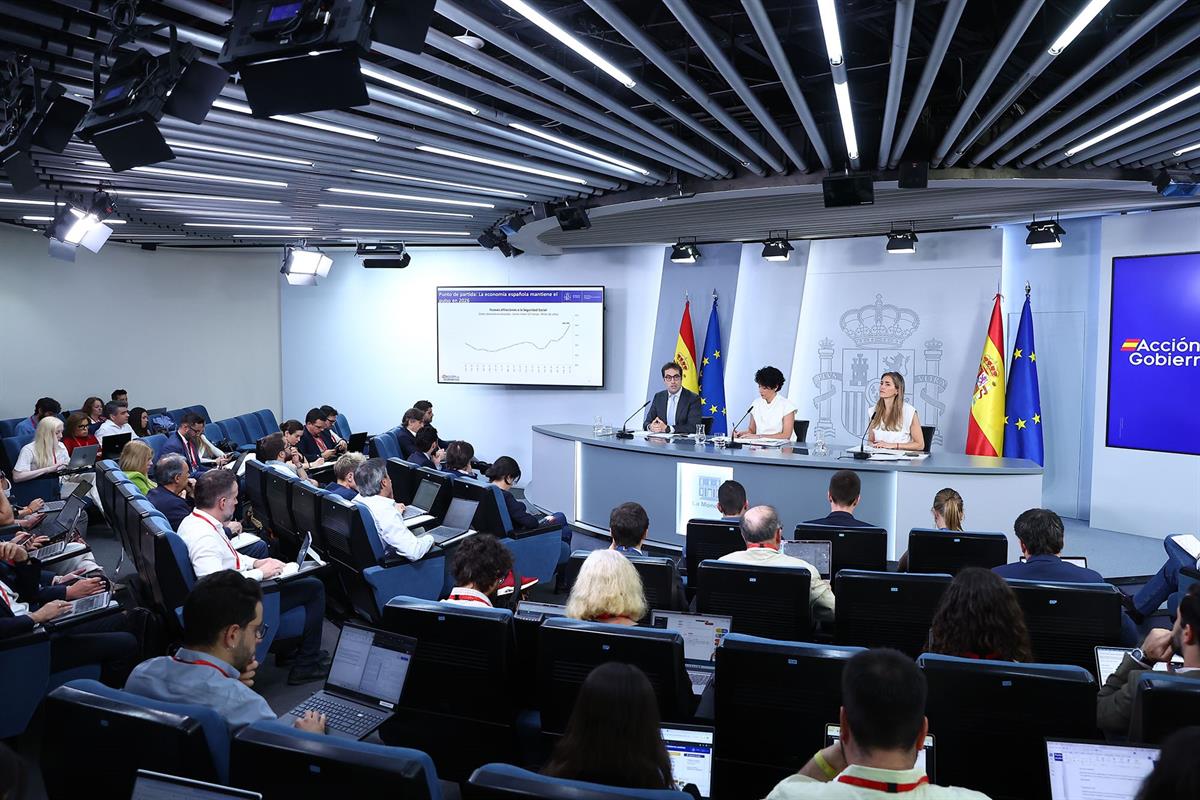 The Ministers for Economy, Trade and Business, Carlos Cuerpo, for Inclusion, Social Security and Migration and Government Spokesperson, Elma Saiz, and for Ecological Transition and Demographic Challenge, Sara Aagesen, after the Council of Ministers (Pool Moncloa/Borja Puig de la Bellacasa)





The Council of Ministers has approved a royal decree-law updating the extraordinary measures adopted last March as part of the Comprehensive Plan to Respond to the Crisis in the Middle East, and sets out new initiatives to continue protecting households and sectors most vulnerable to the effects of the crisis, whilst promoting renewable energy and the electrification of the economy.
The First Vice-President of the Government of Spain and Minister for Economy, Trade and Business, Carlos Cuerpo, specified that the new regulation, like the previous one, rests on two main pillars: the first is short-term in nature, extending measures due to expire on 30 June by three months, with some adjustments; the second comprises structural initiatives aimed at strengthening energy sovereignty, reducing dependence on fossil fuels and enhancing the Spanish economy's resilience against future external crises.
Short-term measures: fuel subsidies
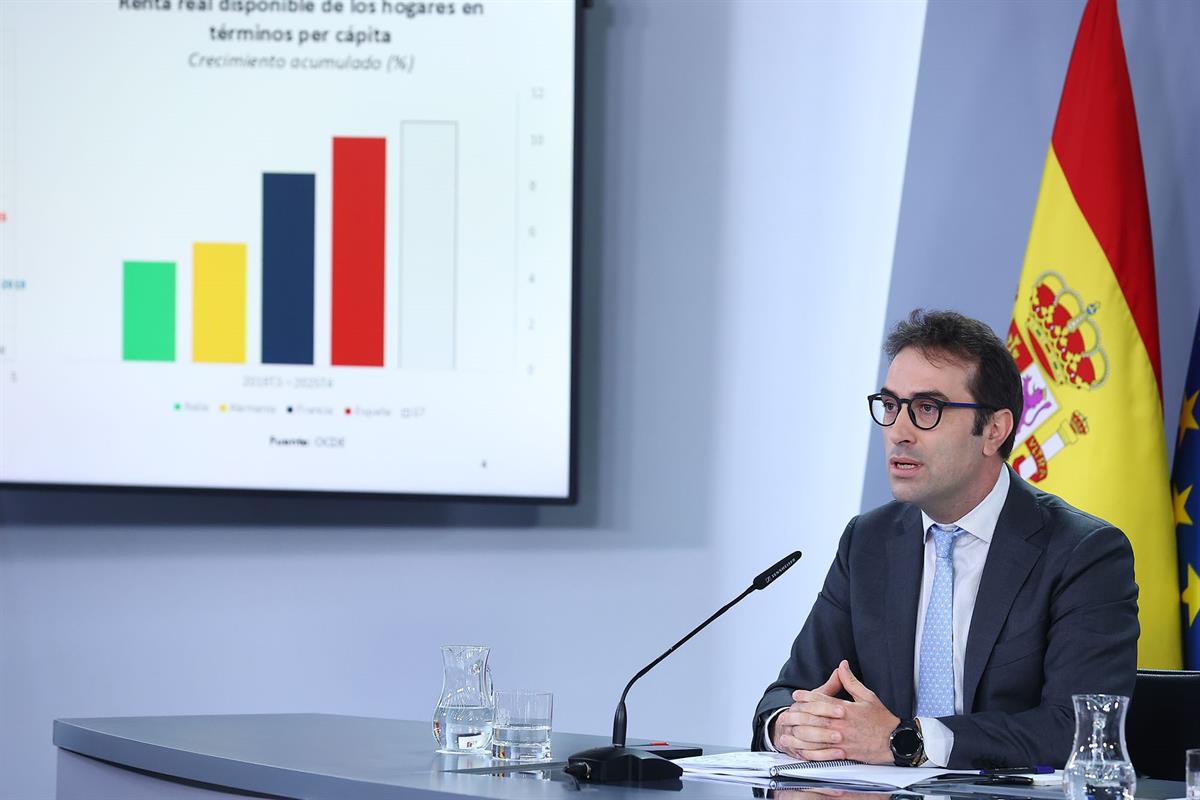 The First Vice-President and Minister for Economy, Trade and Business, Carlos Cuerpo, during the press conference after the Council of Ministers
Carlos Cuerpo explained that subsidies for the primary and transport sectors will remain in place, while the cost of petrol and diesel will be adjusted in line with price normalisation over the coming months: "As prices on international markets fall, we will gradually phase out the support for fuel tax reductions for households".
Consequently, the current relief of 20 cents per litre will drop to 15 cents in July, 10 cents in August, and 5 cents in September. However, the minister gave assurances that the automatic trigger clause remains in place, under which the price would be reduced by a further 20 cents per litre if year-on-year fuel inflation exceeds 15%.
Cuerpo added that, in this area, control and transparency mechanisms are being strengthened to ensure that these measures are complied with. The National Commission for Markets and Competition (CNMC) is authorised to request the information necessary to understand the functioning of the fuel market from wholesalers and retailers in the distribution chain.
The Minister for the Economy also highlighted that an additional 165 million euros in aid for the purchase of fertilisers is being added to the 500 million that had already been made available under the first Royal Decree-law.
Structural measures: tax cuts and the electrification of the economy
Among the structural measures approved, the Vice-president highlighted the gradual phasing out of the Tax on the Value of Electricity Production; the rate will drop from the current 7% to 5% by the end of 2026, to 3.5% in 2027, and will be phased out entirely in 2028. The Minister for Economy noted that, while this measure entails a significant budgetary cost, it is appropriate for continuing to bolster the electrification of the economy.
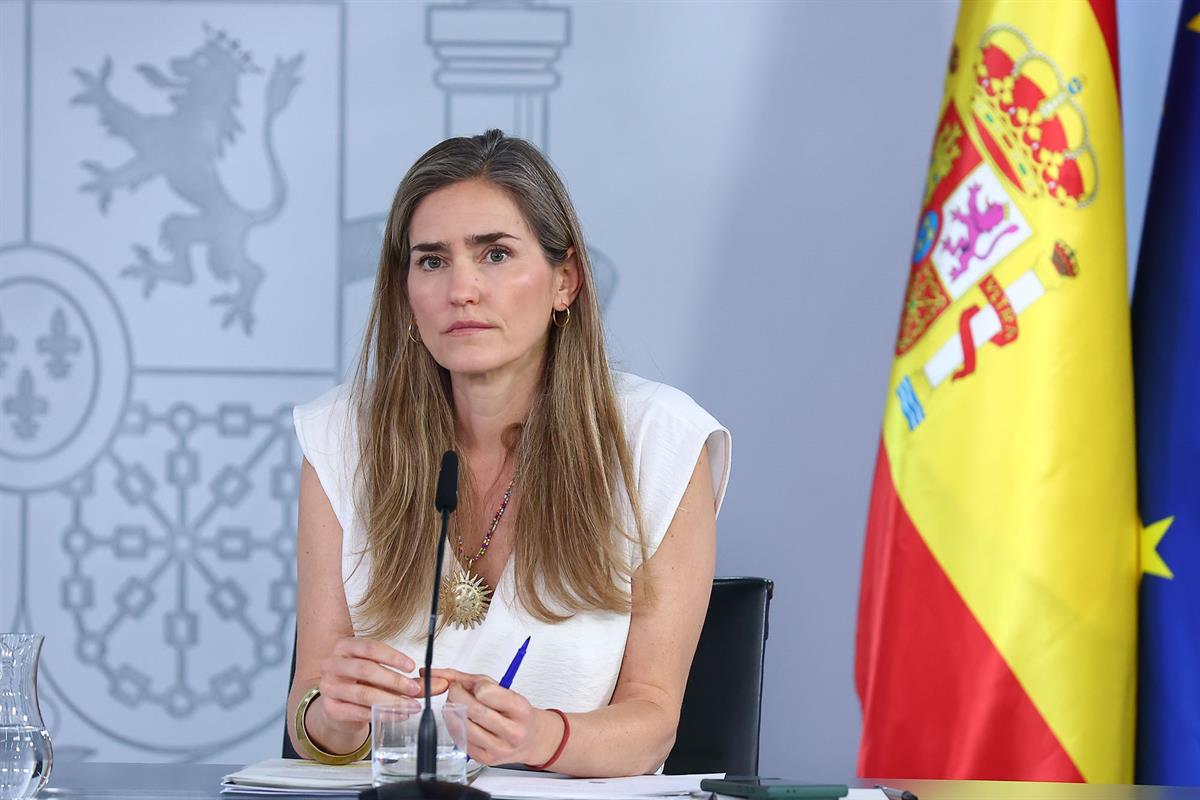 The Third Vice-President of the Government and Minister for Ecological Transition and Demographic Challenge, Sara Aagesen, during the press conference after the Council of Ministers | Pool Moncloa/Borja Puig de la Bellacasa
For her part, the Third Vice-President of the Government of Spain and Minister for Ecological Transition and Demographic Challenge, Sara Aagesen, who appeared alongside the Vice-president, argued that this measure will "help to reduce energy bills for households, the productive sectors and industry" by up to 6%.
Sara Aagesen emphasised that the structural measures focus on the roll-out of renewable energy, whilst always adhering to social, territorial and environmental standards. In this regard, the regulation approved today authorises the National Standardisation Body (UNE) to develop technical standards for a seal of social, territorial and environmental excellence, which will allow the best projects to undergo expedited processing.
This second package of measures - following those approved in March - represents a commitment of €1.825 billion. This is in addition to another €2.7 billion resulting from projected revenue declines in 2027 and 2028 due to the reduction - and eventual total elimination - of the tax on energy production.
Economic growth forecast revised upwards
The Government has updated its economic outlook for the 2026-2029 period, marking the first step in drafting the General State Budget, work on which is already underway.
The Minister for Economy noted that the revision is based on the easing of uncertainty surrounding the conflict involving Iran, the effectiveness of the Executive's response plan - which helped mitigate the war's impact by curbing inflation - and the Spanish economy's dynamism during the first few months of the year.
Carlos Cuerpo highlighted that the forecast for GDP growth has been revised upwards from 2.2% to 2.6% for 2026, four tenths of a percentage point higher than in the scenario presented in November. The forecast for 2027 has also been revised upwards to 2.2%, and is expected to remain above 2% until 2029.
As the minister explained, private consumption and investment are the two key drivers of the economy, alongside improvements in employment and hourly productivity, which he described as "a hallmark of a sustainable and balanced growth model".
Estimates indicate that private consumption will grow by 2.8% and domestic demand will contribute 2.9 percentage points to GDP growth in 2026. Furthermore, the government projects a 2.4% increase in employment for 2026, with the unemployment rate falling below 10% that year and continuing to decline to 8.5% by 2029.
Cuerpo also highlighted that this stronger growth is leading to reduced wage inequality and a lower at-risk-of-poverty rate, with both trends expected to continue their downward trajectory.
Growth and fiscal responsibility
Carlos Cuerpo reiterated that the Spanish economy will continue to outpace major Eurozone economies and that this dynamism is compatible with the ongoing consolidation of public finances.
Excluding extraordinary expenses linked to the DANA weather events, the deficit fell to 2.4% of GDP in 2025 and is projected to drop further to 2.1% in 2026 and 1.8% in 2027.
Climate control and energy efficiency upgrades in schools
The Council of Ministers has agreed to allocate €200 million from the National Energy Efficiency Fund to projectsimproving energy efficiency, including climate control systems, in publicly owned non-university educational buildings.
The Minister for Ecological Transition and Demographic Challenge stated that the measure has a dual objective: to save energy by reducing consumption in public buildings, and to improve comfort and health conditions to facilitate effective learning.
The Minister affirmed that the funds would be distributed among the autonomous communities in a "transparent and objective manner, based on the number of schools".
Eligible projects must demonstrate a minimum 10% reduction in final energy consumption across five key areas: the thermal envelope; the upgrading of heating, cooling and hot water systems; lighting improvements; automation systems; and the control and efficiency of sports facilities.
INNOVAE Programme
The Government has agreed to award grants under the first call for funding for unique energy-saving and energy-efficiency projects (INNOVAE), totalling €115 million.
Sara Aagesen explained that these are innovative energy-efficiency projects - including innovative solutions focused on sustainable mobility, the industrial sector and existing buildings in the tertiary sector - as well as unique cooling generation projects.
Updating the protection system for unaccompanied foreign minors
Elma Saiz, Minister for Inclusion, Social Security and Migration and Government Spokesperson, announced the approval of a royal decree updating the standard capacity of the protection and guardianship system for unaccompanied foreign minors across the autonomous communities and cities.
She explained that the measure will make it possible to guarantee the minors' rights while also providing insight into the status of the various reception systems operating in each territory. In this regard, Saiz noted that the recent amendment to immigration regulations placed "the best interests of the minor at the centre" and initiated a process aimed at easing the pressure on the primary territories of arrival. In her view, the royal decree represents "another step toward protecting and ensuring the rights of unaccompanied minors".
Measures to facilitate access to housing
The Government Spokesperson announced that the Government has agreed to submit a package of housing measures to the Lower House of Parliament in July, with the aim of reaching a "major parliamentary agreement". She described the proposal as an "ambitious and cross-cutting" text that comprehensively addresses the issue of access to housing.
The Government Spokesperson noted that the measures are structured into two main blocks. The first part focuses on lowering rental prices, bringing greater stability to contracts and combating fraud through initiatives such as regulating seasonal and room rentals, extending contract terms, mandating written contracts and implementing various tax measures to encourage price reductions.
he second block aims to increase the supply of affordable housing through measures such as raising the VAT to 21% for tourist rental properties and streamlining administrative procedures. Saiz emphasised that the royal decree-law will include measures that "have been supported by the various parliamentary groups throughout this parliamentary term", with the aim of ensuring that "everyone can feel represented". "A problem like housing can only be resolved through consensus", she stated.
Early partial retirement for public administration staff
The Council of Ministers has approved a royal decree-law setting out urgent measures regarding early partial retirement for staff employed by public administrations. As Elma Saiz explained, the regulation improves and expands rights by providing a permanent solution for this type of retirement, thereby fulfilling a commitment made to trade unions within the framework of social dialogue.
The minister noted that the text establishes "a gradual and flexible system" for hiring relief workers, prioritising the recruitment of permanent staff but allowing for temporary contracts when that is not possible. The new regulation will allow access to partial retirement up to three years before the standard retirement age, provided the established requirements are met and the corresponding relief contract is formalised.
The minister also highlighted that the regulation includes an additional provision authorising a residency allowance for state personnel stationed in the Balearic Islands. Furthermore, it allows for the review of allowance amounts within six months- subject to collective bargaining - ensuring that this update does not, under any circumstances, result in a reduction of the amounts currently received.
Current affairs: solidarity with Venezuela following the earthquake
The Government spokesperson began her address by expressing, on behalf of the Government, its condolences following the deaths of 1,450 people as a result of the double earthquake that struck Venezuela on 24 June. She also expressed the Government's solidarity with the victims' families, the injured and all those affected by the tragedy.
Saiz explained that, from the very outset, the Government of Spain has worked to support Venezuelan authorities by deploying 65 personnel from the Military Emergency Unit, two Army engineers, and eight search-and-rescue canine units, as well as by sending essential supplies. Shee also reported that staff from the Spanish Agency for International Development Cooperation (AECID) are already on the ground to facilitate the deployment of the START field hospital.
The spokesperson further noted that the Government has mobilised up to one million euros in financial aid through multilateral organisations to help mitigate the earthquake's impact, adding that the Spanish Embassy and the consular network continue to provide assistance to the Spanish community residing in the country. Finally, she addressed a message of support to the more than 700,000 people born in Venezuela who currently live in Spain, assuring them that "Spain will continue to stand with the Venezuelan people. Venezuela is not alone".
Non official translation