Council of Ministers
The Government of Spain activates the Verano Joven programme with discounts of up to 90% for bus and train journeys
Council of Ministers - 2026.6.9
Moncloa Palace, Madrid
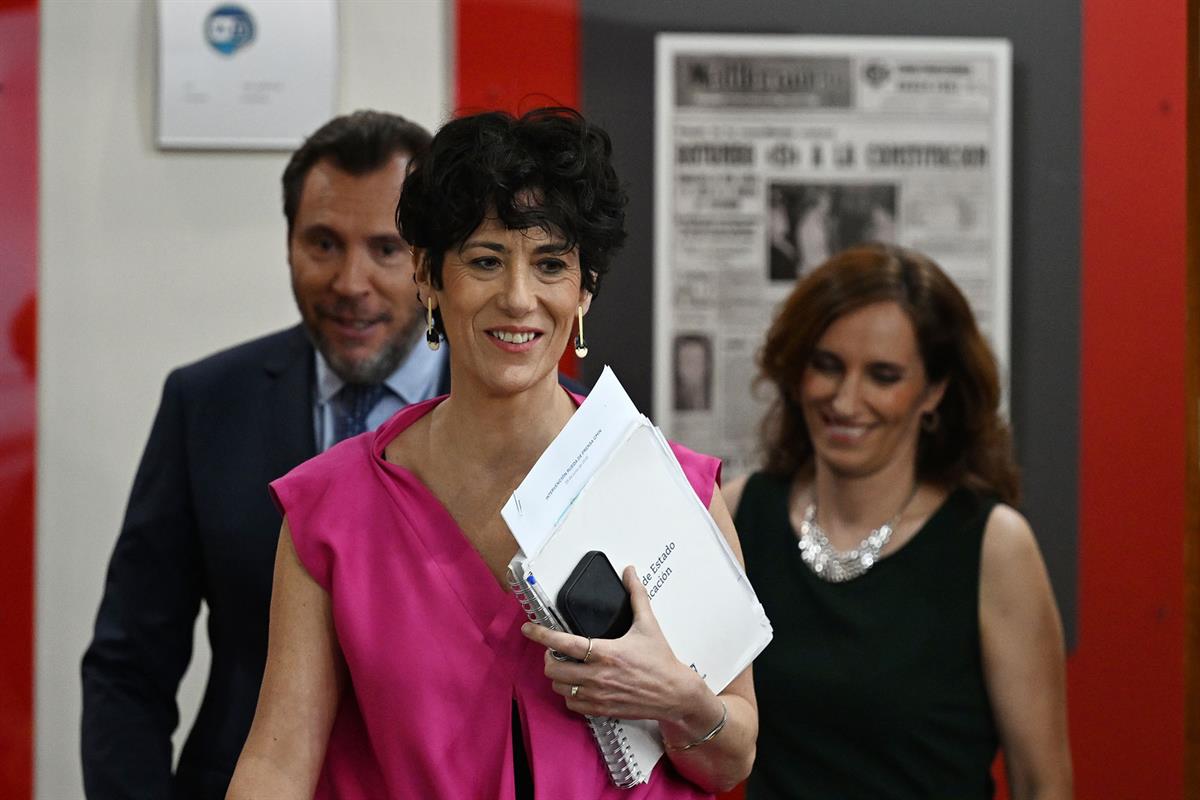 The Minister for Inclusion, Social Security and Migration, Elma Saiz, the Minister for Transport and Sustainable Mobility, Óscar Puente, and the Minister for Health, Mónica García, upon entering the press room (Pool Moncloa/Borja Puig de la Bellacasa)





The Executive has also approved the Forest Fire Fighting Plan for the summer period, strengthened the participation of patients' organisations in health policies and earmarked 1.368 billion euros for air conditioning in hospitals, schools and public buildings.
The Council of Ministers has activated the fourth edition of the Verano Joven programme, which will enable young people aged between 18 and 30 to travel by bus and train during July, August and September with discounts of up to 90% on tickets.
The Minister for Transport and Sustainable Mobility, Óscar Puente, explained that the measure has three purposes: to make it easier for young people to travel regardless of their financial position, to promote the use of public transport as opposed to the use of private vehicles and to improve the economy of the tourism sector, given that if young people spend less on travel they can spend more elsewhere.
The programme has been allocated 130 million euros to cover the subsidies for one-off return tickets for travel in Spain and for Interrail in Europe. In the minister's view, it is a programme that is good value for money and an investment well spent: "It is an investment in mobility, in opportunities for a generation that deserves to travel, to know and enjoy our country and the rest of Europe, without the price of transport becoming an insurmountable barrier".
Target group of the Verano Joven 2026 programme
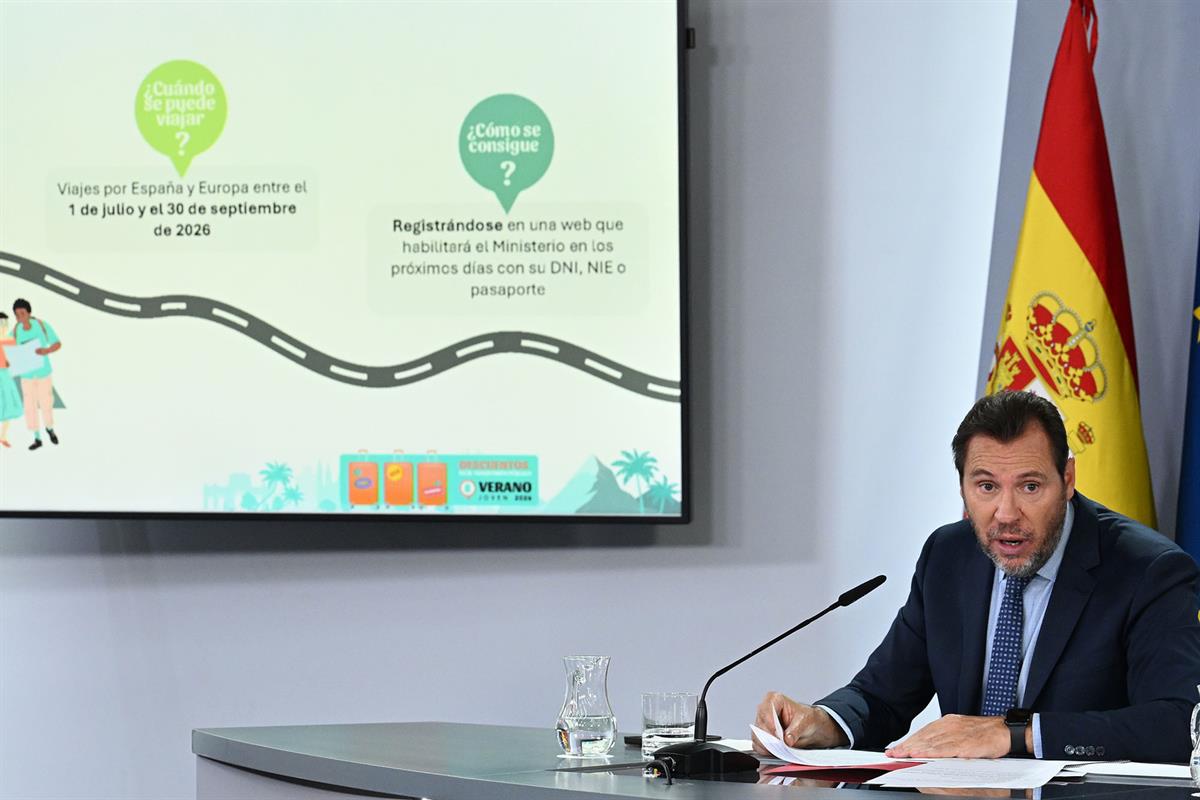 The Minister for Transport and Sustainable Mobility, Óscar Puente, during his speech at the press conference after the Council of Ministers | Pool Moncloa/Borja Puig de la Bellacasa
All young people with Spanish or foreign nationality and legal residence in Spain born between 1 January 1996 and 31 December 2008, i.e. aged between 18 and 30, can benefit from the discounts. They will have deductions on bus and train tickets with a travel date between 1 July and 30 September 2026.
Óscar Puente has detailed that the discounts provided maintain the same formula as in previous editions because they have worked very well. As a result, the discount will be 90% on regular state-run bus services, on conventional long-distance services and on the metric gauge network. Avant single tickets will have a 50% discount, as well as commercial long-distance or high-speed services of all rail operators, with a maximum of 30 euros per ticket. The Interrail Global Flexible of 10 days in two months will also have a 50% deduction when marketed through Renfe.
The Minister pointed out that the procedure for obtaining the discounts is simple, quick and familiar to those who have already participated in previous years: "It's a matter of registering on the ministry's website, checking the requirements, getting a personal code and from there, you can travel."
Assessment of the Verano Joven Programme
During his speech at the press conference following the Council of Ministers, Óscar Puente also took stock of the Verano Joven Programme, which was launched in 2023 and, in his opinion, has been consolidated as a way for young people to gain personal autonomy, discover other ways of living and look at the world through different eyes. The minister stressed that "the programme works and we are probably facing one of the best received public policies aimed at young people in recent years".
"When we launched the first edition, we had an intuition, we thought that if we removed some of the financial barriers to travel, young people would respond. And they have done just that. The reality has far exceeded expectations," added Puente, who pointed out that more than 4 million young people have benefited from the measure since it was launched. "A total of 16 million trips have been made under this programme, which is a spectacular figure, and it has been growing. We started the first year with around 4 million trips and ended the 25th year with more than 7 million," the minister specified.
Puente added that young people are incorporating this programme into their life plans: "I believe that there is no better evaluation of a measure than to see that it is expected and increasingly used by its recipients."
Greater patient involvement in health policies
 The Minister for Health, Mónica García, at the press conference after the Council of Ministers | Pool Moncloa/Borja Puig de la Bellacasa
The Council of Ministers has approved the referral to Parliament of the draft Law on Patients' Organisations, aimed at "filling a legal gap" in the health system, according to the Minister for Health, Mónica García. While these organisations currently participate in the planning and evaluation of the system in a more informal and voluntary way, the regulation recognises their uniqueness and facilitates collaboration with the administrations.
For the first time, the text defines what a state-wide patient organisation is: it must be non-profit, it must be registered in the National Register of Associations, it must be established and active in more than one autonomous community, and its governing bodies must be made up of a majority of patients, relatives or non-professional carers.
The regulation incorporates operating principles that the Health Minister has described as "essential": transparency in funding, independence from private interests, accountability, equality of opportunity and universal accessibility. If these organisations are to increasingly influence the health system, it is necessary "that we have clear rules of transparency that reinforce their independence and legitimacy and public confidence in their actions", said Mónica García.
The law institutionally recognises these organisations through the creation of a state census, an instrument that will enable them to organise their dialogue with the Administration, facilitate participation in consultative bodies and reinforce the mechanisms of transparency and representativeness.
Participation rights and membership in governance bodies
At the heart of the regulation is the recognition of the specific participation rights of patients' organisations, which will be able to access the public information necessary to defend the interests of the people they represent. This includes information on legislation in the pipeline, health strategies, administrative actions and initiatives that may affect patients. In addition, they have the right to participate in the development and evaluation of health policies. The minister stressed that this participation will take place from the early stages of policy development, when input can be incorporated more effectively, and will not end with the consultation process, but that organisations will have the right to know what decisions are finally taken and the reasons behind them.
The text also includes the obligations of the General State Administration, which must guarantee flexible access to information, promote accessible communication technologies, facilitate the continuous training of the organisations and promote mechanisms to assess the degree of effective participation of patients.
 The Minister for Health, Mónica García, at the press conference after the Council of Ministers | Pool Moncloa/Borja Puig de la Bellacasa
Another pillar of the future law is the stable incorporation of patients into health governance bodies. Thus, the permanent presence of eight representatives of the organisations in the National Health System Consultative Council, the main body for social participation in the health system, is guaranteed. In addition, organisations will be able to participate in other strategic spaces linked to the evaluation of technologies and the incorporation of innovations. García pointed out that this will make it possible to add the experience of those who live with a disease as a complementary vision to the clinical and technical evidence.
The regulation establishes objective criteria for the participation of organisations in these bodies, such as representativeness, territorial implantation, track record and specialisation. The Minister highlighted the role given to rare disease patient organisations, "whose associative experience has been particularly relevant in promoting advances in our healthcare system".
The text also includes measures to support the patient association movement, which has been shown to improve knowledge of the disease and the monitoring of treatments, and to generate support networks that are beneficial to health and quality of life, García said.
"In short, it is a regulation that aims to move from occasional, sporadic and informal participation to stable, recognised and guaranteed participation", said the minister, who thanked the organisations for their contribution to the text and referred to the figure of Dr. Albert Jovell, "who paved the way for the need to make healthcare revolve around the needs and experiences of the patient".
New system for the verification of medicinal products
The Council of Ministers has updated the medicines verification system to bring it into line with European safety and traceability mechanisms.
The Minister for Health has explained that the 'tamper-evident coupon' that pharmacists currently have to remove when dispensing a medicine will be eliminated. In addition to reducing bureaucracy in pharmacies, the new system reinforces guarantees against counterfeiting, improves traceability and interoperability and establishes "more secure, modern and accurate" drug identification, according to Mónica García.
1.368 million for air-conditioning of hospitals, schools and public buildings
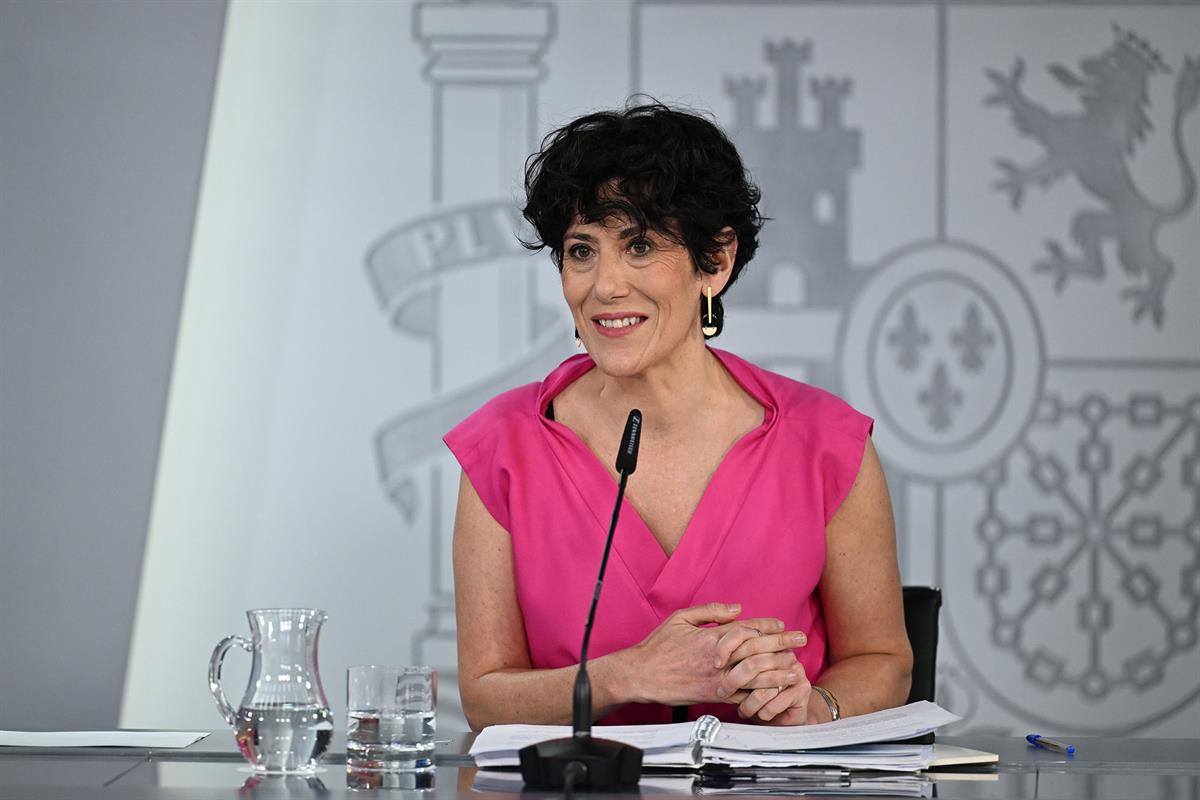 The Minister for Inclusion, Social Security and Migration and Government Spokesperson, Elma Saiz, during her speech at the press conference after the Council of Ministers | Pool Moncloa/Borja Puig de la Bellacasa
The Minister for Inclusion, Social Security and Migration, and Government Spokesperson, Elma Saiz, has reported that the Government has agreed to allocate 168 million euros for the National Energy Efficiency Fund, an initiative that aims to "finance air conditioning, rehabilitation and energy saving actions in facilities that are mainly used for healthcare purposes, such as hospitals, health centres, local clinics and other public buildings".
The spokesperson of the Executive emphasised that this economic allocation will be transferred to the autonomous communities and cities for management, as they are responsible for carrying out these actions, "once the proposal for the distribution criteria of the Sectoral Conference on Energy has been approved. These criteria are: hospital beds installed in the National Health System, number of health centres or local clinics".
Elma Saiz stated that the funds for energy rehabilitation will also be joined by another similar line with 200 million euros for educational centres. "This is a much-needed measure. The effects of climate change in the classroom have consequences for our children. That is why the Government of Spain has decided to act, because we take a logical concern of parents and education professionals seriously."
The minister also recalled that in addition to the above figures, "the more than 1 billion euros from European funds made available to local authorities and regional governments to refurbish public and public ownership buildings with the aim of improving their energy efficiency."
Forest Fire Prevention and Fighting Plan
The spokeswoman of the Executive informed of the approval of the Forest Fire Prevention and Fighting Plan and other coordination measures for the summer period. The aim of the initiative is to reinforce the response capacity of public administrations to the risks associated with high summer temperatures.
Elma Saiz stressed that this plan "involves the work of up to 13 ministries" and that it will have a similar mechanism to that of previous years, made up of personnel from the forest fire brigades, the Military Emergency Unit and the State Law Enforcement Forces and Agencies.
The minister recalled that "last May was very hot in terms of temperatures and particularly dry in terms of rainfall", circumstances that make it necessary to step up surveillance, prevention and coordination efforts in view of the increased risk of fires during the summer months.
The Government Spokesperson stressed the importance of collaboration between administrations and public bodies in order to anticipate possible emergencies and guarantee a rapid and effective response. "All prevention and coordination work is essential," he insisted.
Current Affairs: Visit of Pope Leo XIV
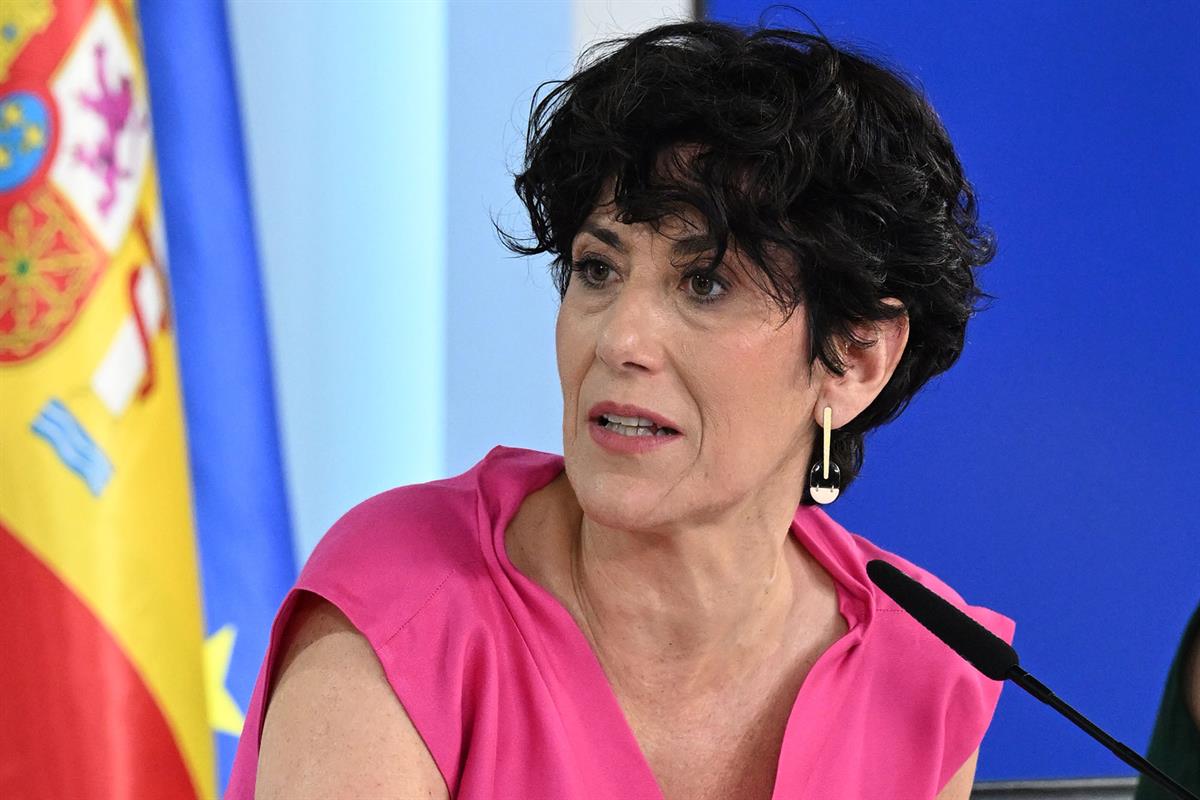 The Minister for Inclusion, Social Security and Migration and Government Spokesperson, Elma Saiz, at the press conference after the Council of Ministers | Pool Moncloa/Borja Puig de la Bellacasa
Elma Saiz began the press conference after the Council of Ministers by mentioning the visit of Pope Leo XIV to Spain, which takes place from 6 to 12 June.
Saiz wanted to "highlight an event of special relevance for our society" and welcomed the fact that Spain was the first European state to be visited by Leo XIV since the start of his pontificate.
The minister stressed that Pope Leo XIV had shown "enormous humanity" in the first acts that took place in Madrid, and referred, in particular, to the meeting he held with a migrant who had availed himself of the extraordinary migratory regularisation process promoted by the Government.
"At a time of great global challenges, we share with the Pope the defence of a humanist vision centred on the dignity of people," said Elma Saiz. She concluded by adding, "Our country will continue to be a benchmark for coexistence, solidarity and the defence of human rights, both within and beyond our borders. A strong society is one that is able to reach out, to integrate, and to offer opportunities to those who seek to build a better future.
The Government Spokesperson also expressed her gratitude for the important effort of institutional coordination that has been necessary in recent months to host a visit of this magnitude. After visiting Madrid, Pope Leo XIV will travel to Barcelona, Gran Canaria and Tenerife.
Non official translation