Council of Ministers
The Government of Spain launches an extraordinary regularisation process for foreign nationals already living in Spain
Council of Ministers - 2026.1.27
Moncloa Palace, Madrid
 Pool Moncloa / Jose Manuel Álvarez






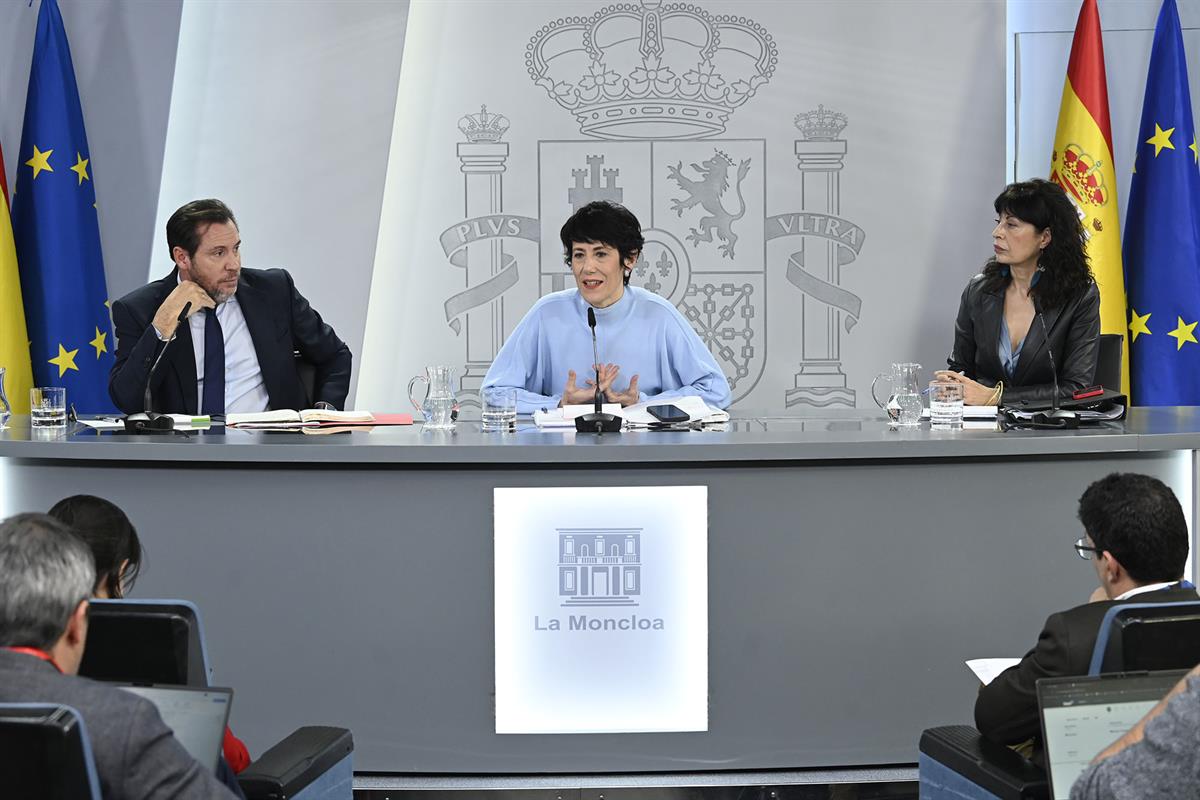
The Council of Ministers has authorised the urgent processing of a royal decree to carry out an extraordinary regularisation process for foreign nationals already in Spain. The aim is to offer this group the opportunity "to live with equal rights," as well as to respond to "a reality that exists on our streets and has an impact on coexistence, well-being, and the economy", explained the Minister for Inclusion, Social Security, and Migration and Government Spokesperson, Elma Saiz.
The measure, added Saiz, has been "worked on and discussed at length" and revives the spirit of the Popular Legislative Initiative that was supported by more than 700,000 signatures and considered by a large majority of the Lower House of Parliament. It is also part of the Plan for Integration and Intercultural Coexistence that will be published soon. "It is a historic day for our country. We are strengthening a migration model based on human rights, integration, and coexistence, compatible with economic growth and social cohesion", the minister asserted.
Requirements and procedures for the extraordinary regularisation
The process is aimed at foreign nationals who have been in Spain for at least five months before 31 December 2025. Applicants for international protection who submitted their applications before that same date will also be eligible for regularisation. Another essential requirement is having no criminal record.
The Minister for Inclusion, Social Security and Migration explained that those who benefit from regularisation will be able to obtain a legal residence permit in Spain with an initial validity of one year. After this period, these individuals will be able to join the categories provided for in the Regulations of the Immigration Law, "which will allow for full and progressive integration into the system", Elma Saiz stated. The minister added that the government expects applications to begin being submitted in early April, once the necessary procedures for processing the royal decree have been completed, and that the process will remain open until 30 June.
 Pool Moncloa / Jose Manuel Álvarez
Acceptance of the application will allow temporary work in any sector and location in Spain. "This benefits workers, who gain rights, but also companies, which gain legal certainty", Saiz stated. Another key aspect of the measure is the protection of families: the process will allow for the simultaneous regularisation of minor children of applicants already in Spain; in this case, the permit will be for 5 years.
The government spokesperson recalled that "governments of different political stripes" have carried out extraordinary regularisations since 1986: "When social reality outpaces bureaucracy, the responsible state is the one that acts to regulate it, not the one that looks the other way".
Support measures for those affected by the Adamuz and Gelida accidents
The Council of Ministers has approved a Royal Decree-Law providing aid to the victims of the Adamuz and Gelida train accidents, which includes measures totalling €20 million.
The Minister for Transport and Sustainable Mobility, Óscar Puente, announced that €10 million will be allocated to immediate aid for the victims and another €10 million as an advance on part of the compensation corresponding to civil liability insurance. This will be in addition to existing mechanisms that recognise the right of train accident victims and their families to comprehensive assistance. The aid will be paid in a single instalment and will be exempt from taxation.
The minister indicated that the assistance plans, mandatory insurance, coverage, and guarantees established in both national and European regulations will continue to be applied, although he acknowledged that "ordinary procedures and judicial timelines do not always respond to the vital urgency of those who have suffered a tragedy like this".
 Pool Moncloa / Jose Manuel Álvarez
In order to expedite the receipt of aid, Puente emphasised that the regulation approved today "stems from a very clear conviction: in the face of a tragedy of this magnitude, the State cannot limit itself to ordinary timelines; it must be present, it must anticipate, and it must act with humanity". "The victims cannot wait, as has happened in past accidents, for years to receive financial support that will allow them to cover medical expenses, psychological treatment, travel, ongoing care, or the complete reorganisation of their daily lives", he added.
Óscar Puente explained that the direct aid in the event of death amounts to just over €72,000, which the Government will pay immediately as a non-refundable grant, plus another €72,000 as an insurance advance. In cases of bodily injury, the aid is structured according to levels of severity, with amounts ranging from €2,400 to over €84,000.
"This isn't about putting a price on pain; that's impossible. It is about ensuring that no victim or family member has to face, in addition to a personal tragedy, a distressing financial situation or institutional neglect", the minister emphasised.
Puente reiterated that the regulation represents a commitment to the deceased, the injured, and their families: "The speed of the institutional response is not just an administrative matter; it is a way of caring, of supporting, and of demonstrating through actions, not just words, that the victims and their families are not alone and that the institutions are by their side".
Furthermore, the minister announced that regulatory changes will be initiated to establish a structural mechanism for public intervention so that the Spanish State can assume, in advance, the payment of a percentage of the compensation corresponding to personal injuries resulting from public transportation accidents, without prejudice to the subsequent determination of civil liability of the responsible individuals or legal entities.
Commitment to transparency
During his remarks at the press conference following the Council of Ministers meeting, Óscar Puente, on behalf of the government, conveyed his sympathy to the victims and those affected by the train accidents in Adamuz (Córdoba) and Gelida (Barcelona) and emphasised that he will continue to provide the necessary explanations about the accidents with transparency. He also maintained that the government will continue working to "clarify what happened and strengthen railway safety".
Comprehensive support for victims
 Pool Moncloa / Jose Manuel Álvarez
For her part, Elma Saiz reiterated that the government "will stand by the victims at all times and for as long as necessary". The Government Spokesperson indicated that those affected will receive priority assistance through channels specifically set up by Social Security, such as the telephone number 900103535 and the email address info.accidente@seg-social.es, as well as the usual telephone numbers (915421176 and 901166565). They can also manage benefit queries online.
Furthermore, the Ministry of Territorial Policy has established support lines for victims with the opening, starting tomorrow, of comprehensive support offices at the Government Sub-delegation in Huelva and also in Barcelona. Those affected can also access the "La Administración cerca de ti" (The Administration: close to you) service, which allows staff from the delegations to visit their homes, if they wish, to assist them with the application process.
Comprehensive system for monitoring domestic abuse perpetrators
The Council of Ministers has authorised the contracting of a comprehensive system for monitoring compliance with restraining orders and no-contact orders in cases of gender-based and sexual violence, using electronic means.
The Minister for Equality, Ana Redondo, noted that the current contract began in November 2023 and will conclude on May 6 of this year, and that the service is managed by a joint venture between Vodafone and Securitas Spain. Following the platform change in 2023, she pointed out, "various malfunctions occurred regarding data roaming". These malfunctions were included in the 2024 report of the Crown Prosecutor of the State, which referenced a significant number of dismissals and acquittals of some abuse perpetrators. The Minister for Equality stated that the Ministry is still awaiting the court rulings, but that, in any case, they were aware of the need to improve the contract and incorporate the recommendations from the internal investigations and the external audit. "It is clear that technology can fail, but what cannot fail is the response of a responsible government", she maintained.
Greater security for victims

Among the improvements to the contract, the Minister for Equality highlighted its amount and duration: while the current service was tendered for €50.1 million and 30 months, the new one has a budget of €71.3 million for 3 years (extendable to €111 million if the extensions are implemented, bringing the total to 5 years).
As for the tracking devices, the contract increases the number available, allowing for the replacement, within a maximum of 24 hours, of any devices that have been tampered with or that show any signs of malfunction. Ana Redondo explained that they will be using an ankle monitor, which, according to technicians, is more reliable and less easily tampered with than bracelets. Furthermore, the system includes an eSIM card for both the victims' and the perpetrators' mobile phones, which cannot be removed, thus facilitating geolocation. Battery life has also been improved, as requested by victims to provide greater autonomy.
A second set of improvements concerns the Sala Cometa, the control and management centre for the electronic means of enforcing restraining orders against victims. While the current contract began with 70 operators, the new one will require a minimum of 151. This group of staff will also include those responsible for coordinating material resources and liaising with the State law enforcement forces and agencies, among other institutions, and with LexNET (the secure information exchange platform between judicial bodies and various legal professionals).
Finally, the Minister for Equality highlighted the improvements related to contract monitoring: the contingency plan is reinforced, psychological support staff are added for Cometa personnel, and the winning company is required to incorporate all innovations that may occur during the term of the contract.
Other agreements: advanced therapies and the centenary of the Generation of '27
 Pool Moncloa / Jose Manuel Álvarez
The Council of Ministers has chosen the municipality of Majadahonda (Community of Madrid) as the main headquarters of the State Network Consortium for the Development of Medicines and Advanced Therapies (CERTERA): the scientific management will be located in Barcelona. The Government Spokesperson emphasised that the selection of headquarters is the result of an objective, competitive, and transparent process, and that Spain is a leader in advanced therapies due to both public participation and private investment. Certera has 43 health research centres spread across 14 autonomous communities.
In addition, the government has created the National Commission for the Commemoration of the Centenary of the Generation of '27, which will promote and coordinate activities related to this anniversary throughout the country.
Current affairs: falling unemployment
At the press conference following the Council of Ministers meeting, the Government Spokesperson highlighted the Labour Force Survey for the fourth quarter of 2025, which was released today. According to the National Statistics Institute, for the first time in 18 years, unemployment has fallen below 10%, and the number of employed people has reached 22.5 million. "These figures indicate the positive state of our economy and represent a national success", she stated.
Non official translation