Council of Ministers
The Government of Spain approves pension increase and extends social shield measures
Council of Ministers - 2025.12.23
Moncloa Palace, Madrid
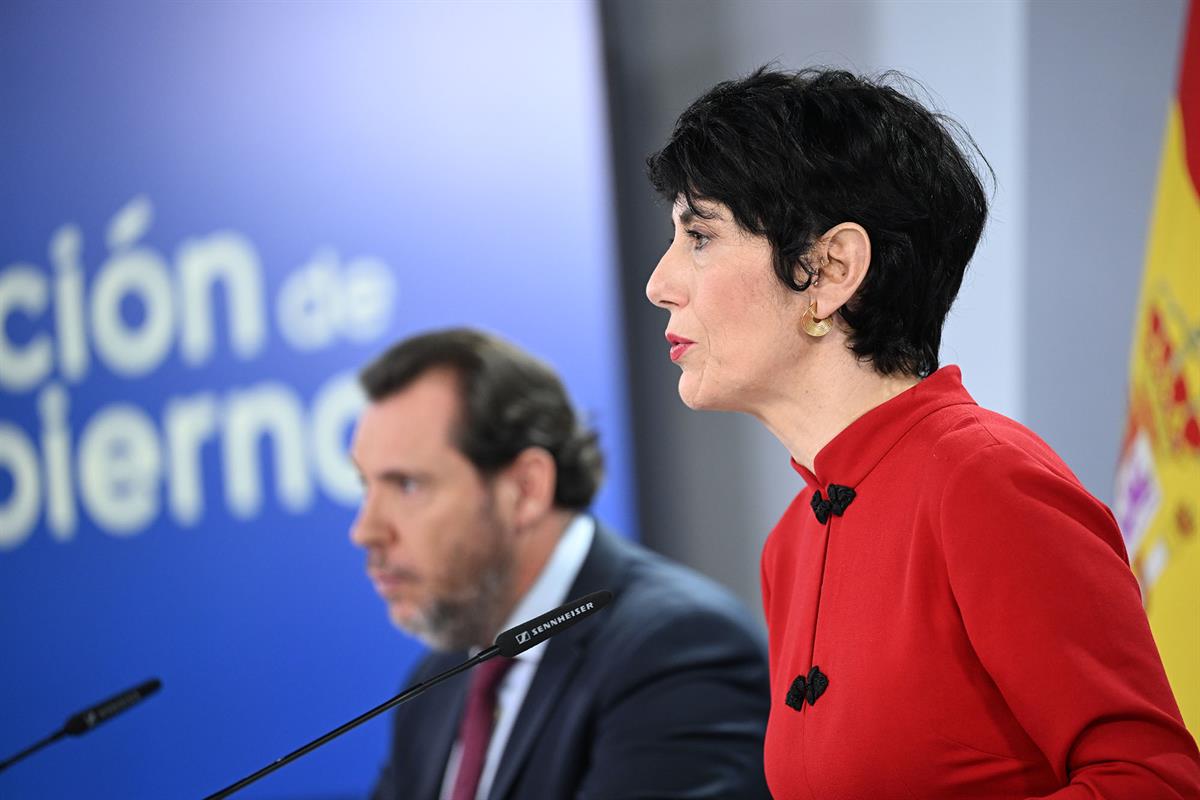 The Minister for Inclusion, Social Security, and Migration and Government Spokesperson, Elma Saiz, speaks at the press conference following the Council of Ministers meeting. (Pool Moncloa/Borja Puig de la Bellacasa)





The Council of Ministers has approved the Royal Decree-Law extending certain measures to address situations of social vulnerabilityand adopting urgent measures regarding taxation and Social Security. The legislation includes the pension increase for 2026 and extends social measures for groups struggling to meet their energy and housing needs, within the framework of the social shield implemented by the Government.
The Minister for Inclusion, Social Security and Migration, Elma Saiz, announced during her first press conference as Government Spokesperson that, thanks to the approval of this legislation, pensions will generally increase by 2.7%, reflecting the price increases of the previous year. This increase will translate into approximately €570 more per year for those receiving an average retirement pension.
In total, nearly 13 million pensions will be increased, meaning pensioners will maintain or increase their purchasing power. With this measure, Saiz said, "the government is fulfilling an unwavering commitment: to offer the more than 9.4 million pensioners in our country the certainty that if prices rise, their pensions will also rise to help them cover their daily expenses".
Minimum pensions to increase by between 7% and 11%
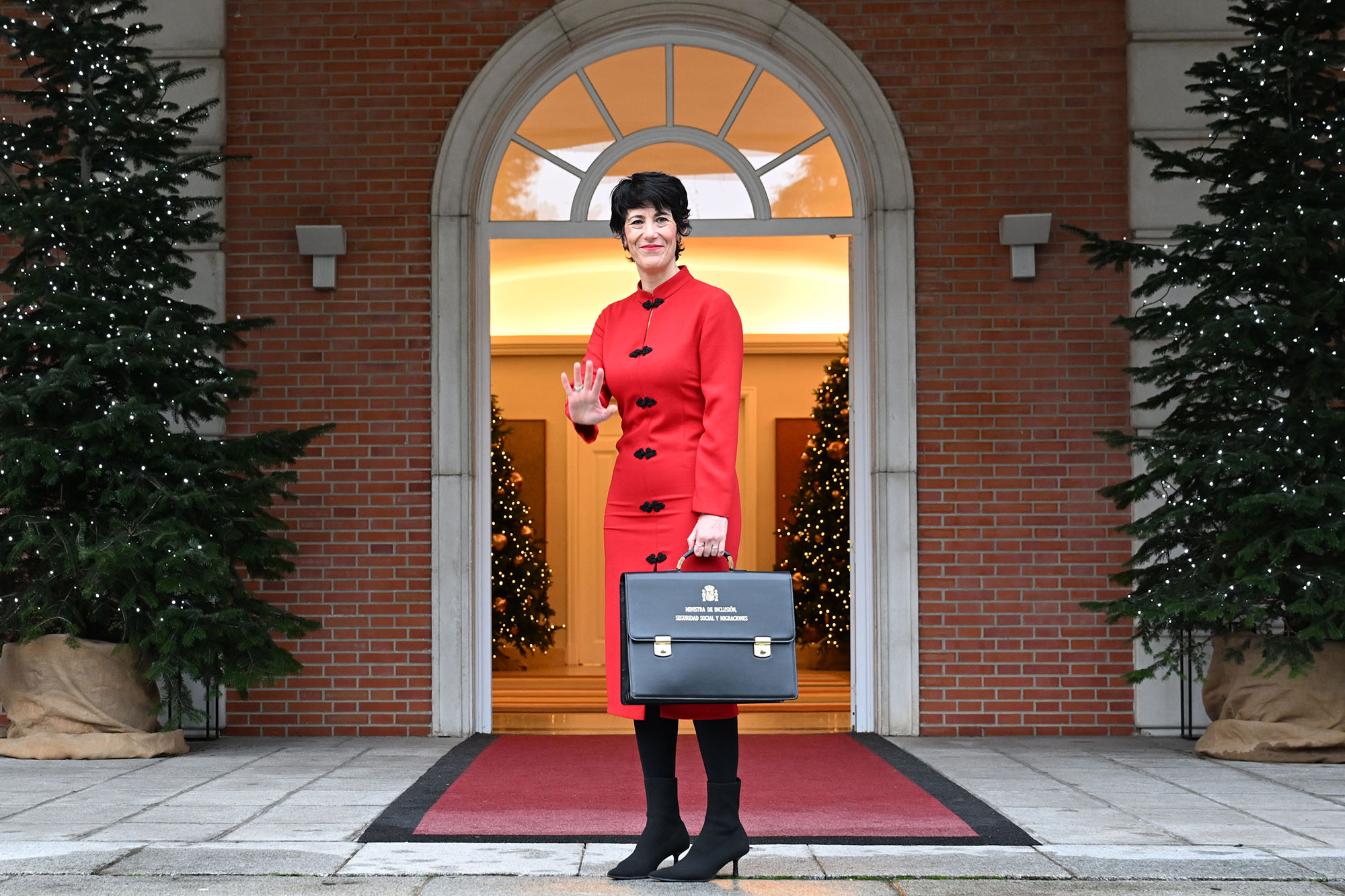 The Minister for Inclusion, Social Security and Migration, Elma Saiz, poses as the new Government Spokesperson on the steps of the Council of Ministers building | Pool Moncloa/Borja Puig de la Bellacasa
The Government Spokesperson recalled during her address that in 2018 pension increases were not guaranteed, a situation that led to a "social and political response" after which a new framework was established to increase pensions above the Consumer Price Index (CPI) to guarantee minimum income thresholds.
In this context, Saiz announced that in 2026 minimum pensions will increase by more than 7%, a percentage that, in the case of some pensions-such as minimum pensions with a dependent spouse or widow's pensions with dependent children-will be even higher, reaching 11.4%. Non-contributory pensions and the Minimum Basic Income will also be increased by 11.4%, as explained by Saiz, who asserted that this measure constitutes "further proof of the government's commitment to supporting those who need it most".
"Our system, which is based on solidarity and contributions, is a fundamental shield for many families", the minister stressed, citing an APN study that shows pensions save almost 8 million people from poverty and reduce the national poverty rate by 16.4 percentage points.
Measures for firefighters, forestry and healthcare workers
The text approved by the Council of Ministers also outlines other measures related to Social Security, among which Elma Saiz highlighted those aimed at environmental agents, forest firefighters, and healthcare workers.
In relation to the first two groups, who according to Saiz "risk their lives every year to protect our towns, forests, and homes from devastating fires", an additional contribution has been approved so that environmental agents and forest firefighters can retire early, "a fair measure that I am especially proud of", she added.
In addition, in response to the significant positive reception this initiative has received, the option for general practitioners, family doctors, and paediatricians to combine their retirement pension with their work has been extended for another year. "We are doing this because we believe it is beneficial and, moreover, it has yielded very favourable results: between 2023 and 2025, more than 1,200 professionals have taken advantage of this measure", Saiz concluded.
Those who benefit the most: the self-employed, vulnerable families and those affected by fires
The approved royal decree-law also includes technical aspects, such as the updating of the social security contribution bases and the contribution table for self-employed workers for 2026, which remains unchanged from 2025. Furthermore, the suspension of evictions and foreclosures for vulnerable families without alternative housing is extended throughout 2026, as are the compensation payments from the affected landlord or property owner.
In the energy sector, the new Royal Decree-Law maintains, until 31 December 2026, the guarantee of electricity, natural gas, and water supply for vulnerable consumers, as well as the current electricity social tariff discount levels, set at 42.5% for vulnerable consumers and 57.5% for severely vulnerable consumers.
 The Minister for Inclusion, Social Security and Migration and Government Spokesperson, Elma Saiz, explains the agreements adopted by the Council of Ministers. | Pool Moncloa/Borja Puig de la Bellacasa
Other energy-related measures that will remain in place until the end of 2026 include tax incentives for individuals and businesses to purchase electric vehicles, install electric charging points (with deductions of up to 15% on personal income tax), and for energy efficiency improvements and renovations to refurbish homes or buildings (with deductions of 20%, 40%, or 60%).
A new exemption from personal income tax (IRPF) is also established for compensation for personal injuries sustained in the forest fires last summer in several autonomous communities, along with an extension of aid for the reconstruction of municipalities affected by the DANA storm.These measures are complemented by existing exemptions from personal income tax and corporate income tax for the professionals and companies affected. To further bolster reconstruction efforts, among other measures, the exceptional authorisation granted to the Valencian Community to undertake new borrowing operations is extended to 2026.
A commitment to public transport to guarantee equality and territorial cohesion
The Council of Ministers has approved two major lines of action to promote public transport as a tool for social cohesion, equal opportunities, territorial balance, and to advance the ecological transition, as highlighted by both the Government Spokesperson and the Minister for Transport and Sustainable Mobility, Óscar Puente.
The first measure is the extension, as of 1 January and for the whole of 2026, of the current public transport subsidies. The second initiative is the implementation of a single travel pass, which will cover state-owned interregional buses and commuter and regional trains, as announced by the President of the Government of Spain, Pedro Sánchez, during his review of the last six months of the year. The two decisions will represent an economic injection of more than €1.371 billion.
The minister stressed that "this government has acted consistently and with a long-term vision since 2018, and even more intensively since 2022, with a clear objective: to improve, facilitate, make more accessible, and promote the use of public transport in a structural way".
 The Minister for Transport and Sustainable Mobility, Óscar Puente, speaks at the press conference following the Council of Ministers meeting. | Pool Moncloa/Borja Puig de la Bellacasa
In this regard, Óscar Puente reviewed the government's investments in public transport from 2018 to the present, which total €9.29 billion and will reach €11 billion by the end of 2026. He stated that this improvement in affordability has resulted in an increase in journeys made, surpassing pre-pandemic levels.
Extension of public transport subsidies
From 1 January 2026, all subsidies in effect during the second half of 2025 will remain in place, adapted to the different services and regions.
Óscar Puente specified that children under 14 will continue to travel free on state-run bus services. The 10-trip pass will maintain its 40% discount, the monthly pass will maintain its 50% discount, and the youth pass (up to age 26) will maintain its 70% discount.
The regulation also includes the extension of subsidies to autonomous communities and local authorities for urban and interurban public transport under their jurisdiction. Free travel for children, the 50% discount for young people up to age 26, and the 20% discount on all other passes will remain in effect.
As a new measure, the minister announced that the government will finance 20% of the cost without requiring the autonomous communities to contribute the other 20%: "We're leaving it up to them. If a community wishes to join in and finance another 20% or whatever amount it deems appropriate, it may do so, but it will not be bound by the royal decree".
Furthermore, specific subsidies for frequent travellers in territories with unique characteristics, such as the Canary and Balearic Islands, will continue with free public land transport, and in Asturias and Cantabria, with free commuter rail.
Renfe discounts
The minister added that Renfe will extend the 10-trip commuter rail pass, the monthly passes with unlimited travel for €20 and €10 for young people, and free travel for children under 14, valid in all areas. Free travel for children on special Media Distancia and Avant services will continue, as will the 40% discounts on monthly passes and 10-trip passes. And the 50% discount on general Avant services is extended.
 The Minister for Transport and Sustainable Mobility, Óscar Puente, during the press conference. | Pool Moncloa/Borja Puig de la Bellacasa
During his speech, Puente noted that since the implementation of these subsidies, Renfe has sold 22 million free or discounted season tickets across Cercanías (commuter rail), Media Distántica (medium-distance rail), and Avant services, resulting in savings of over €1.7 billion for rail users.
New "Pase Vía" pass for Avant and fares
Óscar Puente announced that Avant multi-trip tickets will be discontinued and replaced by new tickets. The "Pase Vía" will be a three-month pass valid for any Avant origin and destination, with a discount that increases with each trip: "It will start at 45% on the first trip and reach up to 72% depending on the total number of trips taken", the minister explained.
Avant services also offer a 10-trip pass valid for 30 days with a 50% discount.
Other RENFE fares
The Minister for Transport indicated that Cercanías (commuter rail) will offer a 40% discount starting with the fifth trip using the Cronos System, meaning paying with a bank card directly at the turnstiles and validators. Furthermore, on the Media Distancia (medium-distance) narrow-gauge network, round-trip discounts are increasing from 7% to 20%, and a maximum price of €7 is set for tickets purchased in Plaza H.
Launch of the Single Travel Pass
The Single Travel Pass covers Cercanías, Rodalíes (commuter rail), and Media Distancia Renfe services, as well as state-owned interregional buses, and costs a single flat rate of €60 for adults and €30 for young people under 26. It will be registered to a specific person and will be available from 19 January.
Puente pointed out that the pass currently only includes state-run public transport, but the ultimate goal is for all metropolitan urban transport networks to be incorporated into this single ticket, making it easier for citizens to travel throughout Spain using local transport. The minister also clarified that the Single Travel Pass does not replace existing tickets and discounts, but rather complements other available offers.
Other agreements
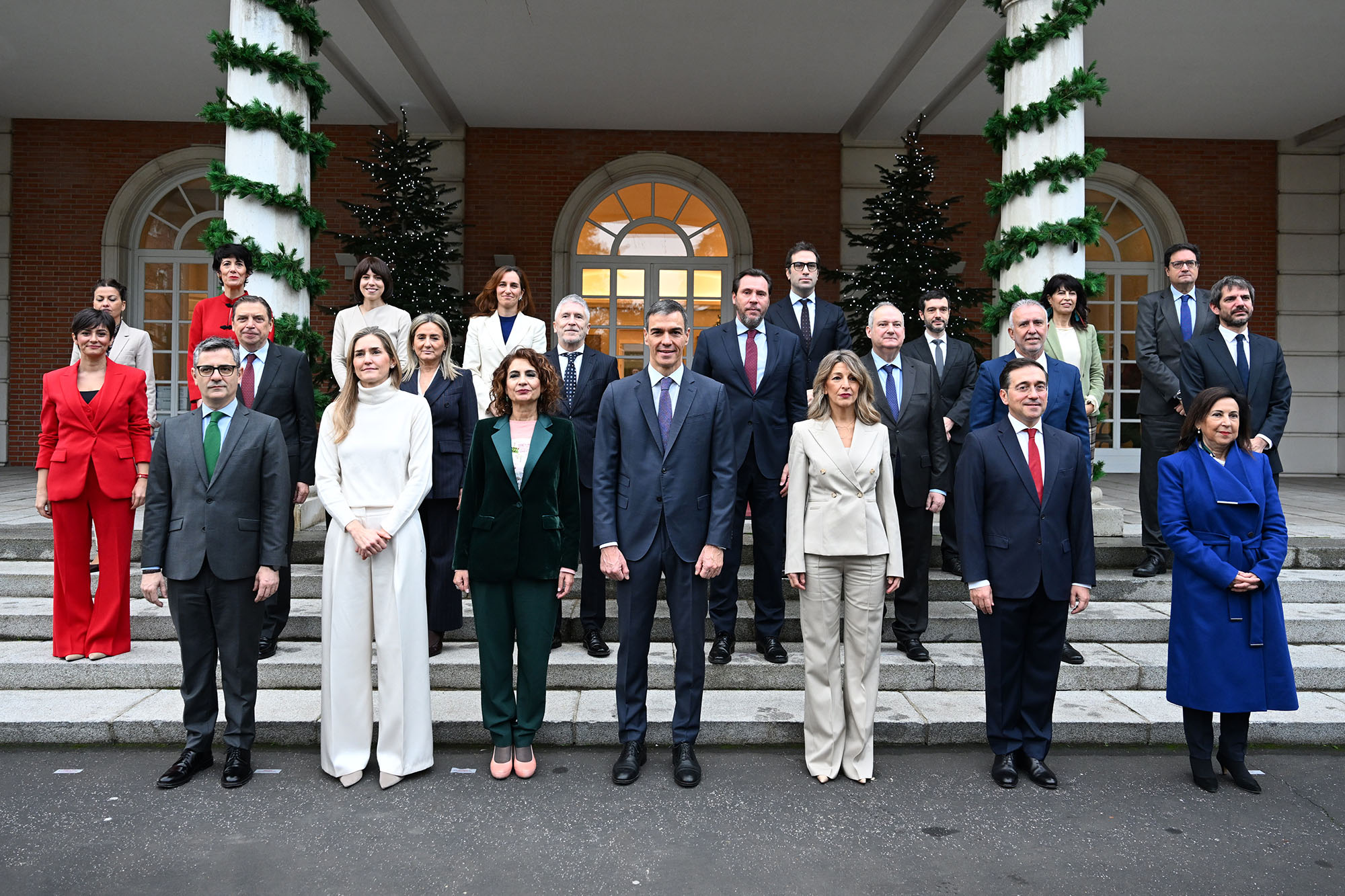 Group photo on the steps of the Moncloa Palace following the latest cabinet reshuffle. | Pool Moncloa/Borja Puig de la Bellacasa
During her presentation, the spokesperson announced that the Government will maintain the €315 million budget for agricultural insurance subsidies in 2026 as a demonstration of its "strong commitment to the agricultural sector at this crucial and very difficult time".
The Executive also approved the 2024 Annual Report on Foreign Action, which, according to Elma Saiz, "accounts for all the actions carried out, the objectives achieved, and the resources mobilised internationally throughout 2024". The report highlights Spain's role in promoting peace in Ukraine and Gaza, its commitment to Europe, and also to the Ibero-American community.
Current Affairs
The new spokesperson emphasised that the National Statistics Institute has published the National Accounts data for July to September, confirming the growth in Gross Domestic Product (GDP) and corroborating the dynamism of the Spanish economy: "This marks the ninth consecutive quarter with quarterly growth equal to or greater than 0.6% of GDP compared to the previous quarter. These figures and the information already available for the last period of the year, back up the forecasts made by the Government and also by the main national and international institutions of GDP growth of 2.9% or higher in 2025.
In Elma Saiz's opinion, these figures show that the economy is still going strong and Spain continues to be "the economic engine of Europe". This growth, she argued, is based on investment and private consumption, which adds an additional component of sustainability.
"Spain benefits from our policies and needs them. We will develop these economic policies that are good for society. "We will continue to increase the purchasing power of citizens and, at the same time, we will continue to reduce the inequality gaps that still exist", the spokesperson concluded.
Non official translation