Council of Ministers
The Government of Spain begins the process to guarantee the voluntary termination of pregnancy in the Constitution
Council of Ministers - 2025.10.14
Moncloa Palace, Madrid
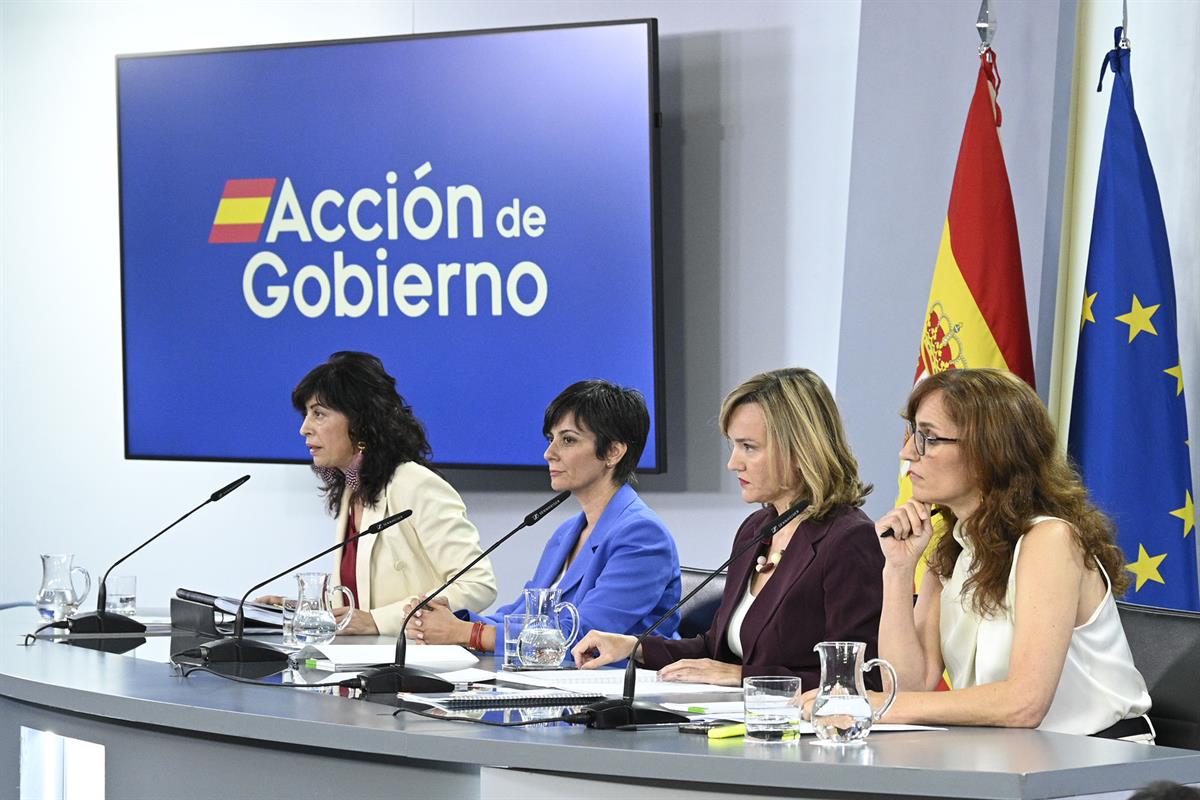 The Ministers for Equality, Ana Redondo; for Housing, Isabel Rodríguez; for for Education, Vocational Training and Sports, Pilar Alegría; and for Health, Mónica García, at the press conference after the Council of Ministers (Pool Moncloa / Jose Manuel Álvarez)






The Council of Ministers has approved the draft bill to reform article 43 of the Constitution to guarantee women's right to voluntary termination of pregnancy.
The Minister for Equality, Ana Redondo, specified that article 43.4 will be added to the Constitution with this text: "The right of women to voluntary termination of pregnancy is recognised. The exercise of this right, in all cases, shall be guaranteed by the public authorities, ensuring its provision under conditions of effective equality, as well as the protection of women's fundamental rights".
Redondo added that a service guarantee will thus be recognised: "We are guaranteeing women's rights to the free termination of pregnancy as a service that must be provided within the public health system".
The Minister for Equality argued that today's decision responds to the reactionary wave, both national and international, that seeks to curtail women's rights and return them to bygone times, to outdated times when women were forced to fulfil certain roles tied to a patriarchal and sexist tradition. "Women's rights are at the centre of the reactionary wave, they are the direct target of the cuts, and that is why it is important to move forward," she said.
The minister stressed that another objective of the reform is to strengthen public health, as this right is incorporated into the framework of article 43 of the Constitution, linked to the right to health and the public health system. In certain autonomous communities, she stressed, the quality of the public health service is going down and there is a clear push toward privatisation and outsourcing of services that specifically affect the voluntary termination of pregnancy. "We want to guarantee, within the public portfolio of services, the voluntary termination of pregnancy and, therefore, to ensure that this right is provided within the public health system," she said.
Ana Redondo reiterated that the government will not tolerate cuts and rollbacks of rights and will take all necessary measures to ensure they do not occur now or in the future.
In this regard, the minister looked back at women's struggle in their historic right to decide over their own bodies and recalled that we are celebrating 50 years of freedom in Spain and the 40th anniversary of the first law on voluntary termination of pregnancy.
The reform of Article 43 of the Constitution is being processed
 The Minister for Equality, Ana Redondo, during the press conference after the Council of Ministers
The reform will be processed through the procedure provided for in Article 167 of the Constitution and will require a report from the Council of State and approval by a three-fifths majority in both the Lower House of Parliament and the Upper House of Parliament, the minister explained. In the event of disagreement, a Joint Lower-Upper House Committee would be set up to propose a new text, which would then be put to a vote again. Approval would then require a two-thirds vote in the Lower House of Parliament and an absolute majority in the Upper House of Parliament. Ana Redondo also pointed out that a ratification referendum could be called if requested by one-tenth of the members of the lower or upper houses of parliament.
The minister called on the opposition parties to rise to this challenge and join in the defence of women's rights: "We will carry out educational work to inform and explain the project. We will meet with the whole parliamentary spectrum".
"An overwhelming majority of Spanish citizens are in favour of this constitutional reform, and what we aim to do is to transfer that broad social majority to the institutional majority, to the parliamentary majority, which is the one that must endorse this reform. We will work tirelessly, without pause," she concluded.
Register of objectors to the voluntary termination of pregnancy
 The Minister for Health, Mónica García, during the press conference after the Council of Ministers | Pool Moncloa / Jose Manuel Álvarez
The Council of Ministers addressed the obligation of the autonomous communities to maintain a register of healthcare professionals who are conscientious objectors to the voluntary termination of pregnancy. The Minister for Health, Mónica García, explained that the Executive will be issuing a formal request to the three communities that do not comply with this mandate of the organic law on sexual and reproductive health. "The law must be obeyed, full stop," she said.
The register, according to the Minister for Health, is not something that is optional or a "fad", but rather a legal obligation and an essential tool to ensure that the rights of professionals are compatible with women's right to voluntarily terminate pregnancies under conditions of equity, safety, and respect.
Mónica García recalled that on 16 December 2024, the Plenary Session of the Interterritorial Council of the National Health System (SNS) approved, with the favourable vote of all the autonomous communities, the protocol for the register of objectors that implements the provisions of the law. The minutes of that meeting were approved and signed on 4 April 2025, and the Ministry of Health has since closely monitored the implementation of the register through the High Inspectorate of the National Health System.
One month to respond to the Government's request
According to the minister, the "vast majority" of the communities have complied with the obligation or are in the process of doing so; the exceptions are Aragón, the Balearic Islands and the Community of Madrid. "There are three communities that have done nothing, but only the Community of Madrid has been explicit in its failure to comply with the law," said Mónica García. The minister pointed out that the Madrid region does respect the law with regard to the register of conscientious objectors to participation in euthanasia. "It is a normal procedure within our legal system and our healthcare system," she said.
The three communities have one month to respond to the government's request and stop breaching the law. After this period, the Executive has two months to go to court and file an administrative appeal.
The Minister for Health stressed that the Constitutional Court's jurisprudence establishes conscientious objection as an active and individual procedure. "Bypassing this procedure not only violates the rights of women, but also the rights of professionals who wish to actively and individually exercise their right to object," she argued.
More land for public housing
The Council of Ministers has authorised the incorporation into the State Housing Entity of eight penitentiary infrastructures and land previously owned by the Ministry of Home Affairs. The Minister for Housing and Urban Agenda, Isabel Rodríguez, framed this agreement within the Executive's commitment to use all state resources to guarantee the right to housing. "Our goal is to have a public housing stock that guarantees this right as soon as possible," she stressed.
 The Minister for Housing and Urban Agenda, Isabel Rodríguez, during the press conference after the Council of Ministers | Pool Moncloa / Jose Manuel Álvarez
Rodríguez recalled that this is the third incorporation of assets into the new state entity, following the conversion of former barracks into land for housing and the assignment to that state entity of housing included in the Sociedad de Gestión de Activos Procedentes de la Reestructuración Bancaria (SAREB).
Collaboration with municipalities and local residents
The plots transferred today, valued at €78 million, will be used to build public housing, benefiting 1,332 families in five autonomous communities. Isabel Rodríguez also stressed that in these places there were situations of repression and deprivation of freedoms and rights "that need to be remembered and redefined".
The minister also pointed out that the land is located in urban centres, so it will serve to strengthen neighbourhood coexistence. To this end, the Ministry of Housing and Urban Agenda will be working on these urban developments with the residents of these areas, as well as with the relevant authorities. Isabel Rodríguez this morning called on the town councils involved to speed up the process of converting the land into houses as much as possible.
The most significant development in terms of the number of homes and their value for democratic memory is the Carabanchel prison grounds in Madrid. Up to 508 homes can be built on its 27,000 square meters, which will also provide continuity to the work in the new Campamento neighbourhood.
The rest of the land is located in Seville, Cordoba, Denia (Alicante), Huesca, Zaragoza, Segovia and Briviesca (Burgos).
Also within the scope of the Ministry of Housing and Urban Agenda, the Council of Ministers has regulated the composition and operation of the Council for Architectural Quality, as established in the Architecture Law approved during the previous term of office.
Other topical issues: Middle East Peace Plan
 The Minister for Education, Vocational Training and Sports and Government Spokesperson, Pilar Alegría, at the press conference after the Council of Ministers | Pool Moncloa / Jose Manuel Álvarez
The Minister for Education, Vocational Training and Sports and Government Spokesperson, Pilar Alegría, referred during her speech at the press conference to the signing of the Middle East Peace Plan which took place this week in Egypt. An act that, according to the spokesperson, "opens a horizon of hope in Gaza" for the consolidation of a "just and lasting" peace in the region.
The minister stressed that Spain has played "a key and courageous role" in this process, in which it "led the way" as one of the first countries to demand recognition of the two states. For this reason, Alegría continued, following the release of the hostages and the resumption of humanitarian aid access, "it is important to continue making progress toward consolidating peace, working on the reconstruction of Gaza, and making progress toward a two-state recognition solution".
Non official translation