Council of Ministers
The Government of Spain agrees measures to stop the genocide in Gaza and to support the Palestinian people
Council of Ministers - 2025.9.9
Moncloa Palace, Madrid
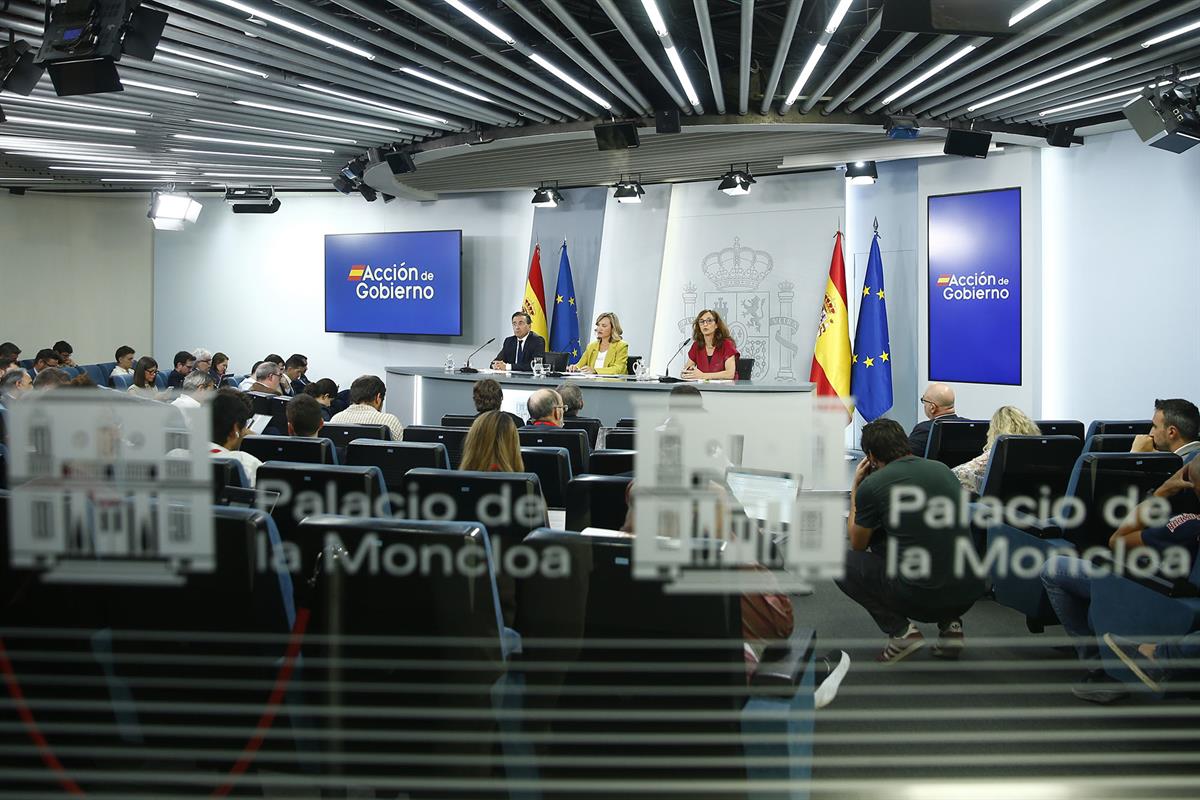 Ministers José Manuel Albares, Pilar Alegría and Mónica García during the press conference after the Council of Ministers (Pool Moncloa/César Porras)






The Council of Ministers has agreed on the measures to stop the genocide in Gaza and to support the Palestinian people announced yesterday by the President of the Government of Spain, Pedro Sánchez.
During the press conference that followed, the Minister for Foreign Affairs, European Union and Cooperation, José Manuel Albares, gave details of these initiatives, which are:
- The urgent approval of a Royal Decree-Law to legally consolidate the arms embargo on Israel that has been in place since October 2023.
- The extension of the ban on ships carrying fuels used by the Israeli armed forces from calling at Spanish ports.
- The ban on aircraft transporting military material to Israel from entering Spanish airspace.
- The ban on entry to Spanish territory of all those directly involved in the genocide, human rights violations and war crimes, who will also be included in the Schengen Information System. The minister cited the inclusion of Israel's National Security Minister Itamar Ben-Gvir and Finance Minister Bezalel Smotrich on the official list of barred individuals.
- Ban on the import of products from illegal settlements in the occupied Palestinian territories.
- Limitation of consular services provided to Spanish citizens residing in illegal Israeli settlements to the minimum legally required assistance.
- Reinforcement of the Government of Spain's financial support to the Palestinian Authority and the establishment of new cooperation projects.
- Increase in the humanitarian aid and cooperation budget for Gaza, which is to reach 150 million euros by the end of this year.
- Extension of the Spanish contribution to the United Nations Relief and Works Agency for Palestine Refugees in the Near East (UNRWA), with a further 10 million euros, in addition to the amounts that the government had already tripled, specifically earmarked for the relief of the Gazan population.
 The Minister for Foreign Affairs, European Union and Cooperation, José Manuel Albares, during the press conference after the Council of Ministers | Pool Moncloa/José Manuel Álvarez
José Manuel Albares stressed that "these are nine urgent measures that show the government's commitment to peace and respond to the overwhelming majority of Spanish people's feelings towards the war, the unacceptable violence and the famine to which civilians, women, girls and boys are unjustly subjected in the 21st century".
"These measures are not against the people of Israel, they are for peace, for human rights and for peace and security for all in the Middle East, including the people of Israel. We have always defended the right of the people of Israel to have a state and to their security, but the Palestinian people have exactly the same right," he added.
The minister reiterated that "Spain is firmly committed to peace, human rights and international law in Gaza and the West Bank". He also recalled that the government condemned from the outset "the horrible attack" that the Hamas terrorist organisation perpetrated on 7 October 2023 near the Gaza border, and has always demanded the unconditional release of all hostages.
Albares argued that Spain has led the international recognition of the State of Palestine, which other countries are now joining, as well as the implementation of the two-state solution. In this regard, the minister reviewed the measures promoted by the Executive in recent years to urge an end to the violence and support for the civilian population.
The Minister for Foreign Affairs also expressed his solidarity with the family and friends of the Spanish citizen killed yesterday in an attack in Jerusalem, as well as with the rest of the victims.
Modernisation of anti-smoking legislation
 The Minister for Health, Mónica García, during the press conference after the Council of Ministers | Pool Moncloa/César Porras
The Council of Ministers discussed the draft bill amending the law on health measures against smoking. The Minister for Health, Mónica García, pointed out that this is a "profound" and "long-awaited" reform, since "Spain has been at the forefront of the fight against tobacco". García recalled that in 2005 smoking was banned in enclosed spaces and in 2010 it was banned in bars and restaurants. "Times have changed, new products have appeared and there are new public health needs," she argued at the presentation of the bill.
The Minister for Health also stressed that tobacco causes 140 deaths a day in Spain, amounting to 50,000 deaths a year, and that 30% of cancer cases are related to the risk factor of smoking. The new law regulates all tobacco-related products decisively, with clarity and scientific evidence. It is a regulation," said Mónica García, "designed for the vast majority of the population who do not smoke, but also for smokers who want to stop smoking.
More smoke-free spaces and advertising restrictions
The first key element of the draft is the extension of smoke-free areas. When the law is approved, smoking will not be allowed on terraces, a measure that, according to the minister, is backed by science and the social majority. The ban extends to campuses, school playgrounds, sports facilities, public swimming pools, public shows, bus stations, platforms, bus shelters and work vehicles.
Mónica García pointed out that, for the first time, the ban affects new devices, vapes and tobacco-related products, which will also have to respect the protection perimeters of at least 15 metres around educational, health, cultural or sports centres, as well as parks and children's playgrounds.
Secondly, the law curbs the advertising, promotion and sponsorship of tobacco products and their derivatives. Advertising may not show people smoking or vaping in any media, including social media involving presenters, contributors or guests, and may not feature brands, logos or devices associated with tobacco and tobacco products. There will also be a ban on displaying these products in shop windows. In addition, penalties are being reinforced: anyone who breaches these rules could face heavy fines of up to 600,000 euros.
Thirdly, single-use, disposable e-cigarettes are to be removed from the market. These devices, the minister argued, have become the most attractive to young people and are particularly harmful to the environment because of the waste they generate. "They are strawberry-flavoured toxins," said Mónica García.
Boosting anti-smoking programmes
The fourth pillar of the reform is the setting up of the Observatory for the Prevention of Smoking, a joint working space for the Government, the autonomous communities, scientific societies and civil society to promote initiatives, programmes and activities that foster compliance with the law. In addition, it will set clear targets for reducing tobacco consumption, report every two years on the implementation and results of the regulation and help coordinate the work of the administrations responsible for tobacco marketing and consumption.
Finally, the draft bill promotes prevention, education and smoking cessation programmes within the healthcare network. "We want to continue promoting through our primary care network that people who want to quit smoking can do so through our National Health System," said Mónica García.
The minister reiterated the government's commitment to public health over commercial interests. "This is true freedom, the freedom to breathe clean air, to work without risking our health, to enjoy our leisure time without inhaling smoke and to live longer and better", she concluded.
Back to school with report on education
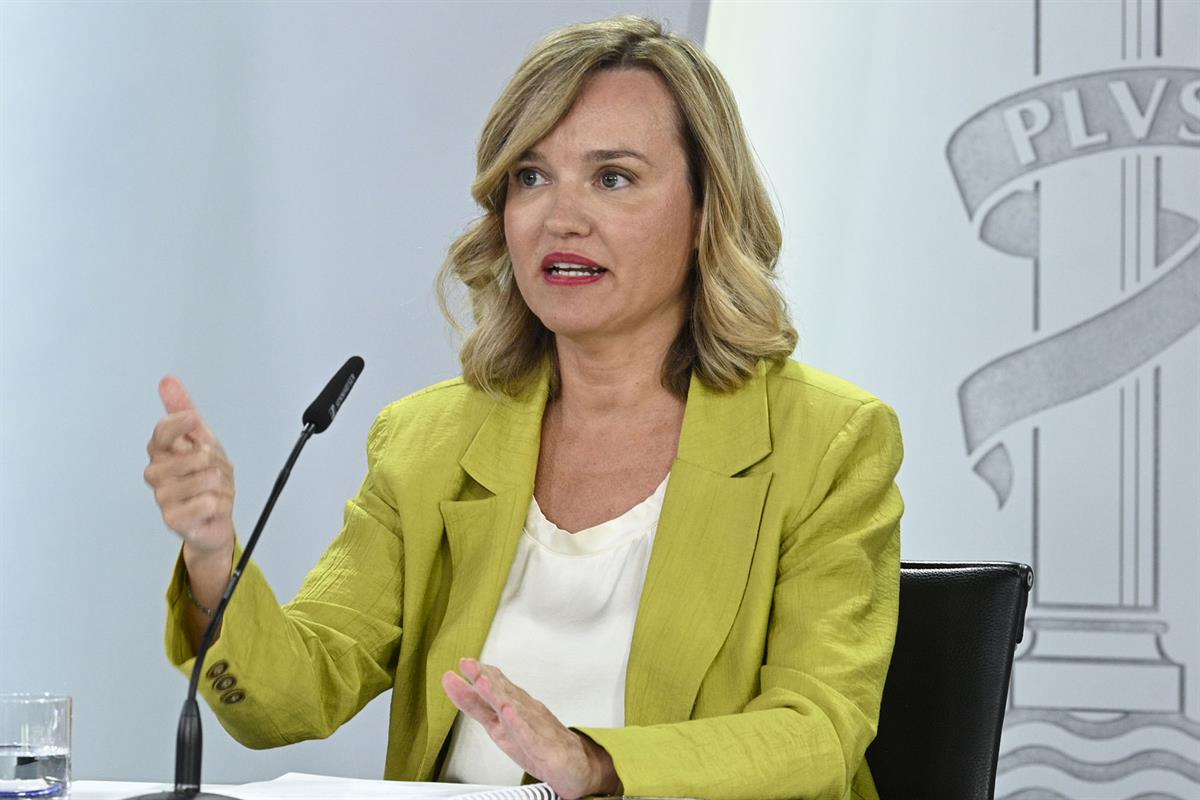 The Minister for Education, Vocational Training and Sports and Government Spokesperson, Pilar Alegría, during her speech at the press conference after the Council of Ministers | Pool Moncloa/José Manuel Álvarez
In the context of the start of the new school year, the Minister for Education, Vocational Training and Sports and Government Spokesperson, Pilar Alegría, presented the Council of Ministers with a report on the main advances made in recent years in the field of education policies, described by the minister as "fundamental" in their role as "a tool for guaranteeing equal opportunities and progress in a country".
Alegría pointed out that, despite the decrease of almost 30,000 students between this academic year and the previous one, the number of contracted teachers increased by 13%. She also highlighted the evolution of the education budget in Spain, which has increased by 104.5% in recent years, with a total of 6.730 billion euros allocated to this area. "If there is one increase that we should all feel very proud of, it is the growth in grants," continued the spokesperson, who said that the increase in the budget for educational grants since 2018 stood at 81.8%.
The minister also referred to the growth in the number of pupils in the first stage of pre-school education, which has led to the investment of 670 million euros in the creation of 60,000 new places for 0-3 year olds; the six current territorial cooperation programmes, with an investment of 382 million; the more than one million young people enrolled in Vocational Training and the reduction in the dropout rate. All these achievements reflect, according to the minister, a "clear commitment" by the government to education policies.
Grand Cross of Sporting Merit for Sergio Scariolo
The Council of Ministers has awarded the Grand Cross of the Royal Order of Sporting Merit to Sergio Scariolo, until now the coach of the Spanish national basketball team, who has just announced his retirement as national team coach after 15 years at the helm of the Spanish national team.
The Minister for Sports highlighted Scariolo's track record - which includes four gold medals and a bronze medal at the Eurobasket, two Olympic medals and a gold medal at the World Cup - although she placed the Italian coach's "mark of humanity and humility" above these sporting achievements.
Non official translation