Council of Ministers
Government approves agreements with regional governments to control temporary disability
Council of Ministers - 2017.8.25





Moncloa Palace, Madrid
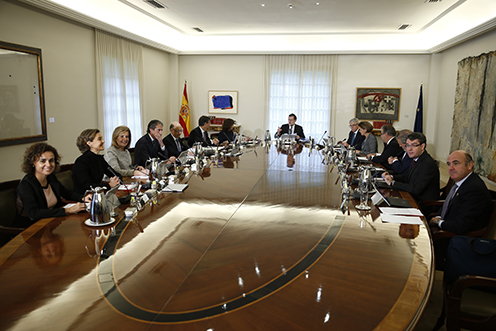
The Council of Ministers analysed the situation following the terrorist attacks in Catalonia, according to the explanation provided by the President of the Government, Mariano Rajoy, at the press briefing following the meeting.
Aside from this issue, the government approved collaboration agreements between all the regional governments - with the exception of the Basque Country and Navarre - and the National Institute for Healthcare Management (Spanish acronym: INGESA) to control temporary disability during the period 2017-2020.
The agreements will improve collaboration and coordination between the Public Health Services of the autonomous regions and the management and collaboration agencies of the Social Security system with the aim of controlling the provision of services without prejudicing workers.
The government also set the credit conditions to finance these agreements. One of the new features is the increase in the credit percentage allocated to the electronic transmission of medical reports for sick leave, confirmation and return to work. Furthermore, the training of primary aid doctors will be increased in regard to temporary disability benefits, the credit allocation for the management of proposed discharges sent to collaborating mutual insurance companies will be increased and electronic access to clinical records will be increased.
The aim of these measures is to ensure that national health spending is allocated to suitably protecting those workers that are on sick leave.
Technological modernisation of justice system
The government agreed on the criteria for the distribution of a 6-million euro credit among the regional governments with transferred powers on justice matters aimed at their technological modernisation.
At present, there are nine different procedural systems, which is very complicated to coordinate, thus resulting in a loss of quality in the service provided to citizens and professionals in the justice system.
The ministry has proposed a technologically and operationally advanced common system of procedural management that guarantees maximum efficiency and a cost saving for all public authorities. The new system will gradually replace the current one, incorporating the management of judicial affairs in an electronic format.
Research
The government has authorised the State Research Agency to put out a call for proposals for public subsidies at "Severo Ochoa" centres and "María de Maeztu" units of excellence".
The call for proposals, with a provision of 40 million euros, seeks to boost the quality of Spanish scientific research through the acknowledgement and accreditation of those centres and units that are internationally renowned for the results of their research.
Non official translation
Pool Moncloa / Archivo