Council of Ministers
Spain will contribute 153 million euros to the EU mechanism for refugees in Turkey
Council of Ministers - 2016.6.10





Moncloa Palace, Madrid
The acting Vice-President of the Government, Soraya Sáenz de Santamaría, recalled that the Summit of Heads of State and Government of the European Union with Turkey, held on 29 November 2015, tackled the creation of a mechanism for refugees in Turkey with an initial allocation of 3 billion euros to be contributed over a period of four years. This instrument, she pointed out, seeks "to offer additional humanitarian aid to refugees located in that country and to the host communities there, thus contributing to greater coordination and effectiveness of the measures taken by the EU and at national levels".
Of these 3 billion euros, 1 billion will be financed under the European Union budget and the remaining 2 billion through national contributions, which are determined according to the relative participation of each country in the overall Gross National Income of the European Union.
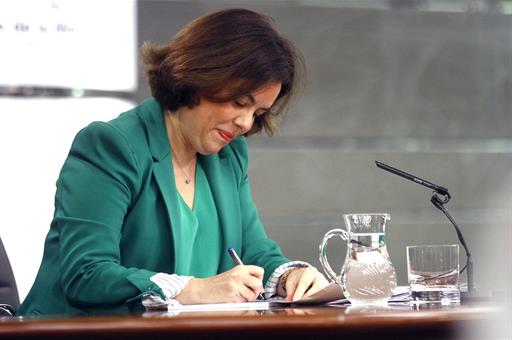
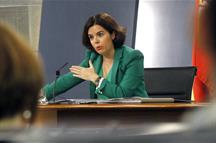 Pool Moncloa/JM.CuadradoSoraya Sáenz de Santamaría confirmed that Spain will make a contribution of almost 153 million euros to the mechanism for the period 2016-2019, as announced by the Minister for Foreign Affairs and Cooperation, José Manuel García Margallo, in the Lower House of Parliament on 17 February this year.
The Vice-President of the Government underlined that the European Union is speeding up the pay out of the funds under the mechanism "to cater for the most urgent needs, provide healthcare, education and employment training services, actions to help manage the flow of immigration and to build the infrastructures necessary in the host communities".
The government has already relocated 124 refugees from Greece and Italy and in the next fortnight it will resettle another 285 from Lebanon, according to the overview provided by the Vice-President of the Government. The arrival of the first refugees under the "one-for-one" mechanism deriving from the agreement between the EU and Turkey is also scheduled to take place soon.
On another note, Soraya Sáenz de Santamaría referred to the Justice and Home Affairs (JHA) Council held on Friday in Luxembourg. At this forum, Spain announced that it will relocate 200 new refugees from Greece and resettle another 200 from Turkey in the next quarter.
The Vice-President of the Government highlighted that Spain undertook to take in 17,000 refugees and is now placed "as the fourth-ranked leading country in the European Union in terms of effective procedures for relocation and resettlement".
New access to Port of Barcelona
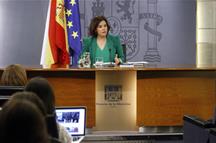 Pool Moncloa/JM.CuadradoThe Council of Ministers authorised the signing of two partnership agreements for the implementation, operation and development of the New Southern Railway Access Line to the Port of Barcelona, with an estimated cost of 149.8 million euros.
The Vice-President of the Government pointed to the importance of this access line for boosting intermodality between sea and railway transport. She also highlighted that the agreements have been endorsed "following a tremendous technical effort and sincere and loyal dialogue between the public authorities involved", including the Ministry of Public Works and the Regional Government of Catalonia.
The agreements, on the one hand, involve the transfer of a stretch that belongs to the Railway Department of the Regional Government of Catalonia to ADIF in order to include this in the railway network of general interest and the technical solution designed will be developed along that stretch. On the other hand, they regulate the financial contributions to be made by the parties in order to develop the access line: ADIF will contribute 77.4 million euros and the Port Authority of Barcelona a further 72.6 million.
Soraya Sáenz de Santamaría recalled that the Port of Barcelona is the third largest port in Spain in terms of volume of activity and one of the three most important in the world in container traffic, with this new access line being framed within the commitment to the Mediterranean Corridor.
Development of mining districts
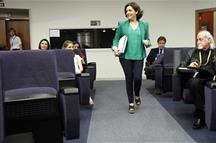 Pool Moncloa/JM. CuadradoThe government authorised subsidies aimed at business projects that generate employment in the mining districts. The call for this round of subsidies, with a provision of 40 million euros, will be carried out through the Institute for the Re-structuring of Coal Mining and the Alternative Development of Mining Districts.
The Vice-President of the Government explained that these subsidies will help fund investment projects over the period 2017-2020 and that each of these must create a minimum of three new jobs, although in order to facilitate self-employment this commitment may be reduced in the case of those local authorities worst affected by the closure of mining companies.
As a result of this action, one of the points agreed between the government and the social stakeholders within the Framework of Action for Coal Mining and Mining Districts 2013-2018 will thus be complied with, pointed out Soraya Sáenz de Santamaría.
On another note, the acting Minister for the Treasury and the Public Administration Services, Cristóbal Montoro, reported to the Council of Ministers on the agreements adopted by the Delegate Committee for Economic Affairs last Wednesday.
Other agreements
• Regulation of subsidies for cooperation activities on projects for the sustainable supply of biomass. The budgetary provision amounts to 1.2 million euros, of which 990,000 come from the European Agricultural Fund for Rural Development.
• Partnership agreement for the creation of the Inter-administrative Commission on the event of exceptional public interest entitled "Cantabria 2017, Liébana Jubilee Year".
• Emergency works to repair the damage caused by flooding and storms in January and February 2016. The total investment amounts to 6.5 million euros: 1.5 million for the Ebro river basin, 2 million for the Miño-Sil river basin, 2.5 million for the Duero river basin and 0.5 million for the Jucar river basin.
• Authorisation of temporary residency of Sahrawi minors under the "Holidays in Peace" 2016 programme.
Current affairs
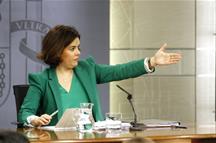 Pool Moncloa/JM CuadradoThe Vice-President of the Government pointed out that time has shown how the initiative, adopted in the last term of office, to approve the Budget for 2016 was "a good decision" which "has offered great stability". "A sensible decision that has avoided this country being brought to a standstill", she stressed.
When asked about the statements made by the President of the European Central Bank, Mario Draghi, on the labour reform of the Spanish Government, Soraya Sáenz de Santamaría remarked that both the Organisation for Economic Co-Operation and Development (OECD) and Mr Draghi himself have highly assessed the reforms undertaken by the Government of Spain in various reports, particularly the labour reform. In this regard, according to the Government Spokesperson, what is important in "this raft of reforms is that it has enabled something to happen in Spain that has never happened before: for any growth to immediately translate into job creation".
As regards the breakdown of the agreement to govern signed a few months ago between the CUP (Candidature for Popular Unity) and the CDC (Democratic Convergence of Catalonia), manifested by the refusal of the CUP to support the Budget for 2016 presented by the Regional Government of Catalonia, Soraya Sáenz de Santamaría maintained that this fact has placed the regional government in "a situation of impasse" which only leads to instability and uncertainty". "Leaving things in the hands of radicals leads to these outcomes", she concluded.
Pool Moncloa/JM.Cuadrado