Council of Ministers
Government challenges creation of Foreign Affairs Department of Regional Government of Catalonia
Council of Ministers - 2016.2.5





Moncloa Palace, Madrid
The Minister for Justice, Rafael Catalá, explained that following a favourable opinion from the Council of State, the Council of Ministers filed a challenge to the regional regulation in Catalonia because, despite taking into consideration the powers held by any regional government to organise its internal departments, "the competency for international relations is exclusively a State competency", as provided for in Article 149 of the Spanish Constitution.
Rafael Catalá added that the Constitutional Court has been asked to suspend this law because "the mere consideration of this department - the attribution of competency on international policy on foreign affairs to the Regional Government of Catalonia - is contrary to the distribution of powers between the State and the regional governments".
The minister pointed out that this decision must be placed in a context whereby "on the part of certain political bodies in Catalonia, the intent to elevate seeking independence onto the international stage has been made clear".
Rafael Catalá underlined that "the government is an acting government as a result of constitutional provisions, but the Rule of Law is never classified as acting, and hence, the protection, oversight and guarantee that the Constitution will be upheld, the constitutional order and the powers attributed to each public authority must be continuously observed". He also recalled that resorting to the Constitutional Court in the case of a conflict of powers is "the habitual manner in which to resolve discrepancies" between the State and the regional governments.
Pardon for María Salmerón
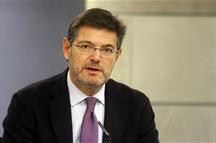 Pool Moncloa / J.M. CuadradoThe Council of Ministers decided to grant a partial pardon to María Salmerón, sentenced for an offence of disobedience.
The Minister for Justice recalled that, as a result of a divorce process, she was attributed the rights of custody over a young daughter while the father was granted visitation rights and sentenced for an offence of gender-based violence. After refusing to respect the father's visitation rights on multiple occasions, the mother was convicted of a series of offences of disobedience, one of which resulted in her being sent to prison.
The Minister for Justice pointed out that the right to a pardon allows the specific subjective social circumstances of cases to be analysed following a binding ruling. "The interest of the protection of the minor leads us to the consideration of invoking this partial pardon, substituting the deprivation of liberty by a sentence of community service", she said.
Rafael Catalá pointed out that María Salmerón also has other sentences pending enforcement while the pardons requested by her lawyers are being processed.
Guarantees for SMEs
The government authorised the Regional Government of Murcia to grant guarantees to SMEs for a maximum amount of 25 million euros.
The Vice-President of the Government, Soraya Sáenz de Santamaría, explained that the beneficiaries will be small- and medium-sized enterprises and companies with a medium level of capitalisation that have their registered office in this region and carry on investment projects therein, under the terms provided for in the corresponding agreement with the Official Credit Institution (Spanish acronym: ICO).
Zero tolerance on female genital mutilation
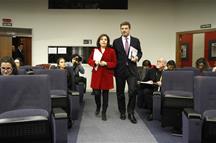 Pool Moncloa / J. M. CuadradoOn the occasion of the International Day of Zero Tolerance on Female Genital Mutilation on 6 February, the Council of Ministers approved an institutional declaration that classifies this phenomenon as a "serious violation of human rights" and as a "manifestation of violence against women and girls".
The Vice-President of the Government asserted that it is estimated that at least half a million women and girls in Europe are at risk of this form of mutilation, which is classified as a criminal offence in Spain in all its forms.
The government, she stressed, has been pushing through measures and actions "not only to prosecute this practice, but also to prevent and care for those who suffer from it". At the Equality Sector Conference held in 2014, she pointed out that this issue was included for the first time on the common work agenda with the regional governments.
Current affairs
When asked about whether Spain's position will be agreed upon in respect of the European Council to be held on 18 and 19 February, the Vice-President of the Government pointed out that the State Secretary for Parliamentary Relations held talks with the spokespersons of the main political groups to convey the intention to tackle with them the progress of work that will take place with the EU on the continued membership of the United Kingdom.
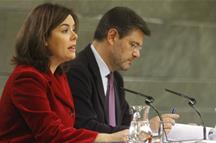 Pool Moncloa / J. M. CuadradoGiven the importance of this issue, the government wants the State Secretary of the European Union to appear at the corresponding committee to report on the issue.
As regards whether it is appropriate for the President of the Government or the ministers to appear in the Lower House of Parliament to submit to its control, the Government Spokesperson argued that, in a system with separation of powers such as in Spain, the acting government "does not have parliamentary confidence from the House". Whilst it had this confidence in the previous legislature, that is no longer the case, she clarified, and hence "control does not correspond to the Lower House, but rather to the judicial review courts".

Pool Moncloa / J. M. Cuadrado