Council of Ministers
Government approves Stability Programme and National Reform Plan
Council of Ministers - 2014.4.30





Moncloa Palace, Madrid
The Council of Ministers approved the Stability Programme 2014-2017 and the National Reform Programme 2014, that have been submitted to the European Commission
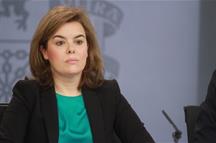
The Vice-President of the Government, Soraya Sáenz de Santamaría, highlighted that both documents demonstrate how Spain has met and even improved on the economic forecasts made a year ago, although it considers that more work still needs to be done. Furthermore, she remarked that these forecasts will ensure greater growth. "Spain has overcome the recession, it will grow by double the amount that was forecast a year ago, it is meeting its fiscal consolidation objectives and, furthermore, it will improve them in order to provide stability and meet our tax reform objectives".
Soraya Sáenz de Santamaría added that this improvement in expectations allows us to assert that "Spain will have fewer people out of work at the end of 2015 than at the end of 2011" and that employment will grow by more than was anticipated.
National Reform Programme
 Pool Moncloa
The Vice-President of the Government highlighted that the priority aim of the National Reform Programme 2014 is to consolidate economic recovery so that growth can be sustainable and thus help foster job creation.
Soraya Sáenz de Santamaría explained that the main lines of the programme are the tax reform, measures to boost the financing of the economy and to drive the mobilisation of credit, initiatives to foster current and future competitiveness, the battle to combat unemployment and the modernisation of the public administration services.
The Vice-President of the Government remarked that it is necessary to achieve "stable, quality employment to consolidate the path of reducing unstable employment". To that end, the Spanish Strategy to Activate Employment 2014-2016 will be implemented, that will bring together active and passive policies to a greater degree, the National Plan to Implement the Youth Guarantee, which has a provision of 1.89 billion euros of funding from the EU, and measures will be promoted to reinforce the return to the labour market of groups that have the greatest difficulties in finding a job. Actions will also be implemented at a social level that will complement the government's commitment to maintaining the Welfare State.
 Pool Moncloa
Soraya Sáenz de Santamaría underlined that "the path to fiscal consolidation has been achieved while maintaining the purchasing power of pensions, unemployment benefits and social policy". It should also be added that the National Action Plan for Social Inclusion 2014-2016 and the Comprehensive National Strategy for the homeless will be implemented.
As regards the reform of the public administration services, the government calculates that 50% of the measures included in the plan drafted by the Committee for the Reform of the Public Administration Services (Spanish acronym: CORA) have already been completed. Furthermore, she pointed out that the National Reform Plan contains a democratic regeneration programme to strengthen institutions and enhance the fight against corruption.
Updating of the Stability Programme 2014-2017
 Pool Moncloa
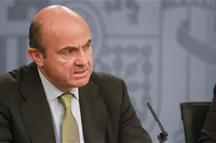
The Minister for Economic Affairs and Competition, Luis de Guindos, asserted that the macroeconomic chart 2014-2017 shows "a projection of prudent growth". This year, economic growth is forecast of 1.2% of the Gross Domestic Product, in 2015 of 1.8%, in 2016 of 2.3% and in 2017 it will reach 3%. Average growth between 2014 and 2015 will stand at 1.5% according to the minister's estimations.
Luis de Guindos highlighted that both internal and external demand will contribute positively to growth. 2014 will be the first year to see growth in internal demand following six years of negative figures. Private consumption is also positive for the first time this year after three years of declines. As regards the construction industry, the minister pointed out that, after six negative years, it will now contribute positively to growth.
The minister remarked that the joint progress of exports and imports of goods and services will contribute to the Spanish economy having a financing capacity vis-a-vis the rest of the world of 2% this year and 2.4% next year, "which means that we are reducing our foreign debt by around 50 billion euros".
Luis de Guindos underlined that employment will grow for the first time since the start of the crisis. In national accounting terms, it will grow by 0.6% in 2014 and by double next year. As a result of these forecasts, 600,000 jobs will be created between the end of 2013 and the end of 2015 according to the Active Population Survey and the number of people out of work will fall by approximately 800,000.
The unemployment forecast for 2014 stands at 24.9%, representing a fall for the first time since the start of the crisis. Forecasts for 2015 put it at 23.3% and by 2017 it will fall below the 20% barrier, to stand at 19.8%.
According to the minister, during the legislature as a whole, the number of unemployed will be less by in excess of 100,000 people and the unemployment rate will be less than the rate at the end of 2011.
The Minister for Economic Affairs and Competition concluded his speech by commenting that "2014 will mark a before and after in the progress of the Spanish economy during the crisis".
Public deficit objectives
 Pool Moncloa
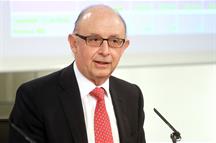
The Minister for the Treasury and the Public Administration Services, Cristóbal Montoro, announced the news of the proposal to reduce the deficit of the public administration services as a whole from the current 5.8% to 5.5% for 2014.
The minister asserted that as a result of these forecasts, the deficit in Spain will fall below 3% by 2016, thus complying with the commitment to stability demanded by the European Union. "The reduction of the public deficit will continue in 2017. The Government of Spain's proposal is that further progress be made in this reduction", maintained the minister.
He also pointed out that in order for Spain to definitively exit the crisis and stabilise the economic recovery, the public deficit needs to be reduced and to achieve that, it is not necessary to increase fiscal pressure but rather to reduce public spending by maintaining the measures implemented under the CORA plan. This reduction in the public deficit will principally take place in Central Government.
The public debt will stand at 99.5% in 2014, at 101.7% in 2015 but will fall to 101.5% in 2016 and to 98.5% by 2017.
Cristóbal Montoro confirmed that the fiscal reform being studied by the government will be presented in full in June and will come into force on 1 January 2015. The approximate impact of the Personal Income Tax reform as a whole will amount to 5 billion euros net between 2015 and 2016.
Cristóbal Montoro stressed that "there will be no more tax hikes other than those deriving from EU regulations, in other words according to law, but not from any other type of recommendation".
Current affairs
 Pool Moncloa
Pool Moncloa