The Government passes measures to foster business activity, investment and job creation
Council of Ministers - 2010.12.3





In the press conference following the meeting of the Executive Committee, First Vice-President, Alfredo Pérez Rubalcaba, announced that the Government will approve the reform of the pension system on 28 January prior to being forwarded to Parliament.
Meanwhile, the Second Vice-President and Minister for Economy and the Treasury, Elena Salgado, has explained that the purpose of the measures contained in the Royal Decree Law is to make our economy more competitive, reactivate investment, create employment, and open up new markets to foster growth.
The Royal Decree Law includes a raft of tax-related measures to stimulate economic activity and reduce taxes, especially for small- and medium-sized companies.
Elena Salgado explained that more companies will be able to benefit from the lower corporate income tax rate of 25%. This will be achieved by increasing the turnover threshold for companies eligible to be considered as SMEs from eight to ten million euros.
The Second Vice-President said that, after exceeding the threshold, companies "will be allowed to their keep small company status for tax purposes for a period of three years."
Incentive measures aimed at companies will also include the exemption from transfer tax and stamp duty on corporate transactions aimed at the creation, capitalisation and maintenance of companies.
Deregulatory measures
 Pool Moncloa
 The Vice-President went on to say that the Royal Decree Law also contains a raft of measures aimed at the deregulation of economic activity, among which she mentioned the removal of the obligation to belong to an official chamber of commerce. The reform makes membership of the Chambers of Commerce, Industry and Shipping and, therefore payment of the corresponding fees, voluntary.
Elena Salgado has said that, as of now, small companies "will not have to pay anything in respect of mandatory chamber of commerce fees", while for other companies there will be a transitory period "extending throughout 2011".
The Royal Decree Law also provides for the faster incorporation of companies by cutting down on bureaucracy and costs.
The Second Vice-President went on to say that, in order to make it easier to set up companies, "a company with a share capital of between 3,000 and 3,100 euros may now be set up in one day at a maximum cost of 100 euros". According to Elena Salgado, 90% of Spanish companies are incorporated with this level of capital.
The obligation to announce corporate events such as the company's incorporation, changes to Articles of Association, and capital reductions, by publishing them in the printed press is also removed. Salgado said that "publication by a digital medium will be sufficient."
Employment-related measures
The Second Vice-President has stressed that the Government will continue to pay special attention to the unemployed, and recalled that the Ministry of Work is designing new active employment policies.
In order to concentrate efforts to make it easier for the unemployed to access new jobs, the Royal Decree Law strengthens the Public Employment Service. In this respect, Elena Salgado stressed that the contracts of 1,500 job developers working in public employment services will be extended until December 2012, and a further 1,500 will be taken on to create "personalised pathways" for the unemployed, particularly for those who "have reached the end of their contributory benefits."
Today the Government has also studied the regulation of private placement agencies to enable them to collaborate with public employment services, although the final wording will be approved at a future Council of Ministers.
Social Security, AENA and Lotteries
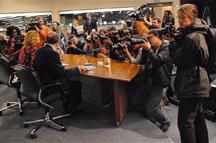 Pool MoncloaWith the aim of strengthening the Social Security system, the Royal Decree establishes that civil servants starting work in any government department as of 1 January 2011 will be insured under the general social security regime. As a result of this measure, Salgado says, "revenues of the General Treasury of the Social Security will continue to grow."
Meanwhile, the public business entity Loterías y Apuestas del Estado (the State lottery and gaming agency) will be modified to create an independent regulator, which will be attached to the Ministry of Economy and the Treasury until the future National Gaming Commission has been set up.
The Second Vice-President stressed that "the lottery outlets and their owners will continue to operate under exactly the same conditions as before, since the nature of the business will not change." She added that "A company will be set up, but it will continue to be a public company. For the moment it is only planned to privatise 30%".
The Government will also reform the airport management model with the creation of a State-owned company which will take over the management of the 47 airports that are now managed by AENA. Elena Salgado revealed that a minority percentage of private investment would be allowed to form part of the new corporate structure, which would maintain its public status.
The Vice-President said that the airports making up the network may be managed by means of the creation subsidiaries of AENA or under concessionary contracts, and went on to assure that "the rights of AENA employees will be wholly unaffected by these changes."
In the case of concessions, a supervisory authority will be set up in which the central government, the autonomous regions and, in some cases, municipal representatives will all participate.
Elena Salgado also highlighted the fact that the Royal Decree Law clarifies the working day of the air traffic controllers so that there will be no doubt as to their working hours.
Tobacco
The Royal Decree Law also provides for a "moderate" rise in taxes on tobacco. Elena Salgado justified the decision by saying, "The reason is basically a public health issue. By making tobacco more expensive, we will doubtless reduce consumption. In this case, it will also help to finance the revenue shortfall which we may have due to the tax cuts we have made."
The Vice-President estimated that tobacco tax revenues would rise by 780 million euros and pointed out that "prices will continue to be lower than in the United Kingdom, France or Germany".
Other resolutions
- The implementing bill of the Convention on the Rights of Persons with Disabilities was passed.
- Over 800,000 euros were earmarked to pay for private security services to protect the tuna fishing fleet operating in the Indian Ocean.
- The creation and regulation of the Council on the Representativeness of Associations of Self-Employed Workers.
- The figure of 47,021,031 people registered as resident in Spain on 1 January 2010 was declared official.
- Vote counting and other services for the local and autonomous region elections were contracted.
- 35 Gold Medals for Work Merit were awarded.
Current issues
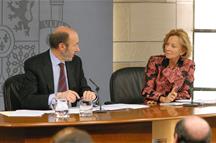 Pool MoncloaIn response to questions from journalists during the press conference after the Council of Ministers, the Second Vice-President recalled that the extension of the 426-euro benefit payment to those unemployed who had used up their unemployment benefit entitlement was ended by decree and is currently in parliamentary procedure, which is why no mention of it is made in this new decree passed today by the Council of Ministers.
With regard to whether these measures have been adopted as a result of market pressures, Elena Salgado insisted that "the principal fundamentals of our economy have not changed; they were the same this week as last. Since May, we have been immersed in a process of rapid fiscal consolidation and reforms, some of which have already been passed while others, such as pensions, have now received approval." In Salgado's opinion, "we must see market turbulence for what it is: turbulence."
The Vice-President also pointed out that the tax cuts for SMEs will come into force in 2011 and will be of a permanent nature. "The economic impact of these cuts, using the latest figures in our possession, would amount to around 230 million euros in 2011, about 70% of which, in cash accounting terms, would affect 2011 and the rest would affect the net tax amount."
Asked whether the Government's forecasts would be met, the Vice-President of the Economy reminded that "we are in December and our budget execution remains on track."
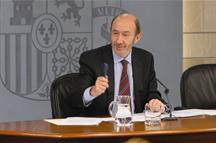 Pool MoncloaIn reply to questions from journalists, the First Vice-President, Alfredo Pérez Rubalcaba reiterated that relations with Morocco are "strategic, that is to say, extremely important, and they will continue to be so. In recent years we have made an effort to strengthen these bilateral relations and we have been successful. There is a basis of confidence which has not existed for some time and this confidence tells me that we will resolve any issue that might arise."
Asked about the march on Ceuta which Moroccan organisations and political parties have called for tomorrow, Saturday, Pérez Rubalcaba stated that "Ceuta and Melilla are totally safe, absolutely safe."
On the matter of the documents about Spain leaked through the Internet portal Wikileaks, the First Vice-President explained that "we are talking about some communiqués between the United States Embassy and their State Department. It is a two-way communication which reflects information, and a fair number of opinions, points of view, and suggestions which are solely of the writer" and so are "largely subjective."
Alfredo Pérez Rubalcaba stressed that the Spanish government is "scrupulous in its observance of the law and has never interfered with or pressured the courts of law".
Pool Moncloa