Grande-Marlaska: "We have raised disaster risk reduction to the highest political level within our Ibero-American community"
News - 2026.10.22
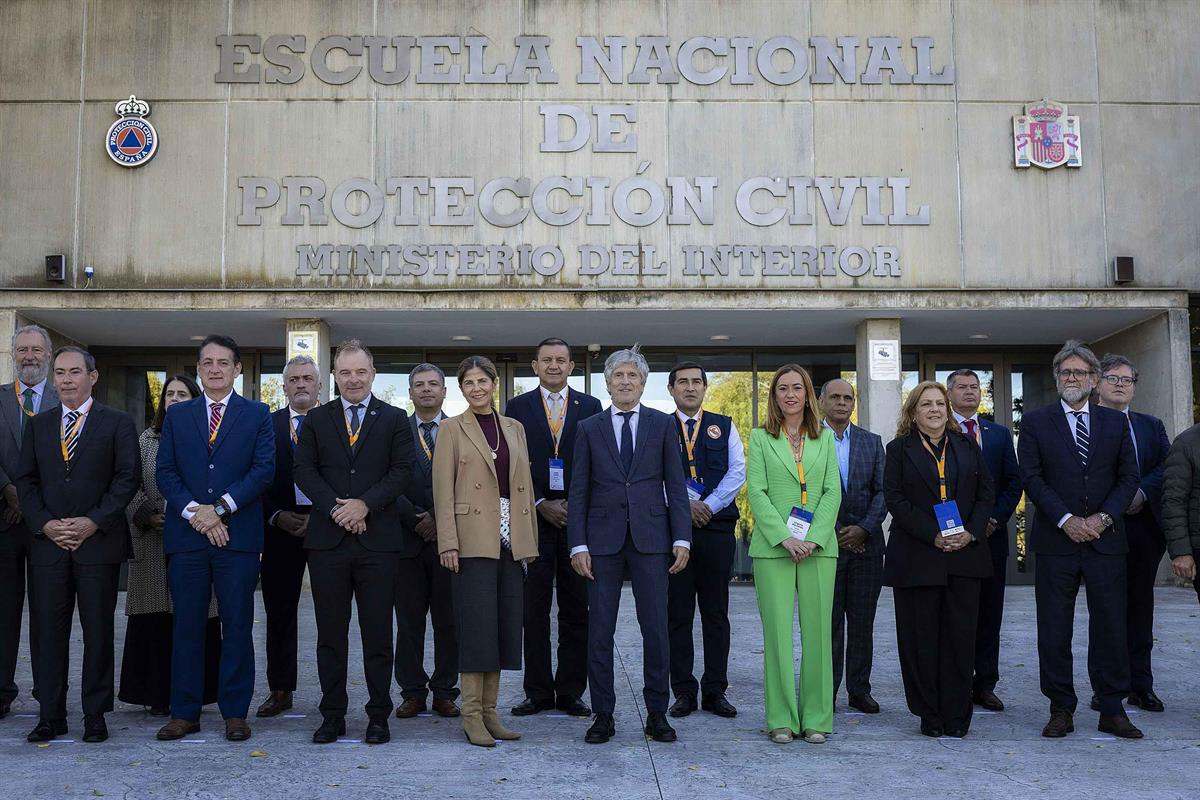 The Minister for Homa Affairs, Fernando Grande-Marlaska, at the closing of the first Conference of National Authorities of the Ibero-American Network for Disaster Risk Reduction and Civil Protection, held in Rivas-Vaciamadrid (Madrid)



The Minister for Home Affairs, Fernando Grande-Marlaska, has closed the first Conference of National Authorities of the Ibero-American Network for Disaster Risk Reduction and Civil Protection (RGIR), which has provided the Ibero-American community with a new permanent instrument for cooperation to strengthen disaster risk reduction, preparedness and emergency response.
At the meeting, which has been taking place since last Wednesday at the headquarters of the National School of Civil Protection in Rivas-Vaciamadrid (Madrid), national authorities from 22 countries endorsed the final constitution of the RGIR and established a joint, permanent cooperation initiative to strengthen resilience and comprehensive disaster risk management for the benefit of more than 670 million citizens. The Network has been established as a stable forum for collaboration to share capabilities, knowledge and experience, and to tackle natural hazards affecting the region in a coordinated manner
The launch of the Network marks the culmination of a process spearheaded by the General Secretariat for Civil Protection and Emergencies of the Ministry of Home Affairs and the Ibero-American General Secretariat (SEGIB), with the support of the Spanish Agency for International Development Cooperation (AECID), the Development Bank of Latin America and the Caribbean (CAF) and the Foundation for the Internationalisation of Public Administrations (FIAP).
The meeting is included in the official programme of events for the 30th Ibero-American Summit of Heads of State and Government. "For the first time in thirty summits, and at the proposal of the pro tempore secretariat currently held by Spain, disasters will be one of the central themes on the agenda of the Ibero-American leaders", said Grande-Marlaska in his speech, in which he emphasised that "we have raised disaster risk reduction to the highest political level within our Ibero-American community".
A new phase of regional cooperation
During his speech, the Minister for Home Affairs emphasised that "we must be aware that risks know no borders and our ability to tackle them cannot be limited or confined to the boundaries of our respective countries".
That conviction, Grande-Marlaska added, lies at the heart of the Network, the creation of which "reflects Ibero-America's desire to tackle shared risks as one, and to do so not only by reacting to emergencies, but by working together to build societies that are better prepared, more resilient and safer". This initiative, he continued, is not intended to replace existing mechanisms, but rather "to complement, connect and strengthen what already works".
Marlaska highlighted the work carried out by the delegations over recent months and expressed his gratitude for the joint efforts of the General Secretariat for Civil Protection and Emergencies, the Ibero-American General Secretariat and all the participating countries, as well as the support provided by the Spanish Agency for International Development Cooperation, the Development Bank of Latin America and the Caribbean and the Foundation for the Internationalisation of Public Administrations, as well as the collaboration of the international organisations and Ibero-American networks that have supported this process.
Objectives achieved and agreements reached
During the meeting, the delegations approved the key instruments that will enable the Network to operate effectively with immediate effect. Among the most significant agreements were the approval of its regulations, the adoption of the strategic guidelines for 2027-2030 and the endorsement of the first Action Plan - documents that will define and guide the organisation's priorities over the next four years.
This document sets out, for each prioritised action, the outcomes to be achieved by 2030 and defines a timeline for their implementation through verifiable milestones, indicative deadlines, indicators and compliance targets.
The plan has taken into account the complementary nature of the Network in relation to the disaster risk reduction initiatives and mechanisms already in place in the region. Within this framework, it will promote an early warning system, a regional mechanism for cooperative response, programmes to strengthen technical and operational capacities, and the promotion of proactive risk management and prevention.
Handover of the presidency
The meeting also formalised the handover of the Network's pro tempore presidency. Having led the process of establishing the organisation and spearheaded its preparatory work, Spain's General Secretariat for Civil Protection and Emergencies has handed over the presidency to Andorra's Department of Civil Protection and Emergencies, in accordance with the rotational model approved by the member countries, and the Principality will effectively assume this role from 1 January 2027.
During the handover ceremony, the Secretary-General for Civil Protection and Emergencies, Virginia Barcones, emphasised that "the Network's formal establishment represents the culmination of a collective effort that has demonstrated the capacity of Ibero-American countries to develop shared solutions to common challenges".
Barcones also stated that "we have succeeded in providing the Network with a solid structure, strategic planning and the necessary tools to turn cooperation into tangible results for our citizens. What we are bringing to a close today is the start-up phase; what we are embarking on today is the action phase".
For his part, Cristian Pons, Director of the Department of Civil Protection and Emergencies in Andorra, emphasised that "we are embarking on this phase with a commitment to turning the agreements reached into clear objectives and concrete actions, establishing effective mechanisms for collaboration and knowledge-sharing, and achieving visible results for the benefit of our communities".
The Member States also agreed to establish a Technical Secretariat as a permanent body to support the Network; this role will be carried out by SEGIB, with specialist technical support from the General Secretariat for Civil Protection and Emergencies.
Its tasks will include coordinating the organisation's activities, monitoring the agreements reached and implementing the joint work programme. The Technical Secretariat will also play a role in providing institutional coherence and continuity, acting as a link between successive rotating presidencies and ensuring the implementation of the agreements and objectives adopted.
In addition, the participants approved the organisation's official visual identity, including the logo that will henceforth represent the Ibero-American Network for Disaster Risk Reduction and Civil Protection.
A new chapter in Ibero-American cooperation
With the approval of its key governance instruments, the launch of a financial support mechanism, the establishment of the Technical Secretariat and the handover of the rotating presidency, the Ibero-American Network for Disaster Risk Reduction and Civil Protection officially begins its work as a permanent platform for regional cooperation.
The establishment of the Network marks a decisive step towards strengthening Ibero-American cooperation in the field of disaster risk reduction and civil protection. With a consolidated governance structure, a common work programme and the commitment of its member states, the organisation is embarking on a new phase aimed at developing shared solutions to the challenges facing the region.
Non official translation