Latin America commits to doctoral and postdoctoral training and moves towards a Common Charter for Research Staff
News - 2026.10.22
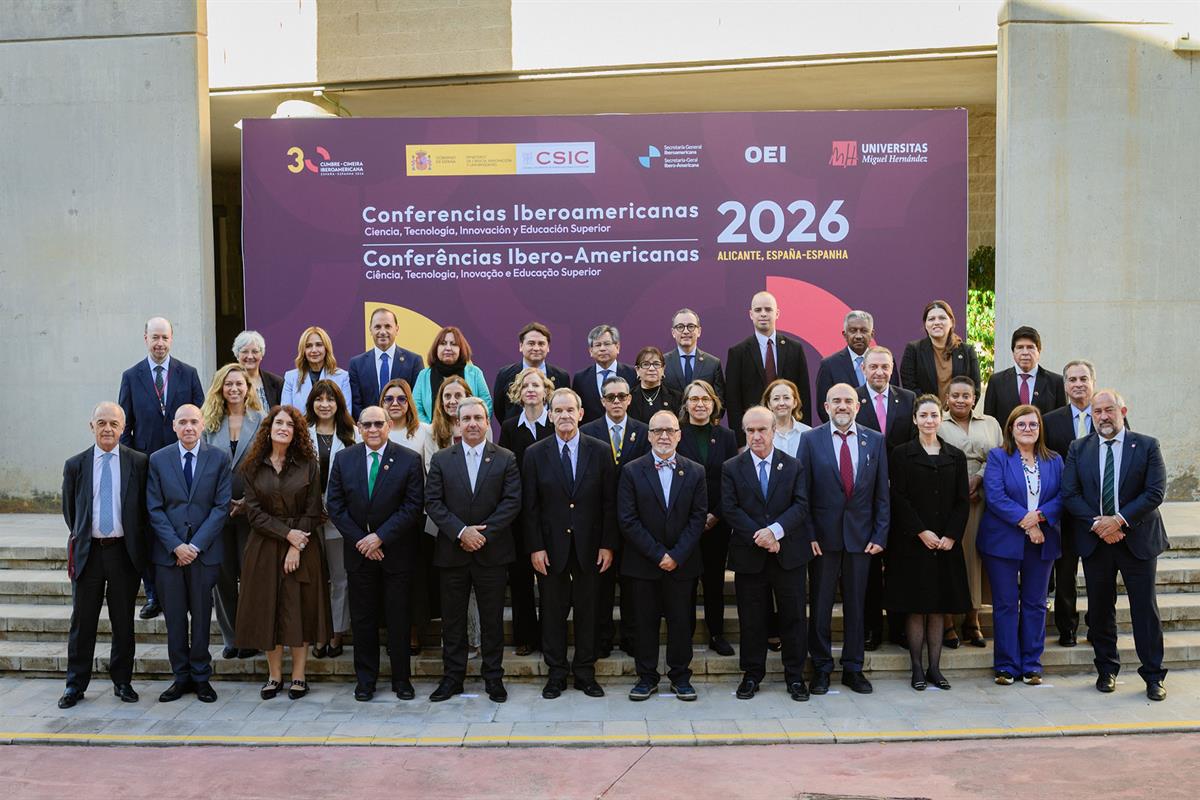 Group photograph of the II Joint Ibero-American Ministerial Conference on Higher Education, Science, Technology and Innovation



The ministers and senior officials responsible for Higher Education and for Science, Technology and Innovation from the Ibero-American countries participating in the Second Joint Ibero-American Ministerial Conference on Higher Education, Science, Technology and Innovation have agreed to launch a pilot project to establish the Ibero-American Programme for Cooperation in Doctoral and Postdoctoral Training.
The agreement forms part of the Joint Declaration of the Second Conference and highlights the countries' commitment to strengthening cooperation and coordination between higher education policies and those relating to science, technology and innovation, thereby promoting the mobility and balanced flow of talent and greater interaction between universities, research centres and other stakeholders in the knowledge systems.
The doctoral and postdoctoral programme will begin as a pilot phase so that it can be tested in academic, administrative and financial terms before being expanded and established as a permanent instrument of cooperation, in line with Ibero-American Cooperation. The declaration emphasises that doctoral training has a 'multiplier effect' on countries' scientific capabilities and is key to strengthening the region's critical mass of researchers.
Spain's Secretary of State for Science, Innovation and Universities, Juan Cruz Cigudosa, has stated that this declaration "is based on the principle of linking training, mobility and the professional development of research staff".
"We need to train new generations of researchers and facilitate their collaboration with institutions in other countries. We need to offer them the best possible conditions so that they can develop their full potential," added Cigudosa, who concluded by stating that "this is precisely the added value of our Joint Ministerial Conference: that those of us with responsibilities in universities and in science can agree on how to improve training, mobility and working conditions for research staff".
"Ibero-America cannot afford to train talent only to lose it afterwards. Through the doctoral and postdoctoral training programme and the future Charter for Research Staff, we want knowledge to circulate amongst our countries and remain within the region. In Valencia we set the course. In Alicante we are beginning to put it into action", declared the Ibero-American Secretary-General, Andrés Allamand.
Mariano Jabonero, Secretary-General of the Organisation of Ibero-American States for Education, Science and Culture, has pointed out that the organisation "has been making a significant effort to strengthen doctoral training in Ibero-America through our Paulo Freire Plus scholarship programme, which has already benefited 25 researchers from across the region. The return of the first PhD graduates is beginning to yield concrete results, as demonstrated by their contribution to the reform of the pension system in Costa Rica and to the drive to electrify public transport in Honduras, which highlights the value of investing in research talent and of promoting cooperation that translates into development for our countries".
A Charter of Rights for Researchers
The Ibero-American countries have agreed to continue working towards the drafting of an Ibero-American Charter for Research Staff, as a common framework of principles and rights designed to strengthen recognition of the profession, harmonise criteria and facilitate mobility, with the aim of building a more integrated Ibero-American research ecosystem.
Gender equality in science
The Conference has also made progress on gender equality. Countries will monitor and evaluate structural measures for gender equality in their policies on higher education and science, technology and innovation. Furthermore, they will systematically collect information on their plans and institutional structures in order to obtain, for the first time, a regional overview of equality policies in this field. Key challenges to be tackled collectively include: developing more comprehensive indicators; reviewing the criteria for evaluating academic careers and scientific output; and promoting career choices free from stereotypes.
The declaration tasks the Ibero-American General Secretariat (SEGIB), in collaboration with the OEI and the CYTED Programme, where appropriate, with promoting, coordinating and monitoring the agreements. To this end, it will draw on the affiliated Programmes, Initiatives and Projects, as well as the Ibero-American Networks.
From Valencia to Alicante
The Alicante meeting follows on from the First Joint Ministerial Conference, held in Valencia in 2024. That meeting established a shared agenda and, for the first time, set out the Ibero-American Programme for Cooperation in Doctoral and Postdoctoral Training, the Charter and work on equality. That agenda is now moving into the implementation phase.
Non official translation