The Government of Spain distributes agricultural funds totalling 69.2 million euros amongst the regional governments
News - 2026.10.21
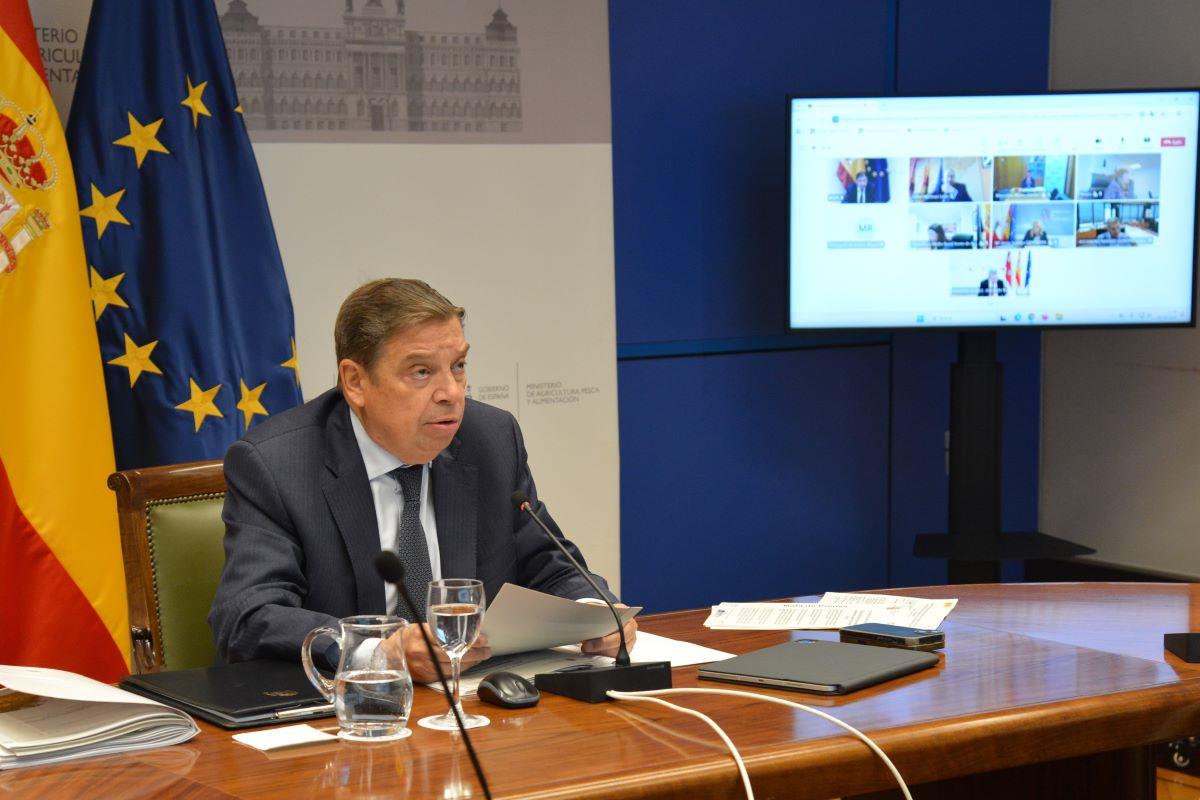 The Minister for Agriculture, Fisheries and Food, Luis Planas, at the Sectoral Conference on Agriculture and Rural Development (Pool Agricultura)



The Sectoral Conference on Agriculture and Rural Development has agreed on the distribution of agricultural funds amongst the regional governments, totalling 69.2 million euros.
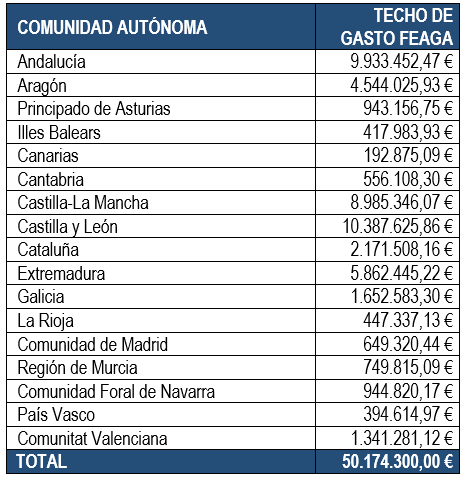
The Ministry of Agriculture, Fisheries and Food has distributed 50,174,300 euros to the regional governments from the European Union's agricultural reserve allocated to Spain to support the farmers and livestock breeders most affected by the rise in production costs resulting from the crisis in the Middle East.
The Government of Spain has chosen to make these European funds available to the regional governments, rather than organising a new centralised aid scheme, so that they can use them to supplement the measures already approved by the Government with greater flexibility and to address other specific needs within the agricultural sector in their regions.
The European aid scheme provides this emergency funding to farmers whose economic viability has been affected by the crisis. The funds must be used for measures to offset increases in the costs of fertilisers, energy or both, taking into account the financial losses incurred.
The reserve fund is in addition to the Comprehensive Plan to Address the Crisis in the Middle East, launched by the Government using state funds under Royal Decree-law 7/2026 of 20 March, which contains specific measures for the agricultural and fisheries sectors that now total, following the two approved extensions, 1.174 billion euros.
A variety of regional circumstances
The regulations do not prescribe a single model for aid. Each regional government will be able to determine the sectors, areas and beneficiaries to which its allocation is directed. In this way, they will be able to strengthen support for farms already receiving state aid or put in place different measures where they identify additional needs.
Furthermore, the regional governments may contribute additional funds from their own resources amounting to up to 200 per cent of their allocated share from the agricultural reserve.
Aid from the agricultural reserve may cover up to 100 per cent of justified additional costs for fertilisers and energy. In any event, market distortions and situations of overcompensation with other national or European aid received for the same costs must be avoided.
The regional allocation of these 50.1 million euros has been carried out on the basis of the utilised agricultural area for the year 2024 as reported to Eurostat, as this is an official, standardised and common statistical source for all regional governments, which covers the entire agricultural area without excluding any type of production.
All the regional governments have expressed their interest in using the funds and their agreement with the allocations notified to them.
On 30 September 2026, Spain notified the European Commission, within the prescribed time limit, of the terms of the measures submitted by the regional governments.
Aid from the agricultural reserve must be paid by 28 February 2027 at the latest, whilst supplementary funding from the regional governments may be paid up to 31 May 2027.
19.1 million euros for animal health
The Sectoral Conference has also agreed on the allocation of 19.1 million euros amongst the regional governments to fund various animal health measures aimed at the control and eradication of diseases. This allocation was authorised yesterday by the Council of Ministers.
The geographical distribution of these funds is as follows:

The measures being funded include support for the national programme for the control and eradication of bovine tuberculosis, to make up for the lack of European co-funding. It also includes compensation paid out in 2026 to support the management of outbreaks of bird flu and contagious nodular dermatosis (CND), which involves the culling of livestock on farms and the administration of CND vaccines, with 50 per cent financial support.
Support is also being provided for the procurement of bluetongue vaccines in regions where the circulation of new serotypes was detected in 2024 (Andalusia, Castile-La Mancha, Castile and León, Extremadura, Madrid and Murcia).
The Government is firmly committed to maintaining and improving animal health. Since 2018, the total amount allocated to support the fight against animal diseases has reached 142 million euros.
Advisory Council on Agricultural and Fisheries Policy
The minister reported to the Advisory Council on the Common Agricultural and Fisheries Policy, which also met today, on the possibility that the European Union's Agriculture and Fisheries Council might reach a political agreement next week on the future Common Agricultural Policy (CAP) for 2028-2032.
The Irish Presidency's latest proposal reflects Spain's aspiration to secure funding equivalent to that of the current period through the application of two mechanisms which could supplement the initial allocation, the implementation of which must be decided at European or national level.
Simplification of fisheries policy
On the subject of fisheries, next week's Council of Ministers will examine the report on simplification, implementation and enforcement presented by the European Commission, in which, according to the minister, there has not been sufficient progress. The Commission must make progress, as soon as possible, on matters such as the adoption of Total Allowable Catches (TACs) and multiannual quotas, and bring forward decisions on these so that the fleet does not have to wait until December to find out its fishing opportunities, thereby ensuring greater predictability and stability. It must also address the amendment of the multi-annual plan for the Mediterranean.
Spain also reiterates its call for the simplification of control regulations and for progress to be made in streamlining the Common Fisheries Policy in areas affecting fleet renewal and generational succession, as well as in reducing the red tape involved in accessing funding schemes.
With regard to trade agreements with the countries of the Association of Southeast Asian Nations, which includes the Philippines, Spain maintains a defensive stance on tinned and processed tuna.
These are particularly sensitive products for Spain. Any preferential access to the European market must be conditional upon compliance with equivalent requirements in key areas such as environmental and fisheries sustainability or the fight against illegal fishing, for example.
Non official translation